
Victoria Prysedskaya / BBC News Ukraine
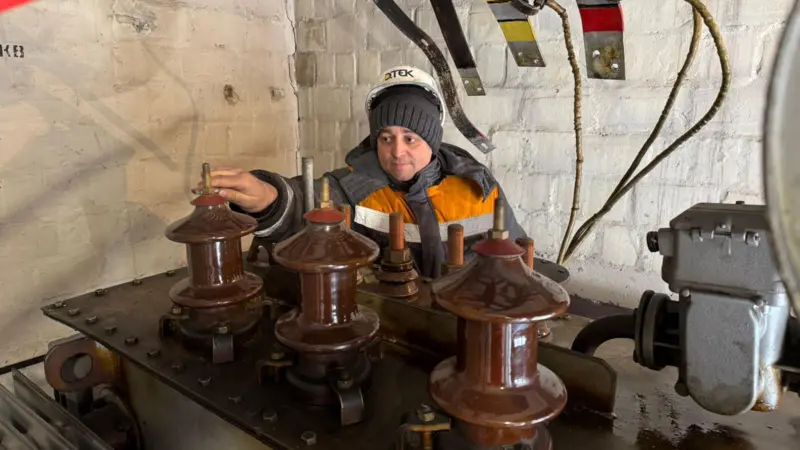
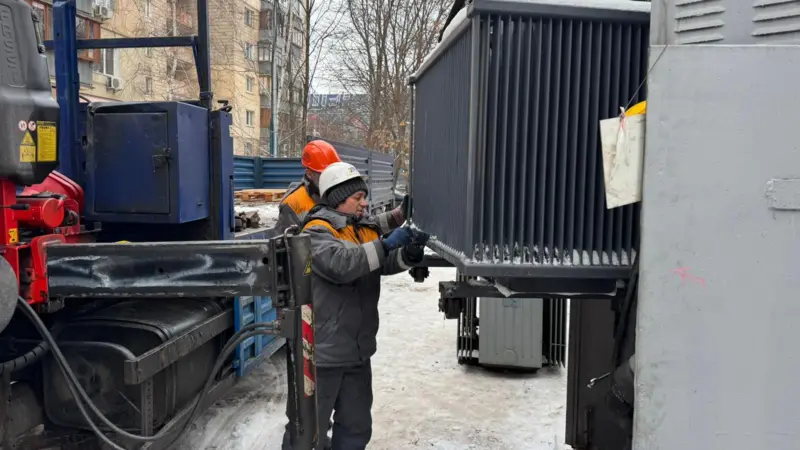
In the morning on one of the streets in the Dnipro district of Kyiv, a team of electricians is replacing a power transformer at the substation.
“We will replace it to restore electricity to consumers,” explains team master Oleksandr Mykolayovych Yovenko. The shift for the emergency team lasts 12 hours, but sometimes they have to stay longer.
“For example, the day before yesterday, we worked until 11 p.m.,” says Oleksandr Mykolayovych. “Now so many people are in a difficult situation, without power for several days, sometimes four days. We work until we complete all the requests.”
The fourth winter of Russia’s full-scale war has become the hardest in Ukraine. NATO General Secretary Mark Rutte called it the “harshest” in over ten years.
An anticyclone from Siberia has brought frosts with icy conditions and snow and is stubbornly holding over Ukraine throughout January. Russia, taking advantage of the extreme weather, intensified attacks on energy infrastructure.
Massive nighttime attacks with rockets and drones, the largest of which occurred on January 9, 13, 20, and 24, left thousands of homes in the capital without electricity and heat.
The temperature in some apartments without heating dropped below 10 degrees.
On January 29, U.S. President Donald Trump stated he personally asked Vladimir Putin not to shell Ukrainian cities for a week during the severe frosts.
According to Trump, Putin agreed, and Kremlin spokesperson Dmitry Peskov confirmed this agreement but only until February 1. Just starting from this date, after a slight thaw, frosts down to -25 are again expected in Ukraine.
The Kyiv city administration reported that heating has not yet been restored in over 300 residential buildings, most of which are in Troyeshchyna.
From the “ice age,” as Kyiv residents have called the cold and darkness, the capital is being rescued by several hundred emergency teams. Kyiv’s authorities involved “Ukrzaliznytsia” and other state companies.
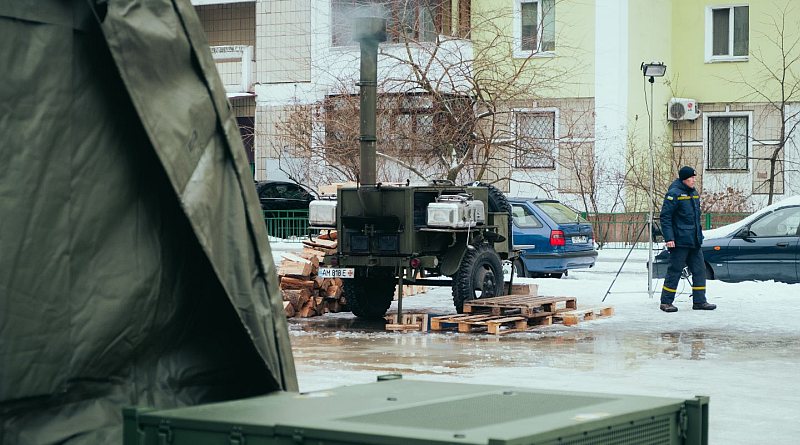
To assist Kyiv’s emergency workers, utilities, electricians, and railway workers arrived from frontline Kharkiv and Zaporizhzhia, from Dnipro, Odesa, Vinnytsia, Lviv, who themselves are suffering from shelling.
Behind these dry numbers are people whose unnoticed work day and night helps return warmth and light to the homes of exhausted Kyiv residents.
BBC News Ukraine spoke with the leaders of two emergency teams: DTEK energy specialists who are restoring electricity, and railway workers repairing heating in Kyiv buildings.
“The hardest part is not nuts and bolts, but responsibility”
I talked on the phone with Oleksandr Yovenko, who was working that day in Kyiv’s Dnipro district, as he only had a few minutes to speak with journalists.
Due to a transformer breakdown, six apartment buildings and a nearby parking lot are without power, and he is in a hurry.
Transformer substations are constantly breaking down due to electrical network overloads. These are indirect consequences of Russian shelling and the cold, which forces residents to turn on heaters as soon as power returns.
When electricity is available for only a few hours a day, people immediately turn on devices that are normally used evenly throughout the day, and the equipment cannot handle the load.
Previously, there was a morning peak when everyone was going to work, and an evening one when people came home.
Now, the peak occurs every time the power returns to homes, even at night, explains DTEK. In Kyiv and the region, the company’s teams are currently mainly engaged in such emergency repairs.
Today, in Kyiv, more than 60 DTEK Kyiv Electric Networks repair teams work daily, says Denis Bondar, the general director of the regional branch.
During peak loads and after massive attacks, the company enlists help from other regions. Currently, 12 additional teams from Khmelnytskoblenergo, Cherkasyoblenergo, Ternopiloblenergo, as well as DTEK Dnipro and Odesa Electric Networks, are assisting the Kyiv energy workers.
“They repair networks and substations daily after shellings and accidents due to overloads on lines and transformers,” Bondar explains.
Often, they need to repair the same facilities that were just fixed, says Oleksandr Mykolayovych. If restoration is not possible, the energy workers, together with the State Emergency Service, connect diesel generators to power the buildings.
The work of energy workers is risky even in normal times. Recently, the death of the former head of “Ukrenergo” Oleksiy Brekht shook the entire country. An experienced engineer who led the restoration of energy networks after hundreds of hits died from an electric shock on the site.
Just a couple of days after this, during emergency repairs at one of the energy facilities in Kyiv, a rescue climber Oleksandr Pytaichuk died.
But during the war, there are other dangers—shelling of energy facilities, unexploded ordnance at repair sites. DTEK employees must undergo training in mine safety and first aid, the company says.
Every energy worker knows the rule: before starting work, pause for a minute to assess whether the task can be done safely.
“Our challenges were compounded by air raid sirens,” says Yovenko. “During alerts, the staff cannot work; we take shelter.””
This winter, however, the main challenge has been the harsh weather.
On the day we speak with Oleksandr Mykolayovych, it warmed up a bit in Kyiv. But in previous weeks, temperatures sometimes dropped to -20 degrees, and forecasters again predict extreme cold.
“We have tea and a crew vehicle where we can warm up when it gets really tough,” says the foreman.
He suddenly comes to life and adds that people from neighboring houses often treat them to tea.
On social media, there are many stories about how repair workers are given warm drinks and food. A hair salon in one district of Kyiv even gave workers haircuts during short breaks, mentioned recently by the head of “Ukrzaliznytsia” Oleksandr Pertsovsky.
“The residents of our buildings are very compassionate people,” confirms Oleksandr Mykolayovych.
At his home, as in most of Kyiv now, there are disruptions in heat and electricity.
“There was a period when we didn’t have power for three days; now it’s a little better,” says the foreman. “My colleagues and I are in the same situation as all the residents of Kyiv.”
Taking advantage of speaking with international media, he decides to express gratitude for the equipment other countries are sending to Ukraine. He says he often sees EU markings on transformers and other devices they install.
Recently, Energy Minister Denys Shmyhal reported that 16 countries have provided Kyiv with generators and power transformers. 437 have already been delivered from the EU and Japan, with more than 500 still expected.
At the same time, about half of the cogeneration units transferred to Ukraine, which could mitigate power outages, are still not operational. Experts explain this primarily due to poor management decisions.
When I ask what is most challenging in emergency crew work now, Yovenko, who has been a repair worker for 25 years, responds – psychological pressure.
“It’s not the metal and bolts we turn, but the responsibility to restore power as quickly as possible,” he says.
“We are all human and concerned about the same things. Because everyone is without power – our parents, children, and colleagues.”
New shutdown schedules
But how quickly can power be restored in the affected area?
It depends on the extent and nature of the damage, explains Denys Bondar, CEO of DTEK Kyiv Electric Networks.
“After shelling, we can only begin work after the all-clear for air raid alerts and permission from all operational and security services.”
At the same time, energy workers look for alternative ways to power the de-energized area temporarily using backup lines.
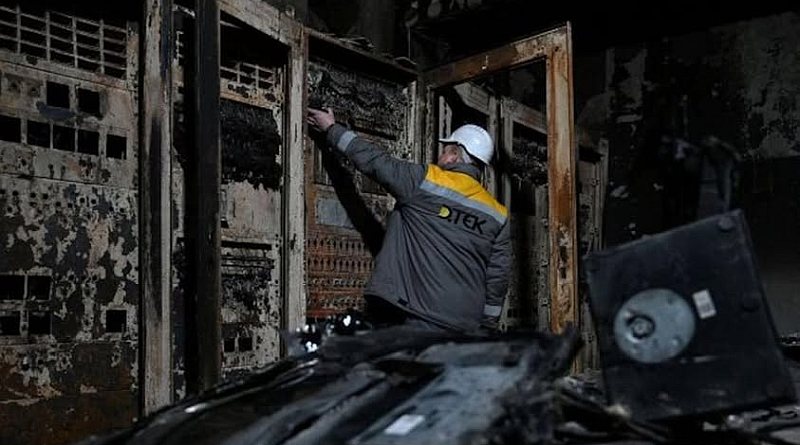
First, critical infrastructure facilities are connected – hospitals, boiler houses, water utilities, transport. After this, the power is restored to residential buildings.
Recently, Kyiv switched from emergency power outages to temporary individual inclusion schedules.
This was done to avoid peak loads when everyone turns on electrical appliances at the same time, DTEK explains. Also because the situation with the state of equipment and the ability to restore networks varies in different parts of the city.
You can check your schedule in the DTEK Kyiv Electric Networks chatbot and in the Kyiv Digital app for each address.
This is a temporary solution, adds Bondar, as accidents or new attacks could bring us back to emergency outages.
“We’re repairing again and again”
In winter, it is physically most difficult to repair underground cable lines, says the General Director of DTEK Kyiv Electric Networks. They are more protected from strikes but are more complicated to repair, especially in frosts.
To replace them, first, the damage location must be found, the frozen ground dug up, and they must be repaired in the cold.
The Russians deliberately target the same energy facilities. With each attack, restoration becomes more difficult, as equipment is more vulnerable to breakdowns after repeated damage.
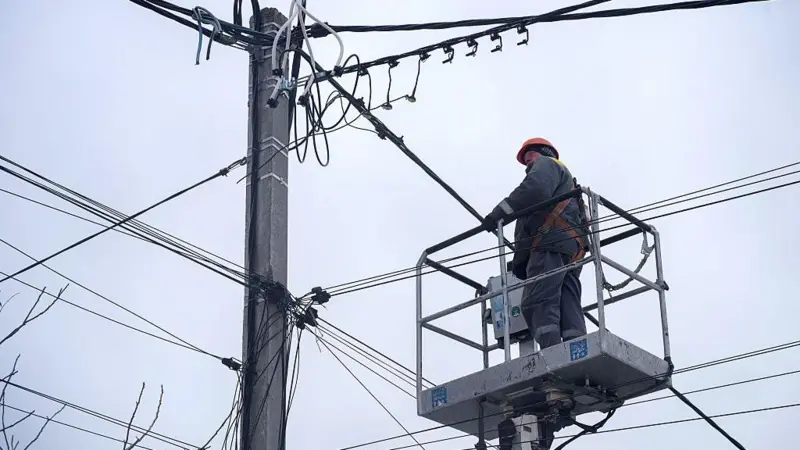
“We repair them again and again after repeated attacks, knowing that this time could be spent on scheduled repairs,” says Denys Bondar.
He adds that it is morally most difficult to work when shelling hits residential buildings or nearby.
“When you see the pain, despair, and sorrow of people, it’s impossible to get used to it.”
“We are hardened, we are ‘Ukrzaliznytsia'”
Meanwhile, on the other side of the capital, in the Solomianskyi district, railway crews are also restoring heat in high-rise buildings.
The old Soviet central heating system did not withstand the targeted Russian attacks on the thermal power plant amid severe frosts.
After the latest massive shelling on January 24, six thousand buildings in Kyiv were without heating. In most of them, heating had already been restored after previous attacks.
When the CHP does not supply water with sufficient pressure, hot water does not reach the building. Due to severe frost, water in the pipes freezes and they burst.
“We heat and drain the water, cut out the burst pipe sections, replace them, wait for the heat carrier, and launch the building,” explains Andriy Zaruba, Director of the Buildings and Structures Department of “Ukrzaliznytsia”, describing the sequence of actions. He coordinates the work of the railway workers in Kyiv.
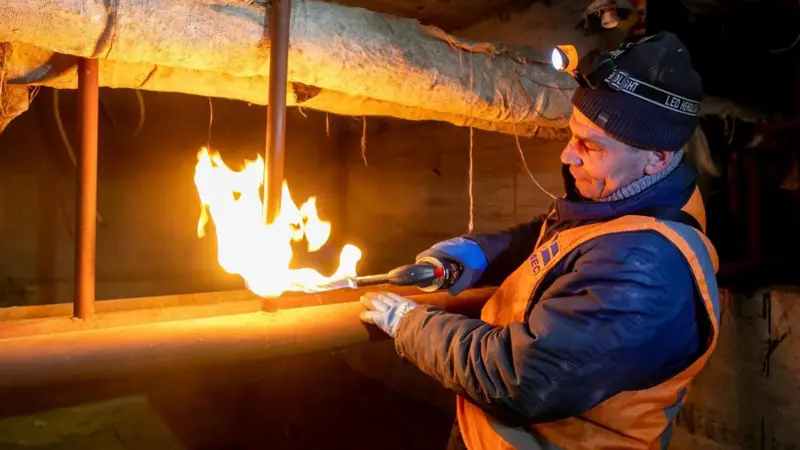
But the pipes in the building may be ready, and the supply of heat has to be awaited for several more days.
“We prepared 10 buildings for launch recently, but couldn’t start because there was no heat carrier,” says Zaruba.
In those same houses, they had to save the water supply and sewage, which began to freeze.
Oleksandr Mykolayovych Lyashuk manages five teams working in the Solomianskyi district. He is the deputy head of the Kyiv unit of the Buildings and Structures branch of “Ukrzaliznytsia.”
In three days of work from January 20, they repaired nine buildings, four of which (at the time of conversation) were put into operation.
“We can spend three days on one building, half a day on another,” he explains. “Different buildings, different damages.”
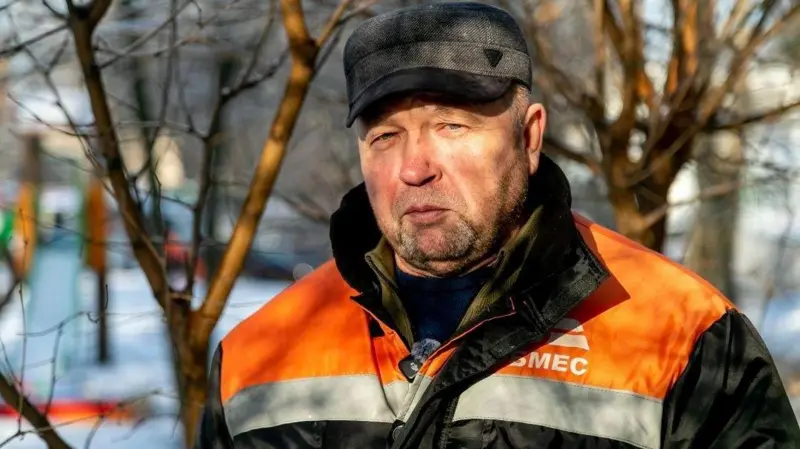
People are on the site from seven in the morning and sometimes leave home after ten in the evening, says Lyashuk.
“When we launch water into the heating system, we cannot leave it until the work is finished.”
It happens that they have to work two or three shifts, both at night and during the day.
“We are hardened, we are ‘Ukrzaliznytsia’,” says Oleksandr Mykolayovych. Exactly 20 years ago, like many of his colleagues, he was also saving the frozen Alchevsk from the cold.
In the apartments where the repairmen work, the temperature can be only 2-3 degrees Celsius, and if the residents have left, it can be below zero.
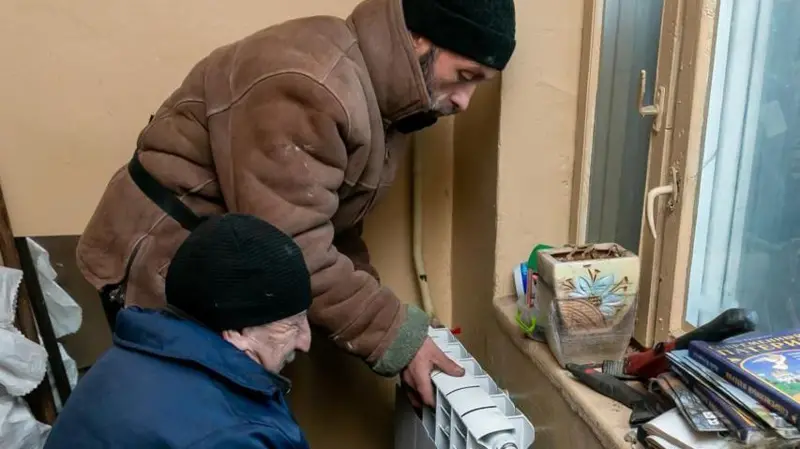
The biggest problem is empty apartments.
“In about 35-40% of apartments, residents are absent. We have to track them down through the municipal service, and sometimes even involve the police. Without access to the apartment, we can’t start the building,” says Liashuk.
A State Within a State
Since last week, the number of railway brigades brought in by the Kyiv authorities has increased from 40 to 60. Fourteen of them are working in Troieshchyna, where a residential area the size of a small town has been without heating for almost a week.
Locomotive operators, machinists, trackmen, energy workers, communication workers, and passenger company employees have united as one team and come to save Kyiv.
“The railway is a small state within a state,” says Oleksandr Liashuk.
“We have a vast infrastructure, with specialists in practically all working professions, operation, and capital repair. The railway can handle any work,” he explains why the railway workers were involved.
They were accommodated in a dormitory and rest rooms at the station, says department director Andriy Zaruba.
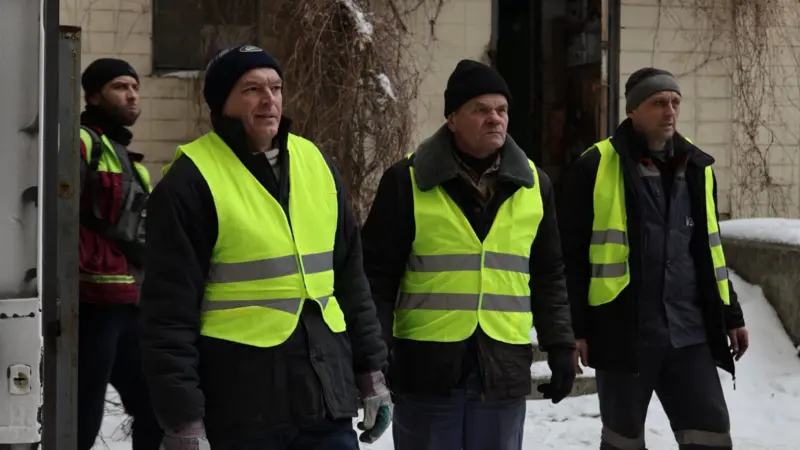
He says that “Ukrzaliznytsia” provided food and heating, but it is still challenging for people.
“After such hard work, to be without electricity, yet we find a way, managed to set up a generator somewhere, trying to ease people’s living conditions,” adds Zaruba.
He says that people are working at the limit of their strength because “everyone understands what happened.”
The average wage of workers is 20-25 thousand UAH, but both the government and “Ukrzaliznytsia” itself promised additional payments to the brigades eliminating the consequences of Russian attacks.
Many compare the situation in Kyiv to Alchevsk in eastern Ukraine, which in 2006 was left without heating in a 20-degree frost due to a heating main accident.
At that time, it was the railway workers who were at the forefront of restoring the city.
“I think the authorities remembered Alchevsk and turned to the head of the board (“Ukrzaliznytsia” – Ed.),” says Zaruba.
However, both he and Liashuk emphasize that the situation in Alchevsk was much more complicated.
“There, the city was completely frozen, along with heating mains, everything. And the temperatures were different. If it was -18 here, it was down to -35 there,” says Liashuk.
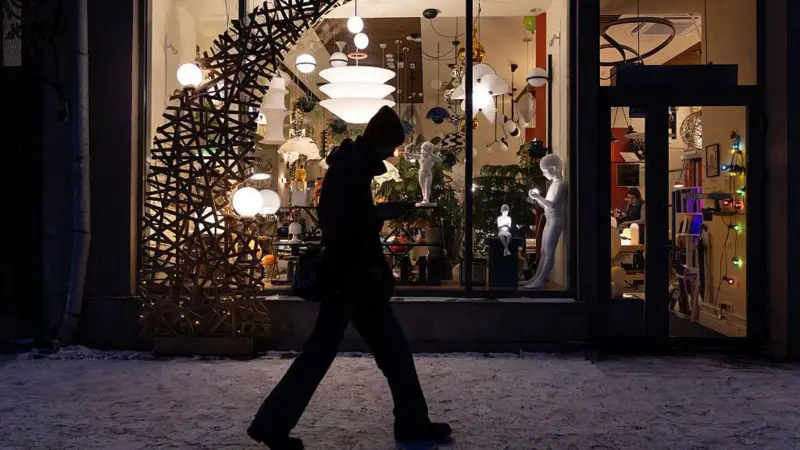
But meteorologists are again forecasting severe frosts, and there remains the risk of new large-scale attacks, meaning that the emergency workers’ job isn’t going to diminish anytime soon.
Concluding the conversation with Oleksandr Mykolayovych from DTEK, I asked what brings him the most joy in his challenging work.
“When we drive away after repairing a substation and look from the car at the windows of houses where the light is already on,” he replied. “It’s very inspiring.”
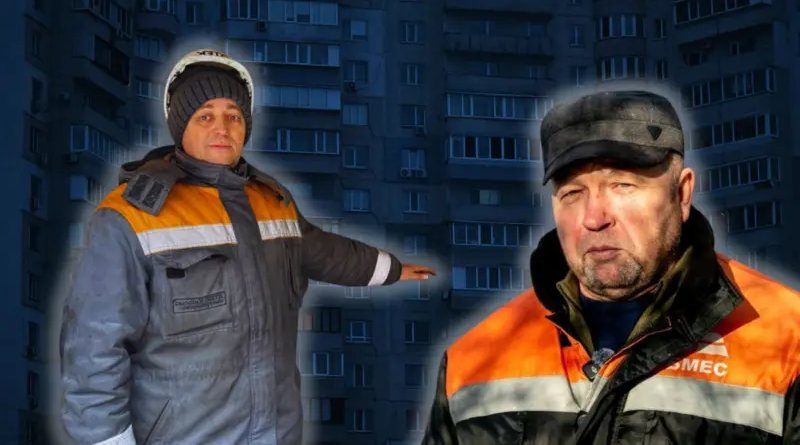
On the cover: Energy worker Oleksandr Yovenko and railway worker Oleksandr Lyashuk. Photo: DTEK/Ukrzaliznytsia/BBC
