
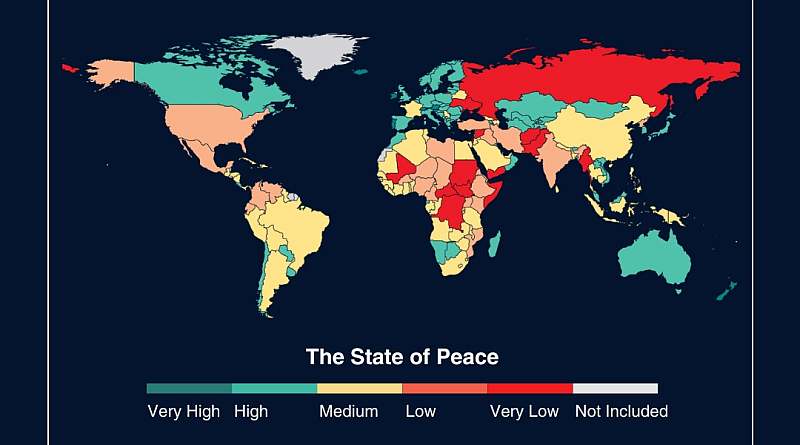

The most peace-loving country in the world is Iceland, which has no army. The least peace-loving is Russia, which attacked its neighbor. Ukraine, experiencing nights like last night, ranks close to Russia at 160 out of 163, between Congo and Israel, below Somalia, Yemen, and Afghanistan. Somalia, where Al-Shabaab controls a significant portion of the territory and where there hasn’t been a functioning state for thirty years, is considered more peace-loving than a country defending itself for the fourth year from the “largest army in Europe.”
Meet the Global Peace Index 2026 from the Institute for Economics and Peace, whose authors seriously write on their website that it is “the world’s leading measure of global peacefulness.” A leading tool for measuring peacefulness.
When you look at the 23 indicators that make up this ranking, you start to understand how Somalia surpassed Ukraine. Six indicators measure militarization, and all six are counted negatively: military expenditure as a percentage of GDP, the number of military personnel per 100,000 people, arms imports, arms exports, nuclear and heavy weapons, contributions to UN peacekeeping missions. Thus, a country that spends more on defense, has a larger army, imports weapons for self-defense, and cannot send peacekeepers because it is at war, receives a lower score on all six counts.
The index does not distinguish between the militarization of the aggressor and that of the defender; for it, a large defense budget is a sign of “non-peacefulness.”
Finland felt this even more than Ukraine, as Finland is not at war. Until 2022, it consistently ranked among the top ten most peaceful countries. Then, due to the actions of a crazy neighbor, the Finns increased defense spending by 36%, joined NATO, and their ranking fell to 16th place. Finland became safer for its citizens because it received a NATO umbrella and modern defense, but the index assessed it as “less peaceful.”
It gets even more interesting. Eleven indicators measure “social security,” among them “the number of refugees and internally displaced persons as a percentage of the population.” Millions of Ukrainians who fled from Russian missiles worsen our score, meaning Ukraine receives a negative for its citizens being bombed. Five of the twenty-three indicators are a “qualitative assessment by EIU analysts,” the subjective evaluation of the Economist Intelligence Unit, the same EIU known from a ScienceDirect study on the Corruption Perception Index as a “critical driver” of that rating too.
This means that the same analytical group subjectively assesses both corruption and peacefulness, and their assessments form ratings that are then cited as an independent source.
If Ukraine were to capitulate tomorrow and dissolve its army, its rating would drastically improve: the “ongoing conflict,” “militarization,” and “refugees” would disappear. According to the index’s logic, capitulation is the path to peace, while defense is a sign of non-peacefulness, and if this sounds absurd, it’s because it indeed is absurd.
The real problem is not that the rating is out of touch with reality, but that it is influential. Investors, insurance companies, credit agencies, diplomats, journalists look at the figure 160 out of 163 and draw conclusions, without scrutinizing the methodology or asking why a country defending itself ranks alongside a country that has attacked. These ratings shape perception, influence financial flows and diplomatic decisions, and that’s why they cannot remain as they are.
The world has long needed changes in the system of calculating various ratings and assessments, as many criteria have changed over the past decades. You cannot take indicators that do not differentiate between aggressor and victim, insert them into a formula, and consider it reliable. Distorted ratings create a distorted reality, and when this distortion begins to affect the real decisions of real people, it ceases to be an academic problem and becomes a political one.
