
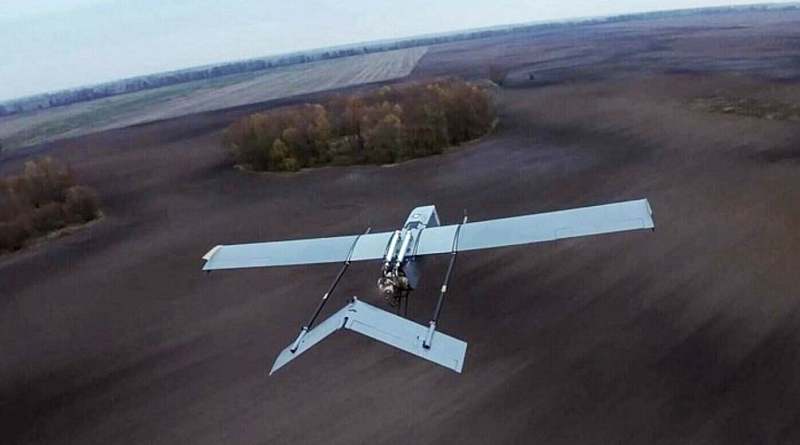
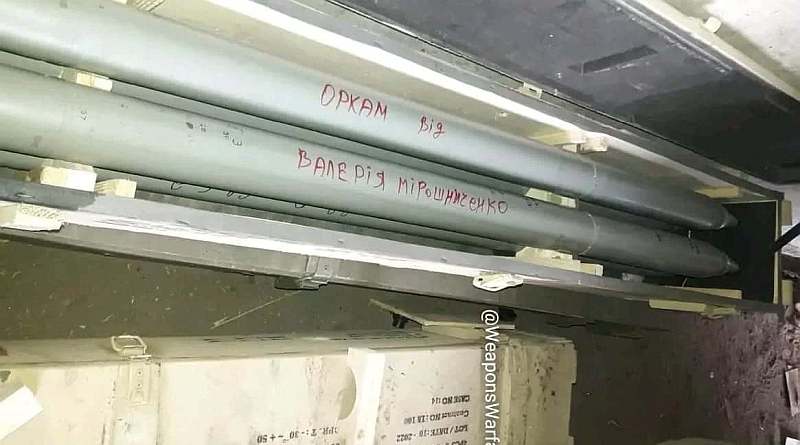
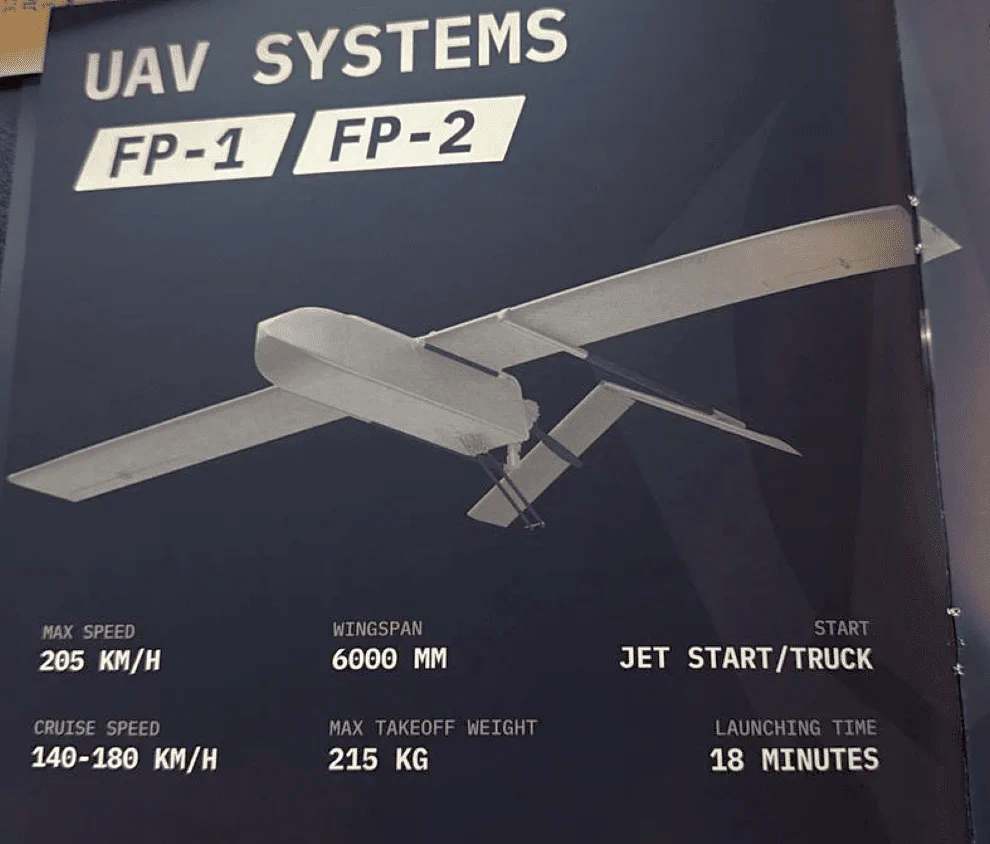
The fact that our FP-2 drones from Fire Point now carry 200 kilograms of warheads and additionally eight S-8 unguided aviation rockets turns them into the perfect and unavoidable killer of enemy logistics.
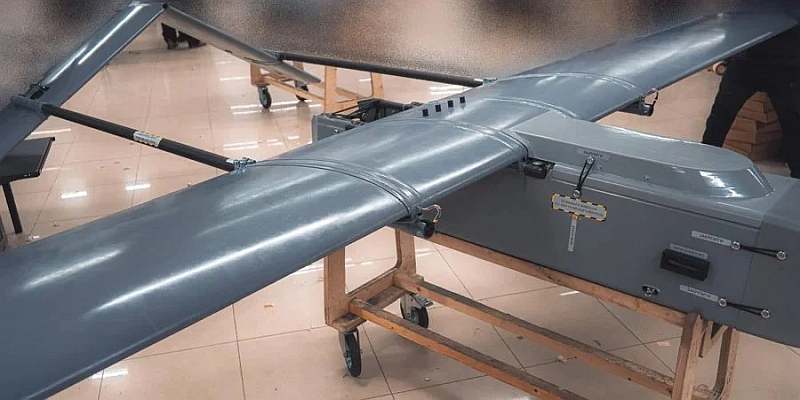
The first desire, of course, is to use this power in hunting down Russian mobile fire groups, electronic warfare calculations, and radar stations. This is classic hunting of the hunters: usually, mobile groups gather at one point to project a focus of fire on a target and keep it in the spotlight or illuminate it with a laser.
It just begs to hit this gathering with fragmentation rockets. The S-8 nomenclature has a great warhead specifically for this task — 2000 ready-made arrowhead elements, which in seconds turn any pickup, crew, or installation into a bloody sieve.
But there’s a fine mathematical point with ballistics here. The S-8 rockets’ wide scatter mainly occurs because they are launched from a climb. The crews of Russian “crocodiles” and “rooks” are not too eager to enter our air defense zone, so they lift their nose and fire in an arched trajectory somewhere towards the landing.
However, the technical dispersion of the rocket with a direct launch from a platform is only 0.3% of the shooting range. It is aimed at a distance of up to 100 meters. So, at a combat distance of 300 meters, the deviation will be a meager 1.8 meters. If two rockets are launched, one is absolutely guaranteed to fall within a circle with a radius of 1.8 meters.
Tactical Jackpot on the Railroad
This represents a tactical jackpot: four guaranteed hits on hard targets up to 8 meters each. What exactly will we attack with this arsenal at a distance of 250+ kilometers from the line of combat engagement? For perspective, the checkpoint “Novoazovsk” is only 150 km away.
What can they physically not cover with their SAMs?
Rail logistics. Too vast a network and too wide open spaces for their leaky air defense umbrella.
With four targeted launches, we take out four ammunition wagons or heavy fuel tanks, or with one salvo — a maneuvering electric locomotive. And then calmly fly to the traction substation, which will receive 200 kilograms of pure explosives from the head of the kamikaze itself.
We can play differently: destroying rails and ties with targeted launches. The C-8 has concrete-piercing munitions capable of penetrating 800 millimeters of reinforced concrete. If a maintenance railcar or recovery train with a crane and crew arrives to fix the damaged track — a kamikaze hits them.
Or work in pairs: one drone serves as pure fire support and suppression, and the other operates as a mother carrier for FPV drones.
If a railway troop repair team arrives — we play the same game with them as they did during their cynical double taps on the emergency services rescuers.
I am absolutely confident that we can simply drop mines by coordinates and wait for the train or disrupt tracks, and then move there a day later to hunt repair crews.
Amazing tactical flexibility arises. We can strike stationary infrastructure or a maneuvering train. Thermobaric warheads are perfect for hitting warming wagons — effectively catching and burning out an entire unit of personnel on the move.
Cascading Supply Collapse
The main strategic objective of this game is to push their logistics as far away from the last kilometer as possible. Let them choke on their wheels, let the trucks continuously consume engine resources, let them pull their mobile repair battalions and emergency machine assembly points deep into the rear. Recently, the Russian KamAZ laid off 1,200 workers and switched to a four-day workweek—try covering the current losses of military trucks and profiting from sanctions. Moreover, massive attacks on railway depots, supply points for heat engines, tank parks, and electric train repair facilities are astronomically expensive and take months to recover. The Western allies managed to completely dismantle Nazi Germany’s railway network purely by attacking sorting stations, totally destroying depots, rolling stock, heavy machinery, and cranes.
Destroying unique technology is a separate kind of art. The recovery train consists of specialized cranes on railway tracks with a load capacity of 80 to 250 tons, heavy bulldozers, platforms with ready rail-sleeper grids. The cranes are extremely fragile to debris: hydraulics, cables, and support booms fail instantly. 200 kilograms of explosives will tear this complex equipment into scrap pieces.
A special place is occupied by the human factor. The repair crew consists of specialists: crane operators, engineers, welders of the highest rank. If a drone arrives at the moment of their gathering or working on the tracks, the enemy loses not just metal. They lose people who need years of training. The Russian Railway Forces are large on paper, but experienced specialists in eliminating complex failures are few at each major transport hub.
Electric train drivers and recovery train crane operators are not contractors. They did not sign up to burn for three million rubles. These are men in workwear, who suddenly realize that driving a military echelon somewhere under Rostov or Voronezh is a lottery with death. When the first 5–10 crews burn out, a quiet revolt will begin at the RZD: mass resignations for health reasons, sick leaves, sabotage. It’s one thing to transport coal to Siberia, another to sit in a cabin knowing that 200 kg of explosives are flying at you, and air defense won’t cover.
Asymmetric Mathematics of Losses
And even just four tanks and a locomotive are still very valuable. The minimum estimate for such a train (with an old shunting locomotive like the ChME3, with used wagons and fuel cargo value) is $400,000–$600,000. A realistic estimate, if the train is pulled by a full-fledged mainline locomotive, reaches $1.8–3.5 million or more.
What will this give us macroeconomically? We will financially bleed them — RZD is already in collapse, facing a severe labor shortage, lacking drivers and working locomotives. One drone from Fire Point costing €54,000 destroys a target that is 10–60 times more expensive than the drone itself.
And these are only the direct, calculable financial losses. This amount does not include indirect losses: melted railway tracks, completely destroyed contact networks, halted logistics on the entire section, and colossal expenses for extinguishing a large-scale fire.
The Magnifying Glass Effect
We will surely push back all safe unloading places for munitions, fuel transhipment, and spare parts by a hundred or two kilometers. All this will fall on Russian road battalions, which we daily and methodically cut down with “Hornets,” “Vampires,” that plant mines, and “Bulavas.” Of course, it is impossible to control everything. But either the expensive heads of reconnaissance drones will burn in a covered vehicle, or the batteries won’t reach their position, or rotation will be severely impacted on the march. It’s extremely difficult to plan an operational offensive when you’re unsure what exactly your unit will receive today, and what will burn like a torch on the “Novorossiya” route or shattered roadside.
Protecting all this is impossible. Long-range strikes have not been canceled, nor have the hunts for their SAM and radar systems. They don’t have spare crews, an endless stock of missiles, and if MZA with radar or drone interceptor crews do appear, they will primarily be pulled to protect the cash cows of the Russian budget, leaving railway workers to take the hits themselves.
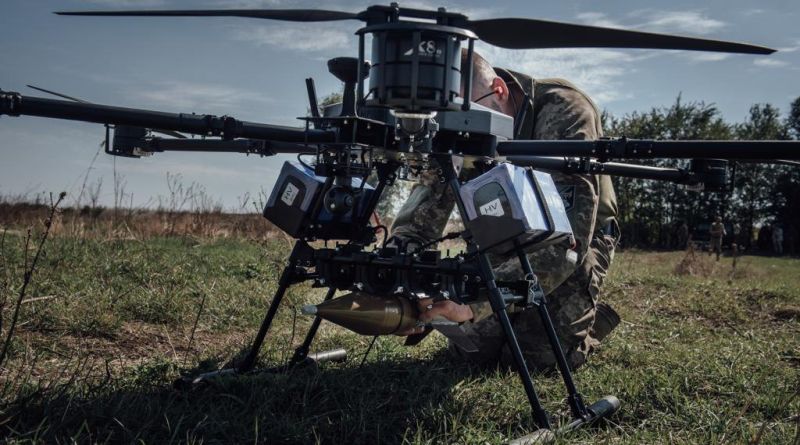
Moreover, looking at this from the perspective of direct fire support for infantry, it fundamentally changes the rules of the game. A deviation radius of 1.8 meters represents specific and very painful targets on the battlefield. This is a standard pillbox, whose machine gun can pin down our assault group for hours. This is a camouflaged anti-tank guided missile position somewhere in a grove, waiting for our armor to break through.
Regular artillery might spend dozens of shells just to place them nearby, dig up a field, and only concuss the enemy. Here, an operator simply targets a marker — and within a circle of less than two meters, a burst of rockets is guaranteed to hit. You no longer need to risk a real helicopter or assault aircraft worth tens of millions of dollars to precisely take apart an enemy fortification. You destroy anti-tank crews and infantry with fragmenting S-8s, and then a kamikaze drone with its 200-kilogram warhead puts a definitive end to it, turning the main bunker into a mass grave.
Some Soviet children loved a sadistic game — on a sunny day, they would take a large magnifying glass and focus its beam on an anthill. That magnifying glass — that’s what modern mid-strikes are.
We pierced the Russian air defense umbrella and began to methodically direct this beam at logistics, at FSB headquarters and command posts, at the deep rear: repair bases, supply depots, and road and rail brigades. The enemy is truly writhing in this fire.
If we manage to scale up the production of FP-2 in EU countries, we will have several months of significant advantage that will undermine the Russian logistical machine from within.
On the cover: FP-1 drone. Source: Fire Point
