
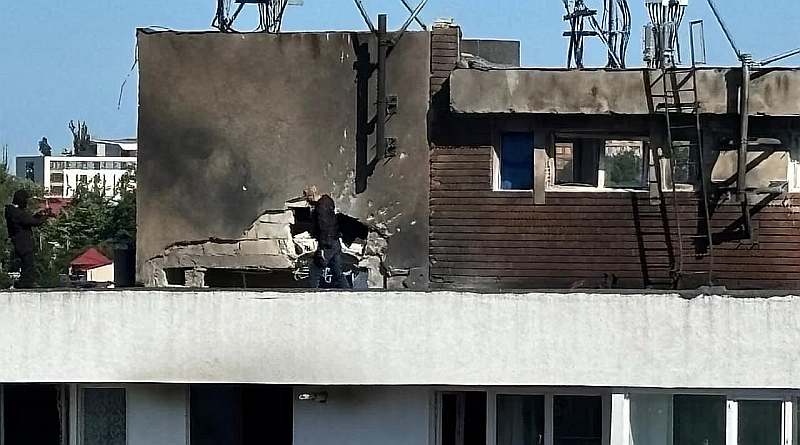

The Russian aggression against Ukraine seems to have finally crossed not only Ukraine’s borders, turning a hypothetical threat to the region into a direct attack on the civilian population of an EU and NATO member state.
The nighttime incident in the Romanian city of Galați, located on the border with the Odesa region, became an unprecedented act of escalation by the Kremlin. A Russian Geranium-2 type attack drone violated the airspace of a sovereign state and, either intentionally or due to critical inaccuracy, attacked a residential high-rise building, bringing war to the streets of peaceful Romania.
According to official data from the Romanian Ministry of National Defense and the emergency response service (ISU), the drone crashed into the roof of a residential building, causing a powerful explosion and fire on the tenth floor. By sheer luck, mass casualties were avoided: about 70 residents were promptly evacuated, but two people were injured.
The expert analysis of Romanian special services confirmed the worst: the drone’s explosive charge fully detonated, indicating colossal risks for hundreds of civilians sleeping in their homes under NATO’s air defense protection.
This incident exposed a systemic security problem on the Alliance’s eastern flank. Romanian radars tracked the drone from the very border to the southern district of Galați. Two F-16 fighters and a military helicopter were urgently deployed with permission to engage. However, they failed to shoot down the Russian drone using aviation forces over the populated area.
As noted by Western analysts, the balance between the need to destroy the target and the risk of debris falling on people’s heads constrains military actions. Moscow cynically exploits this mentioned vulnerability, plotting routes for its deadly devices in dangerously close proximity to NATO country borders, and now directly through them.
The Romanian Ministry of Foreign Affairs rightly characterized the incident as a “serious and irresponsible escalation by Moscow.” Official Bucharest immediately informed NATO Secretary General Mark Rutte and allies, demanding diplomatic consequences for Russia and the urgent acceleration of the delivery of advanced counter-drone measures.
Romanian President Nicuşor Dan convened the Supreme National Defense Council, emphasizing that “this is the worst incident on national territory since the war began.” The EU and NATO leadership has already stated that the RF’s aggression “crossed another line,” and the reckless behavior of the Kremlin poses a direct threat to everyone.
What happened in Galați, as is now clear, was not a “random deviation from the course.” The incident is part of a deliberate Kremlin strategy to test the West’s resolve and blur the “red lines” of collective security.
Previously, debris from Russian missiles and drones fell in uninhabited border areas of Romania and Poland, and the Alliance limited itself to formal protests. As a result, impunity led to today’s explosions of Russian warheads in residential areas of European cities, injuring NATO citizens.
Information attacks and military provocations by Moscow require a firm, consolidated response. The time for “expressing deep concern” has passed. If NATO does not activate collective defense mechanisms, including the right to shoot down Russian missiles and drones over border areas, and strengthen Romania’s and Ukraine’s air defense, the Kremlin will continue to raise the stakes. Moscow is playing open escalation, and the next Russian missile or drone could fly much further than Galați.
Romanian President Nicuşor Dan announced that Romania is closing the Russian Federation’s general consulate in Constanța. “The Russian Federation’s general consul in Constanța has been declared persona non grata, and the consulate will be closed,” Dan stated.
