
Francis Fukuyama / Translation by iPress
Francis Fukuyama, a senior fellow at Stanford University, argues that the decline of the United States as a great power is not the result of external pressure but a direct result of Donald Trump’s policies. Using the example of the president’s visit to Beijing, he demonstrates how Trump, finding himself in a weak position, futilely flattered Xi Jinping and returned home with almost nothing, while China had to do almost nothing – just watch the voluntary self-weakening of its opponent. Fukuyama emphasizes that by polarizing the country, undermining science, universities, and the system of alliances, Trump is doing Beijing’s work. And although Xi is unlikely to attack Taiwan while Trump is in power, he may act swiftly as soon as the US gets a president ready to change this trajectory.
Watching how the media covered Donald Trump’s recent visit to Beijing was both distressing and humiliating, as it vividly demonstrated America’s decline as a great power in the confrontation with China. Expectations before the summit were extremely low: Trump was in a weak position, burdened by inflation and falling ratings, and at the same time needed China’s help to get out of the Iranian trap he had set for himself. Meanwhile, Xi had already forced Trump to retreat in his trade war a year earlier, and China was showing strong export growth amid Washington’s lukewarm response.
That’s exactly what happened. Trump returned to Washington with almost nothing: with two agreements on opening Chinese markets to American products, and without any political help in the Middle East. China did agree to buy 200 Boeing aircraft (less than expected), but it had not fulfilled similar orders before. The White House also stated that China agreed to purchase $17 billion of American agricultural products, but China did not confirm this. Nevertheless, this did not prevent Trump from declaring that they “made great trade deals” and that the meeting was a “great success.”
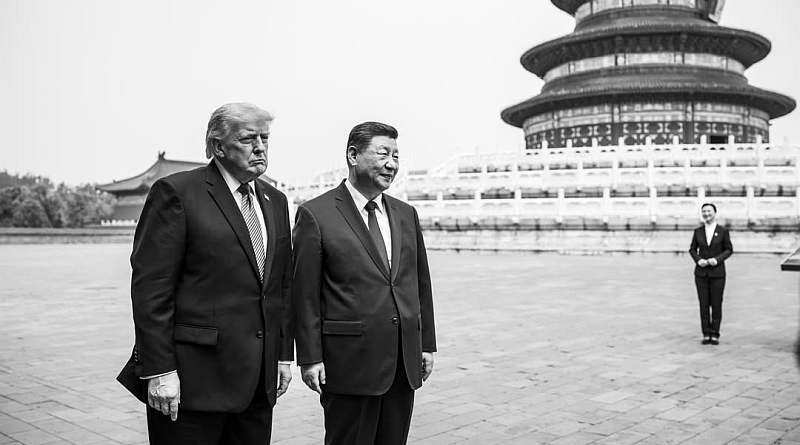
The visual aspect of the meeting showed how much Trump had fallen in the eyes of the Chinese. Xi did not meet him at the airport. Trump was seated in a chair that visually made him lower than Xi—an embarrassment that could have been avoided if Trump’s State Department had not sidelined protocol officials, whose job it is to take care of such things. The most disappointing part of the visit was Trump’s incessant flattery: he exclaimed that Xi was a “great leader,” “a true friend,” “like from a movie”; he repeatedly praised how beautiful and impressive China is. As in previous interactions with various dictators, Trump seemed to think they would be impressed by the same praise and flattery that he himself relishes. Xi, however, did not respond to any of these declarations of friendship, merely noting that the United States and China “should be partners, not rivals.”
The most important issue that emerged from the summit was Taiwan. Ahead of the summit, Trump delayed a $14 billion arms package approved by Congress, and there are no signs that deliveries will resume anytime soon. Xi told Trump that further relations with Washington would depend on the level of support for the island by the United States. Trump thought that Taiwan would be a “very good card” in trade negotiations with Beijing. Trump also made other disparaging remarks about the island, noting that “we supposedly have to travel 9,500 miles to fight,” and reiterated his claim that Taiwan stole semiconductor chip manufacturing technology from the United States.
The fact that he said nothing about security guarantees for Taiwan sharply contrasted with Joe Biden’s clear statement that the United States would come to its defense.
Donald Trump is a politician unable to see the world except through the prism of personal interests and benefits. Upon returning, he was angered by the suggestion that Obama was treated with more respect than he was, and took the opportunity to claim that “nobody respects Obama” and that he was himself a “divider.”
Chinese media have long referred to the United States as a “declining state”; Xi raised this issue in conversation with Trump, expressing hope that their countries could avoid the “Thucydides Trap” if declining America gracefully ceded its primacy to a rising China. Trump immediately interpreted this as Xi’s agreement that under Joe Biden, America was declining, and now, with him as president, it is great again. As always, Trump reserves his greatest anger and hostility for his domestic opponents, rather than the leaders of the world’s largest dictatorships.
The truth, well understood by the Chinese, is the opposite: America’s decline is a direct consequence of Trump’s rise since 2016. It seems as though Trump decided to do everything possible to weaken the United States in its confrontation with China. He divided an already polarized country more than any previous president; cut funding for basic scientific research and hit American universities, which were the best in the world; dragged the United States into an unnecessary war in the Middle East that depleted stocks of the most advanced American weapons; he and his associates openly stated that their domestic opponents, the Democrats, pose a much greater threat to the future of the United States than China or Russia.
Trump also systematically sought to undermine the U.S. alliance system, humiliating allies and imposing tariffs even against the closest traditional friends, as well as threatening to take territory from Denmark, a dedicated NATO ally. He claims that under his leadership the United States is respected like never before, though the truth is almost the opposite: friends and rivals alike agree that the United States has become something of a rogue state, adding instability and disorder to the world, and at the same time becoming a laughingstock.
Trump greatly eased Xi Jinping’s life, and this was evident in the behavior of the Chinese leader during the summit. Under Trump, America has been so persistently harming itself that China essentially has nothing to do—except sit back and watch it all unfold. Trump predicted that China would not attack Taiwan as long as he is president. Perhaps he is right here: Xi does not want to obstruct the decline of the US. But he might be forced to act quickly once America finally gets a president who wants to reverse this trajectory.
Photo: The White House/Instagram
