
Material prepared by Oleksandr Shulman
The full-scale war and the widespread appearance of drones have redefined the role of artillery. Everything is changing around it: reconnaissance, logistics, fire control systems, ammunition production, and the philosophy of its use. What artillery has come to and what its future holds is explained to Texty.org.ua by professional artilleryman Colonel Reserve Victor Kevlyuk. His direct speech follows.
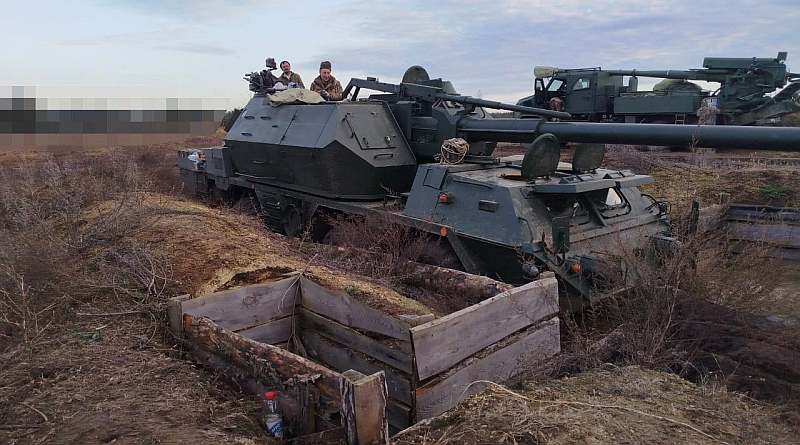
Despite the widespread belief in the “death of artillery,” the war proves the opposite: artillery remains the main means of enemy fire suppression and reducing its combat potential.
Mass artillery fire is still needed to destroy fortifications; suppress and destroy infantry, equipment, and other targets; isolate the battlefield and combat area; disrupt enemy maneuvers; conduct counter-battery warfare.
Management Crisis
The main problem today is the lack of a coherent concept for the development of rocket forces and artillery. That is, what role the headquarters assigns to artillery and what its further development looks like.
It is characteristic that the development of artillery is often handled by general managers rather than specialists who have worked in this field for decades. As a result, the Ukrainian army faces a paradox: the war has become as “artillery-focused” as possible, but there is practically no unified concept for the development of artillery.
Intelligence as a Basis
The need for artillery reconnaissance was first realized during the Russo-Japanese War of 1904–1905. Ukrainian officers were the first practitioners of firing from closed positions where targets were not in direct sight. The battery of Lieutenant Colonel Pashchenko in the Battle of Tashichao and the division of Colonel Slyusarenko in the Battle of Liaoyang inflicted serious losses on the Japanese troops. It became clear that a gun without a target detection system turns into an expensive and pointless, albeit fast, tool.
The main conclusion of the current war: the speed of the “detection — processing — strike” cycle is more important than the number of barrels.
Today, the artillery division must be a full-fledged reconnaissance and fire complex capable of independently:
- identify the target and determine its coordinates;
- calculate data for shooting;
- conduct fire raids;
- control target destruction.
Units need their own radar stations, drones, and adjustment teams — artillery must see what the enemy is doing further beyond the first line. Instead, they rely on information from “higher command” (which also often cannot see in-depth).
For example, in the “Black Forest” artillery reconnaissance brigade, each reconnaissance unit should become separate (i.e., autonomous) and receive reconnaissance means that allow them to see 30–100 km. But what these means will be should be determined by the artillery development concept, which is currently lacking.
Data War
We do not have a unified automated fire control system. Complexes like the “Obolon-A” command vehicle were outdated even at the development stage — what was placed on a tracked vehicle base now fits in a laptop or smartphone.
We have a “zoo” of programs like “Kropyva,” “Ukrop,” “Shkwal,” SUVA, ArtOS, and others. Each system solves its tasks, but there is generally no unified data transmission standard between them. Thus, planning is done the old-fashioned way — on a map.
Data streams from drones, radars, and observers can no longer be effectively analyzed manually. The combined military system “Delta” does not analyze but only displays information received from sensors. The method of analyzing coordinate accuracy looks more like a math textbook. If analysis is done according to classical canons, the reliability of information sources, probabilities, and much more need to be considered.
Modern artillery requires a separate layer for information processing. It must effectively become an IT system with guns as the execution mechanism.
Drones
Before the war, UAVs were absent as a class in the Ukrainian army. Today they have become the basis of artillery reconnaissance. But a problem has arisen: there are no unified requirements for this type of sensor. Different units use dozens of platforms, control stations, and data transmission systems.
Due to this discrepancy, interchangeability decreases, and there are errors in determining coordinates. The air is a complete mess: everyone jams everyone else, and there is no friend-or-foe recognition. Military air defense is in shock — the number of own UAVs shot down exceeds reasonable limits.
There is increasing emphasis on the need for a unified ground control station and standardization of drone software.
New Legal Problem
The development of machine vision and target recognition creates another issue — the distribution of responsibility. If a neural network mistakenly classifies an object as a military target, who is responsible for the strike: the operator, the programmer, or the commander?
Why “Bohdana”
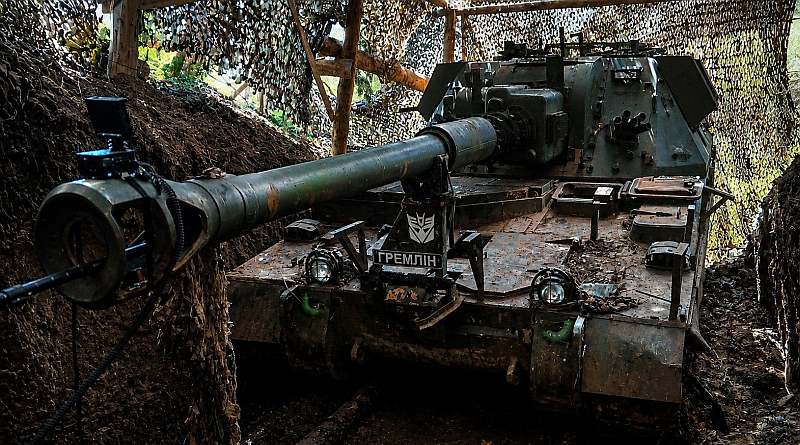
Heavy self-propelled artillery systems like “Dana,” “Suzanna,” and some other Western platforms are increasingly considered too bulky for the modern battlefield, saturated with drones.
An attempt to shift to a different philosophy of warfare is the Ukrainian self-propelled howitzer “Bohdana.” It is better suited for mobile warfare: changes positions faster, simpler to maintain, cheaper to operate.
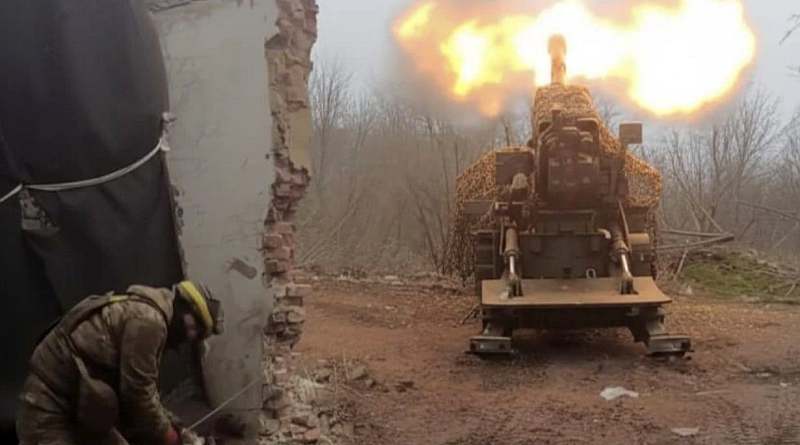
Heavy self-propelled mortar platforms have also become vulnerable. In contrast, small camouflaged mortars are more resilient.
The very organization of work is changing. The classic division of a battery into firing platoons is gradually losing its meaning. Modern navigation and control systems allow guns to operate dispersedly. At the same time, the role of the sergeant — commander of the gun/combat vehicle — is increasing: he must be able to act independently of the control point.
Robotics
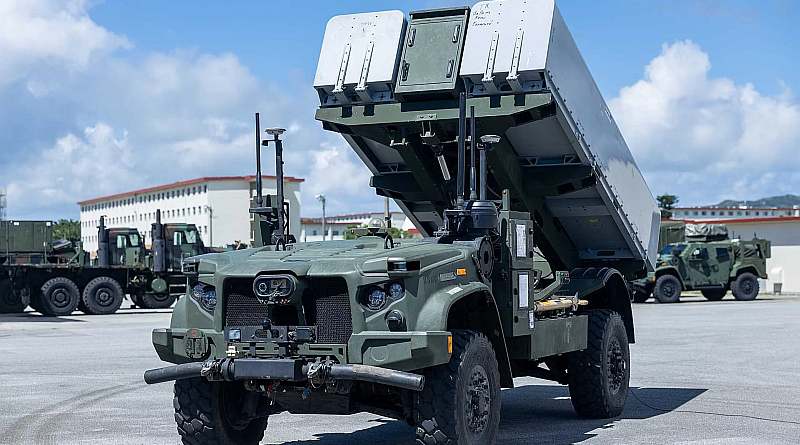
One of the most promising directions in technology development is the robotics of artillery. Trials of the HIMARS system have already demonstrated the possibility of launching missiles without the presence of a crew directly at the firing position. This is not just a modification of a well-known launcher but a new generation of armed systems — the Autonomous Multi-Domain Launcher (AML). Its prototype was successfully tested in the USA.
The next stage of development is crewless self-propelled howitzers, automatic loading systems, remote control, autonomous positioning, and automatic execution of firing tasks. Ukraine, having a strong engineering and IT school, could potentially become one of the leaders in this field.
Shells
The war showed that creating a quality artillery shell is much more difficult than it seems. It requires high-precision machines, quality metallurgy, chemistry, and skilled personnel. Without a modern industrial base, mass production is impossible.
Logistics
Western artillery systems were initially built around container and pallet logistics. This allows for quick loading of ammunition, minimizing manual operations, and reducing time spent in position.
The Soviet system, where shells are manually extracted from boxes, assembled, and prepared just before firing, is too slow for modern warfare. Therefore, Western-style transport-loading machines have become an essential element of the artillery complex. They have demonstrated their superiority.
Non-nuclear Deterrence
The war demonstrated the effectiveness of such high-precision missile systems as HIMARS, MLRS, ATACMS. Therefore, for Ukraine, it’s about forming non-nuclear deterrence forces — several missile brigades capable of striking at strategic depths up to 2000 km with precision missiles, creating the threat of unacceptable losses for the enemy.
In fact, this is about an analog of a missile shield without a nuclear component, but with the ability to inflict damage on the enemy comparable to a nuclear strike.
Main Conclusion of the War
The role and place of modern artillery are no longer determined by the number of guns. Its effectiveness depends on other factors:
effectiveness of reconnaissance;
speed of data transmission;
automation;
logistics;
industry;
communication;
ability to quickly analyze information.
In fact, artillery is turning into a huge distributed data processing system, where the gun is just the final element of the chain.
That’s why talk of the “death of barrel artillery” seems superficial. It’s not the artillery itself that is disappearing, but the old model of its application, specifically the models of the First and Second World Wars.
Today and tomorrow will be won not by the one with more barrels, but by the one who can more quickly turn intelligence data into an accurate strike.
Reference
Viktor Kevlyuk — retired colonel, expert at the Center for Defense Strategies.
Graduated from the Leningrad Higher Artillery Command School, National Defense Academy of Ukraine (operational-tactical level), National Defense University of Ukraine (operational-strategic level).
He progressed from platoon commander to artillery division commander. Later, he held staff positions and was involved in personnel work.
Participant in combat operations. He was responsible for combat tasks as chief of staff of the operational-tactical group “Luhansk” and chief of staff of the rocket forces and artillery of the Joint Forces.
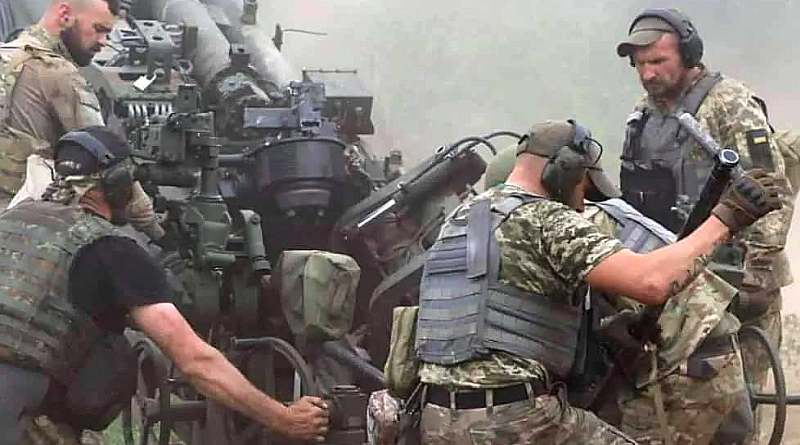
In the featured image: Ukrainian crew of the American M777 howitzer. Photo: 44th Separate Artillery Brigade named after Hetman Danylo Apostol
