
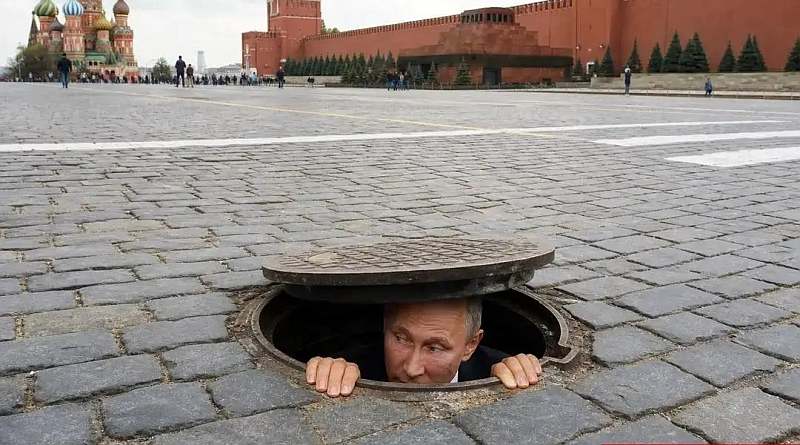
Yaroslav Trofimov, The Wall Street Journal / Translation by iPress
The American Wall Street Journal discusses how, on the eve of another May 9 parade, the Putin regime is for the first time in a situation where there is virtually nothing to celebrate: the war against Ukraine has already lasted longer than the Soviet-German war, the front is stagnant, Russia’s losses have exceeded a million, and Ukrainian drones regularly reach deep regions and even Moscow. Against this backdrop, Putin’s image as a “protector” and “superman” is crumbling – society is increasingly vocal about fatigue, fear, and the failure of the “special operation,” and even pro-war bloggers and loyal officials hint at the possibility of revolutionary changes. WSJ notes that no one predicts a rapid collapse of the regime, but public sentiment has changed so significantly that the coming months may become the most challenging for Putin during his entire rule.
“The Cult of Victory Day,” which the Russian president has nurtured, is turning against him: the war is lasting longer than the Soviet war with the Nazis, the American Wall Street Journal reminds.
As the publication notes, since Putin came to power more than a quarter of a century ago, he has been building a new state religion around May 9 – the anniversary of the Soviet Union’s victory over Nazi Germany and the most sacred day in the Russian calendar.
On Saturday, for the first time, Putin will lead the Victory Day parade at a time when his war against Ukraine has already surpassed the duration of the Soviet Union’s war with the Nazis.
WSJ emphasizes that he has nothing to celebrate. Continuous Ukrainian drone strikes on Russia, including the capital, forced Putin to request a ceasefire during the festivities. Parade organizers, citing security threats, have significantly reduced the scale of the event: the display of armored vehicles and the march of military cadets have been canceled. In Moscow, mobile communication and the internet are planned to be interrupted for several days.
As the front stalls, Russia’s losses exceed a million, the economy is declining, and missile and drone strikes have become commonplace; in recent months, a wave of deep discontent has swept across the country, WSJ notes. It potentially poses the most serious threat to Putin’s rule during all this time and could prove more insidious than the failed coup by leader Yevgeny Prigozhin in 2023.
Russian special services responded with new draconian restrictions, blocking most online activity in the manner of the Chinese “Great Firewall.” These restrictions, justified by the necessity to prevent drone strikes, which nonetheless continue, are so severe that even pro-government nationalists who support the war speak of an impending revolution. Rumors of a supposed coup and internecine struggles between different branches of the security apparatus are spreading through Moscow salons.
This does not mean that revolution is inevitable, nor does it mean that Putin, who is currently 73 years old, will soon be removed. However, the WSJ notes that the change in sentiment is striking compared to the situation as recently as December last year, when Russian officials harbored hopes that President Trump would force Ukraine to make a peace deal on Moscow’s terms, lift economic sanctions and give the green light to “business as usual.”
January was the psychologically pivotal moment. It was then that Putin’s so-called “special military operation,” which according to Kremlin narrative aims to “denazify” Ukraine, exceeded the duration of the war with Nazi Germany from 1941-1945.
“Every day since then has intensified the feeling that we are unworthy of the memory of our grandfathers,” said former Putin speechwriter Abbas Gallyamov, now an opposition politician living abroad. “Putin created this cult of the grandfathers, and now it’s turning against him.”
Kremlin spokesman Dmitry Peskov stated that the war has resulted in a “phenomenal consolidation of society around the president,” adding that it has lasted more than four years because its goals have not yet been fully achieved.
Pro-war Russian media personality Anastasia Kashevarova highlighted the shift in public sentiment when she wrote on Telegram this week that in World War II, the grandfathers “had already reached Berlin by this time, yet we continue to just shake our fists and talk nonsense about red lines.”
Ukrainian drone and missile strikes on Russian oil export facilities, refineries, and military enterprises have become commonplace in recent months. About 70% of Russia’s population, including areas up to 1,700 km from the border, which considered themselves protected, are now within Kyiv’s reach. Initially, these attacks created a “rally around the flag” effect. But now, as Ukrainian forces become more effective, these strikes rather demonstrate Putin’s weakness.
“Putin is now perceived as an old grandfather, a grandfather who does not understand the real state of affairs in people’s lives,” explained senior fellow at the Carnegie Russia Eurasia Center and author of the Russian bestseller on the fall of authoritarian regimes in Spain, Portugal, and Greece in the 1970s, Alexander Baunov. “He is no longer perceived as a protector. He is no longer perceived as Superman,” he added.
In a recent conversation with Trump, Putin proposed a short ceasefire to allow a victory parade to take place. Ukrainian President Volodymyr Zelensky responded by announcing a unilateral ceasefire, set to begin on Wednesday. However, the Russian army continued its attacks on Ukrainian cities after that date, meaning hostilities—along with Ukrainian drone and missile strikes—are unlikely to subside during the weekend parade.
“If Putin could freely choose, he would not hold this parade. He does not want to stand in an open space, considering the damage suffered by Russian air intelligence and air defenses, and how Ukrainian drones and missiles choose where to fly,” said former senior official at the German Ministry of Defense and head of the IRIS think tank, Nico Lange. “But due to the quasi-religious significance of May 9, he also cannot do without the parade,” he noted.
A local TikTok influencer captured public frustration in a post from Chuvashia, in the Volga region, about 1,000 km from Ukraine, which was hit this week. Ukrainian rockets and drones targeting a key Russian military facility also damaged the city’s main shopping center and caused civilian casualties.
Instead of burning with patriotic fury, Vova_Cola (with 178,000 followers) urged Putin and Zelensky to sit calmly and show that “mind is stronger than force” so people wouldn’t have to die again and children could grow up in peace.
“Everyone, perhaps except for Putin, has begun to realize that the war is not going according to plan,” explained Sergey Radchenko, a professor of history at Johns Hopkins University.
For Radchenko, the key turning point was the series of Ukrainian attacks in recent weeks that devastated the oil refinery and oil export port of Tuapse on the Black Sea, causing massive pollution of coastal areas in popular tourist resorts. “That’s when the war came to the homes of those who used to support it from afar,” he said. “The conclusion some might draw now is that the war was a bad idea. For others, of course, the conclusion is: it’s being conducted not decisively enough,” Radchenko noted.
As WSJ notes, the latter is undoubtedly the stance of many military analysts and patriotic bloggers with huge audiences on social media. Yet they, too, are increasingly outraged by government restrictions and high-level corruption. The main antihero of this nationalist wing is former Russian Defense Minister Sergey Shoigu, currently the Secretary of the Security Council, once a trusted confidant of Putin, accused of failing the initial stage of the war.
Although four of Shoigu’s former deputies in the Ministry of Defense have since been arrested on corruption charges, WSJ notes, ultra-patriots were outraged that Colonel-General Alexander Chaika, who led the failed campaign to capture Kyiv in early 2022, was promoted to the position of the new commander of Russia’s Aerospace Forces.
Nationalist commentator Alexander Kartavykh wrote on his popular Telegram channel that under the current “collective psychosis” in Russia, the stock of public stability will last no longer than two months, after which he predicts final revolutionary changes.
The sense of mass confusion and discontent was crystallized by Victoria Bonya, an Instagram influencer and former Russian TV star living in Monaco, who had previously stayed away from politics. In a post and video on Instagram, which gathered 1.6 million likes, she addressed Putin, saying he has no idea of the country’s real problems because thieving governors and officials constantly lie to him and because the country is ruled by fear.
She did not mention the war directly, except for the reference to the Black Sea oil spill, instead focusing on the government’s lack of response to flooding in the Caucasus, how cheap Chinese goods are killing local entrepreneurs, and how new bans on Instagram make it impossible to communicate with clients, relatives, and friends.
“You don’t know what’s happening in the country,” she told Putin, while insisting she remains a loyal citizen of Russia. “People will get tired of being afraid. They’re being compressed into a spring, and one day this spring will uncoil,” she emphasized.
Former Putin speechwriter Gallyamov explained that these sentiments reflect a broader trend. “People who were previously indifferent to politics now find it fashionable to express political views, care about people’s suffering, and complain about the authorities,” he noted. “Historically, such a trend usually precedes revolutions.”
The Kremlin responded to Boni with a statement that her advice would be taken into consideration. Other Kremlin officials have publicly noted that the new bans have gone too far, although no steps have been taken to repeal them.
“The Kremlin understands that serious discontent may lie ahead, so it has decided to allow it to manifest at the grassroots level for now,” believes Marat Gelman, a former advisor to Putin and head of state television, who now lives abroad and supports the opposition. According to him, the Kremlin currently has enough resources to suppress any civil uprising.
John Sullivan, who served as the U.S. Ambassador to Moscow when the invasion of Ukraine began in 2022, is not as confident. “There is a saying in Russia that events develop slowly but when they happen, they happen quickly. I wouldn’t have said this a year or two ago, but I think it’s possible now,” he stated.
