

Information on the current losses of the Russian Federation due to sanctions as of 08.05.2026.
1. Ukrainian drones attacked several strategic industrial sites deep within Russia on the night of May 8, including one of the country’s largest refineries, “Slavneft-YANOS” in Yaroslavl.
– A fire broke out on the premises following the strike. The plant is among the top five largest refineries in Russia and can process up to 15 million tons of oil per year. It is an important element of the central part of Russia’s fuel infrastructure and is controlled by Rosneft and Gazprom structures.
– This is not the first attack on the plant: at the end of 2025, the primary oil processing unit was already damaged there.
– The industrial area of Rostov-on-Don was also under attack. According to Astra, a fire broke out near the “Empils” chemical plant, one of the largest chemical enterprises in southern Russia. Nearby is the “Radar Scientific and Technical Center,” which works with special-purpose complexes and fulfills orders from the Russian Ministry of Defense.
– Strikes on refineries, chemical plants, and enterprises related to the military sector create a cumulative economic effect for Russia: costs to protect objects increase, risks of production disruptions deepen, and the stable operation of export infrastructure becomes more complicated.
2. The Russian Central Bank has effectively acknowledged that Ukrainian drone strikes on industrial and energy infrastructure are already impacting the macroeconomic situation in the country.
– In the materials discussing the Central Bank’s key rate, it was noted that the loss of production capacities is stalling the recovery of economic activity in the second quarter. This primarily concerns the consequences of regular attacks on refineries, ports, and large industrial enterprises.
– In the spring, the strikes intensified significantly: ports of Ust-Luga, Primorsk, and the “Sheskharis” oil terminal in Novorossiysk, as well as several large refineries, including the Tuapse plant and “Kirishinefteorgsintez,” were damaged.
– Some objects still operate with restrictions or have not resumed operations. The Central Bank essentially acknowledges that the attacks have begun to impact not only individual enterprises but also the overall pace of economic growth.
– Damage to logistics and processing capacities complicates the export of oil and oil products, a key source of foreign exchange earnings for Russia.
– Notably, even the Kremlin-affiliated CMACP has already halved its economic growth forecast to 0.5–0.7%. This indicates the cumulative effect of the strikes: the longer the infrastructure disruptions persist, the greater the losses for industry, exports, and the budget.
3. The liquid part of Russia’s National Wealth Fund continues to shrink, indicating increasing pressure on the budget and the gradual depletion of the Kremlin’s main financial “safety cushion.”
– As of May 1, the liquid assets of the NWF decreased to 3.62 trillion rubles, or approximately $48.4 billion. This is only 1.5% of Russia’s projected GDP — one of the lowest levels in recent years. The total volume of the fund also decreased in April — to 13.2 trillion rubles.
– The main part of the liquid reserves now essentially consists of Chinese yuan and gold: about 185 billion yuan and 145 tons of gold in unallocated form were left in the accounts.
– The volume of free ruble funds is almost exhausted — only 1.32 billion rubles. The reserves are dwindling due to high military expenses, budget deficit, and the need to support the economy under sanctions and declining energy export revenues. After 2022, the NWF became one of the main sources of funding for budget expenses and deficit coverage.
– The fewer available reserves left to the Kremlin, the stronger the budget’s dependence on current oil and gas revenues, as well as on domestic borrowing.
4. Russia’s import substitution program in aircraft manufacturing continues to miss its own deadlines.
– The mass production of passenger aircraft MS-21, Superjet, and Il-114-300 has been postponed again — at least until 2027. The serial production of MS-21 will begin next year, although the first aircraft deliveries were promised for 2024 back in 2022.
– Since then, the timelines have been postponed several times — first to 2025, then to 2026, and now to 2027. Only a third of the certification flights have been completed. The situation is similar with the “import-substituted” Superjet: despite promises to start deliveries in 2024, serial production has been postponed again.
– The constant postponements demonstrate deep problems in the Russian aviation industry after losing access to Western technologies, engines, avionics, and components.
– Sanctions have essentially destroyed the import-dependent production model, and creating fully localized aircraft turned out to be much more complicated and expensive than the authorities claimed.
5. The Russian home appliances market has begun losing momentum due to falling consumer demand and decreasing purchasing power of the population.
– By the end of 2025, the revenue of equipment manufacturers decreased by 11.6% to 209.2 billion rubles.
– The decline affected most major manufacturers producing equipment under the brands Haier, LG, Beko, Indesit, Hotpoint, and “Biryusa”. The most significant drop was recorded by the Russian division of Turkey’s Arcelik, the manufacturer of Beko, whose revenue fell by 35%.
– Due to high inflation, expensive loans, and worsening financial conditions, Russians are increasingly delaying major purchases or moving to cheaper segments. Household appliances, which were previously actively bought on credit, are no longer a priority expense.
– The situation is further aggravated by the central bank’s strict policies. High interest rates have significantly reduced the availability of consumer credit, which has been one of the key drivers of equipment sales in Russia for many years.
– The decline in demand for household appliances is another signal of the cooling Russian economy. Unlike the official statistics on wage growth, the consumption dynamics increasingly show that the population is switching to saving mode and cutting expenses on durable goods.
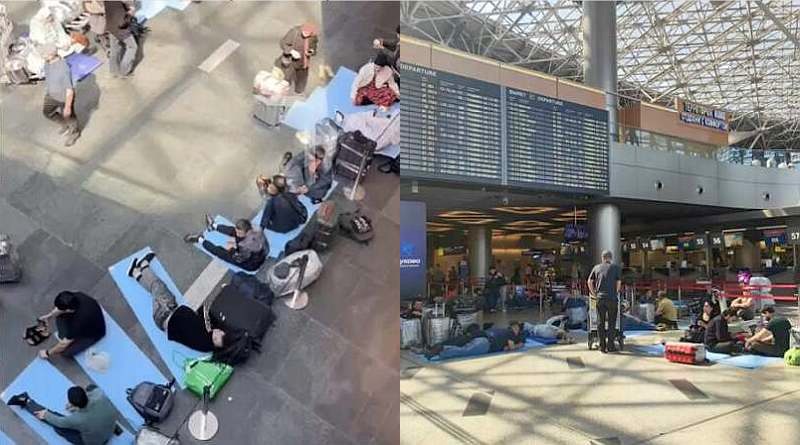
6. Strikes on Russian aviation infrastructure have caused a massive transport collapse, which in Russia is already being compared to the early days of the full-scale war.
– After the drone attack on the office of “Aeronavtika of Southern Russia” in Rostov-on-Don, the authorities were forced to halt operations at 13 airports in the south of the country. The restrictions affected Sochi, Krasnodar, Volgograd, Makhachkala, Grozny, Mineralnye Vody, and other major hubs.
– Rosaviatsiya has imposed airspace restrictions at least until May 12. As a result, hundreds of flights have been canceled or delayed at Russian airports, and the number of blocked passengers has already exceeded 14,000.
– The authorities are effectively reverting to the February 2022 scenario: the Ministry of Transport has already instructed to use trains and buses to transport passengers from canceled flights. This is exactly how the Russian authorities acted after the start of the invasion of Ukraine when airports in the south and west of the country were closed.
– The attack on the air navigation system showed that Ukrainian strikes are beginning to impact not only individual oil refineries or military targets but also critical infrastructure, on which the functioning of Russia’s internal logistics and air communications depends.
7. In Russian society, fatigue from the protracted war, economic problems, and intensified repression is becoming increasingly noticeable.
– Even part of the previously loyal audience is beginning to openly criticize the Kremlin. The fifth year of the war is accompanied by worsening sentiments: Ukrainian drones regularly attack targets deep within Russia, the economy is slowing down, and the government is tightening control over the internet and daily life under the guise of “security.” This is causing increasing irritation even among those Russians who previously avoided criticizing the authorities.
– A telling signal was the sharp rise in negative assessments in sociology. According to the Levada Center, only 55% of Russians believe that the country is moving in the right direction — the lowest indicator for the entire period of the full-scale war.
– At the same time, Putin’s approval rating, according to VCIOM, has noticeably decreased compared to the beginning of the year. Dissatisfaction is exacerbated by economic difficulties: business closures, workforce shortages due to emigration, tax pressures, and deteriorating quality of life.
– More and more Russians feel that the war is beginning to directly impact their everyday reality, rather than just existing in television propaganda. Meanwhile, mass protests are still unlikely due to the high level of repression. However, hidden irritation is accumulating in society, which over time may create problems for the Kremlin.
– In conditions of protracted war, economic exhaustion, and constant tightening of control, the Russian authorities are increasingly facing the erosion of public support.
8. Despite statements about a gradual abandonment of Russian energy, the EU sharply increased purchases of Russian LNG in 2026.
– According to Kpler, supplies from the “Yamal LNG” project increased by 17% year-on-year from January to April — to 6.7 million tons, marking a record for the entire project since its start in 2017.
– In fact, almost the entire export of “Yamal LNG” is now directed to Europe: in the first four months, the EU received 91 shipments of gas — about 98% of the plant’s entire export. Price increases allowed Russia to significantly boost revenues.
– It is estimated that in just four months, Moscow could have earned about 3.9 billion euros from LNG deliveries. Notably, the increase in imports occurred even after the start of restrictions on Russian LNG in the EU.
– This demonstrates the contradiction between Brussels’ political declarations and the actual practices of European companies, which, in a volatile market, continue to purchase Russian gas.
– In addition to LNG, supplies through the “Turkish Stream” also increased — in March they were 22% higher than a year earlier.
