
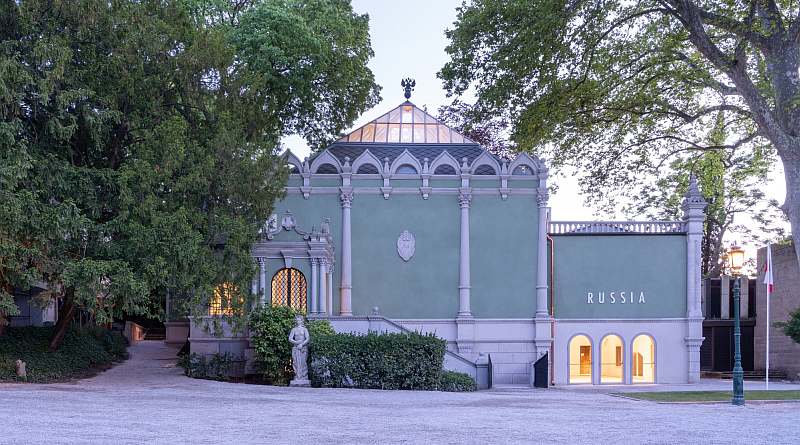
The organization of Russia’s return to participation in the Venice Biennale is being handled by the FSB and the Russian Ministry of Foreign Affairs. The authorities of Italy and the EU have opposed it, but this does not prevent the organizers from continuing to push for Russia’s participation in this European festival.
Russia views the opening of its pavilion at the biennale as another special operation in Europe. The well-known “soft power” of the FSB is meant to show Europeans that Russia is not a pariah, and that mass killings, destruction, and child abductions can be masked with the slogan “art beyond politics.”
The organization of the Russian participation in the biennale is managed by the Russian company Smart Art, which has two owners. The first one is Anastasia Karnieva, daughter of FSB Colonel General Nikolai Volobuev, who is under personal sanctions by the USA and the EU. The second owner is Katerina Vinokurova, daughter of Sergey Lavrov, the Minister of Foreign Affairs of the Russian Federation.
In other words, convincing Europeans that “true Russian culture is beyond politics” is the responsibility of the children of Sergey Lavrov and FSB generals. In a situation where the Kremlin calls Europe its main enemy and threatens to turn European cities into “radioactive ashes,” opening a Russian pavilion in Europe is not just reckless but literally dangerous.
It is no secret that all of Putin’s actions today are united by one main goal — the destruction of Ukraine. As Ukraine’s ability to resist directly depends on European support, creating a split among Europeans regarding their stance towards Russia is a real military objective capable of influencing the course of the war.
Meanwhile, the Italian government condemned Russia’s admission to the biennale, and the foreign ministries of 20 European countries issued a joint statement, while the European Commission canceled subsidies to support the biennale for the next three years.
The Russian special operation has not completely failed, as the invitation to the biennale has not yet been revoked. But the solidarity shown by Europeans in this matter once again emphasized their chosen course of isolating Russia and counteracting Kremlin influence operations.
Russian culture in the hands of the Chekists is not art but merely another tool for dismantling Europe’s independence from Kremlin pensioners. Until Europe realizes that every step towards “dialogue” with the murderers is a step towards its own self-destruction, Kremlin special operations will continue to undermine the foundation of a free Europe.

Meanwhile, since last year, the leadership of the Venice Biennale has been behind-the-scenes negotiating the return of Russia to the international spectacle.
The leadership of the Venice Biennale discussed with the curator of the Russian pavilion, Anastasia Kariyeva, the issues of returning Russian figures and works bypassing the European Union sanctions that prohibit EU member states from cooperating with Russian government agencies.
The President of the Venice Biennale, Pietrangelo Buttafuoco, and Director Andrea Del Mercato have regularly corresponded with Anastasia Kariyeva regarding the possibilities of implementing such a plan.
Russia has not participated in the Venice Biennale since 2019. In 2022, artists from the Russian pavilion refused to participate in the biennale as a protest against Russia’s full-scale invasion of Ukraine. In 2024, Russia did not present an exposition, temporarily giving its pavilion to Bolivia.
But…
Strangely, in 2026, the Russian pavilion will be open during the pre-viewing of the biennale from May 6 to 8, although it will remain closed to the public throughout the rest of the exhibition period.
Russia’s participation in the 61st Venice Biennale, which will be held from May 9 to November 22, has already caused outrage from Italy’s Minister of Culture Alessandro Giuliani, but the exhibition’s president, Pietrangelo Buttafuoco, continues to defend the position of the Russian exposition.
No matter what Russian officials state about sanctions being beneficial to them and their sacred culture meant only for them, they attempt to spread their roots to other countries, using culture as a tool for hybrid warfare to whitewash their image and enhance reputational recognition through international platforms.
Participation in prestigious international events allows Russia to position itself as a “civilized” country. Many tools are employed for these purposes, including bribery.
Russia’s return to Europe’s cultural space creates a risk of gradual integration into international political, economic, sports, and cultural structures without changing its behavior and sets a precedent where aggression does not have long-term consequences for participation in global processes.
This scenario undermines the logic of sanctions as a tool to restrain a war criminal state.
Photo: La Biennale di Venezia
