Phillips P. OBrien / Translation by iPress
The renowned American historian, Professor of Strategic Studies at the University of St. Andrews in Scotland, Phillips O’Brien, in a fresh weekly review, emphasizes that Ukrainian leaders have begun to skeptically assess U.S. security guarantees and have rejected any pressure to cease strikes on the Russian oil and gas sector. He notes that Trump’s actions, namely the war with Iran and the lifting of sanctions on Russian oil, generously rewarded the Russian budget with new revenues. Nonetheless, O’Brien sees the main problem for the Russians as their lack of understanding of how they can overcome Ukrainian defense.
Last week, the Trump administration learned how difficult it is to wage war, while Ukrainians are showcasing their capabilities and gaining experience. On Sunday, U.S.-Iran talks ended without reaching an agreement, leaving the Trump administration in a dilemma of their own making. Should they return to bombings? Escalate the conflict? Or abandon negotiations? They waged this war almost in a state of delusion, believing that what they hoped for would somehow magically come true. Remember: click your heels and say “I think I can,” and the Strait of Hormuz will just “naturally” open.
The Ukrainians never suffered from magical thinking. From the very beginning, they had an enemy determined to destroy them. At the same time, they nurtured hopes and unrealistic expectations, especially regarding the U.S., but also some European partners. Last week, one could say, all these hopes were publicly dismissed. Ukraine began speaking to the U.S. and Europe in a different language, which in itself is noteworthy.
Several people asked me to assess how much Trump’s decision to bomb Iran helped the Russian economy, while Ukrainian strikes on Russian oil facilities harmed it. Here is an approximate calculation – just don’t tell Paul Krugman about it, or I’ll lose my Nobel Prize in Economics.
Finally, the Russian spring offensive has been ongoing for over 3 weeks, and it seems that Russia is still experiencing territorial losses.
The Ukrainians Stopped Pretending
Just on Friday, I published a post about how President Zelensky, perhaps for the first time, openly expressed that the U.S. is colluding with Russia.
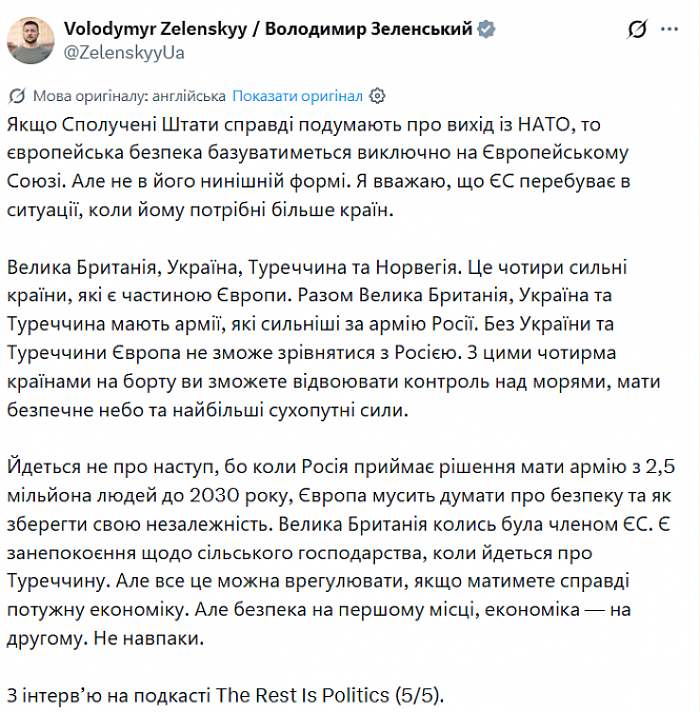
Shortly after his publication, Zelensky went even further. In a tweet addressed directly to European politicians, Zelensky stated that Europe should plan its defense relying solely on European resources, without the involvement of the US. To prepare for such a world, Zelensky called for rather radical measures – creating new and expanding existing structures. Interestingly, he called for Turkey to be included in a new, updated European security structure (which seems to be a kind of more unitary European Union). It is worth reading the entire statement carefully.
And that’s not all. Further in the same tweet thread, Zelensky stated that the US is trying to force Ukraine to give up Donbas, while questioning the significance of American security guarantees. What did Ukrainians get for giving up nuclear weapons under US pressure at the time? Nothing.
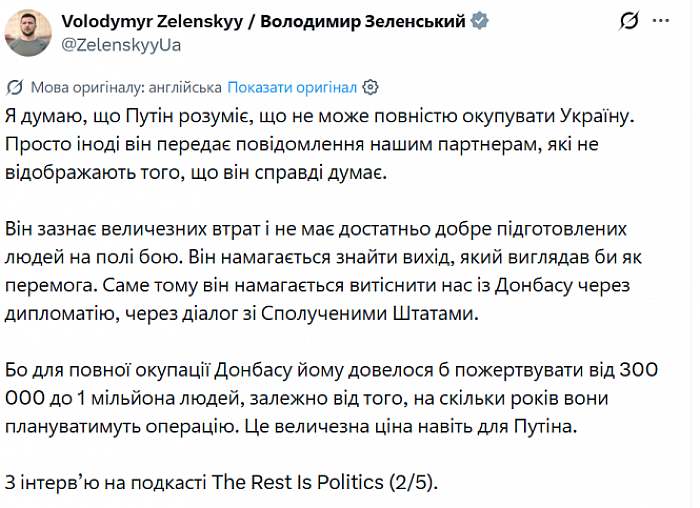
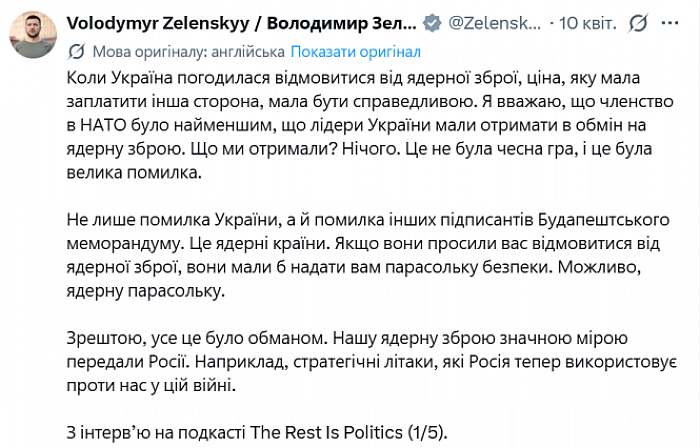
Thus, within a few hours, Zelensky hinted that the US is working in favor of Russia or together with it to lift sanctions against Russia, trying to force Ukraine to give up Donbas in exchange for meaningless security guarantees, and that Europe should start thinking about the future of defense without US involvement.
This can only be seen as a rather radical change in tone from Zelensky: the US is no longer a reliable and key partner for Ukraine’s future, but has turned into an extremely unreliable partner that seems to be colluding with Russia while threatening the security of all Europe.
And Zelensky was by no means the only one. Throughout the week, his office’s head, Kyrylo Budanov, not only rejected US pressure to halt Ukrainian strikes on Russian oil facilities (details in the article, published on Friday), but also publicly questioned the US role as a mediator, hinting that the Trump administration seems eager to strike a deal sought by Putin.
This open Ukrainian skepticism towards the US and the Trump administration seems to extend far beyond the top leadership of the Ukrainian state. European diplomats generally speak of serious doubts Ukrainians have about the value of any security guarantees from the US. Such skepticism towards the US in general and Donald Trump in particular seems to be quite widespread in Ukraine.
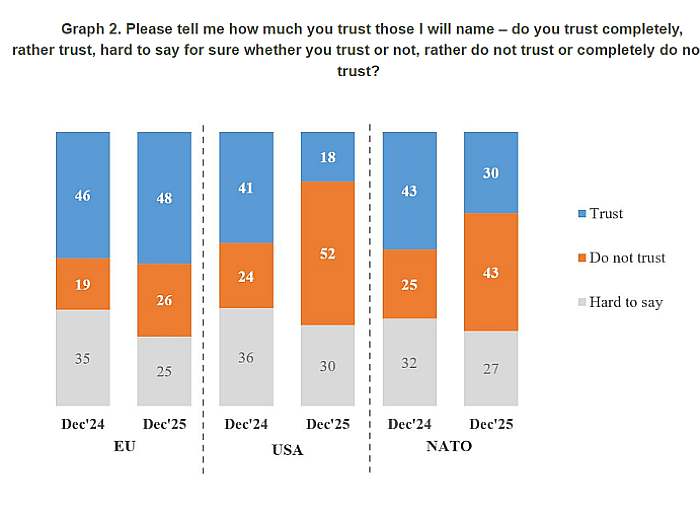
In a study by the Kyiv International Institute of Sociology, published in early 2026 but based on data from late 2025, it is very evident how trust in the US plummeted during 2025, while trust in Europe remained at the same level or even increased.
As for Trump, the decline was even sharper.
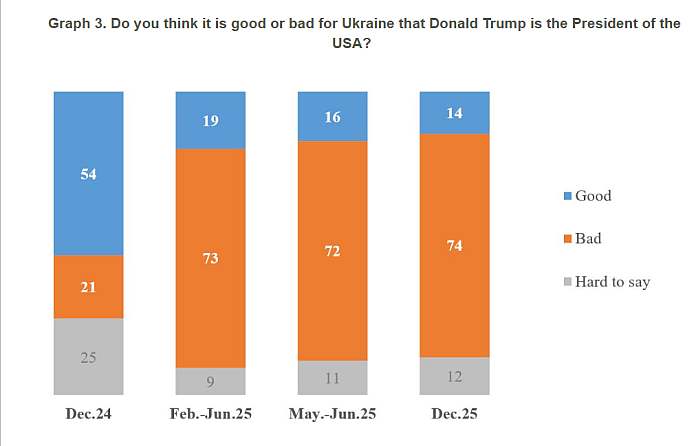
It is quite shocking that at the end of 2024, 54% of Ukrainians believed that Trump would be beneficial for Ukraine. This indicates a large-scale misinformation campaign (some knowingly, some not) conducted by Trump supporters to conceal the fact that he was an instrument of Putin. These voices continue to repeat the same, but they have caused enormous damage, and the hope Ukrainians harbored at that time is evidence of this.
One can only imagine what the trust ratings for Trump and the USA in Ukraine would be after the last few weeks, when Trump did everything possible to publicly aid Russia, but they are probably even worse.
Previously, this could have been a disaster for Ukraine, but now we see a country capable of accepting the truth. It is hard to overstate how important this is. As someone who has spent their entire professional life studying states in wartime, I can say: one of the biggest problems they face is that they, especially their leadership, see the war not as it is, but as they desperately want it to be. There is immense pressure to turn the enemy into a caricature, which you believe you can control or defeat. That is, my enemy is weak, will eventually collapse, ask for peace, etc. Putin, it seems, still lives in such a self-created world of hopes. All I can say: similar hopes often lead to a miserable end in a bunker under a Berlin garden or on some inconspicuous Italian street.
It is good that the Ukrainian people understand the truth, and the Ukrainian leadership speaks the truth. This means they are waging a war as it is, not as they would like it to be.
This is undoubtedly the most important event of the past week.
Costs and Balance of Russian Oil
American bombings of Iran began six weeks ago (February 28), and it is interesting to observe how they intersect with Ukraine’s campaign of strikes on Russian oil facilities.
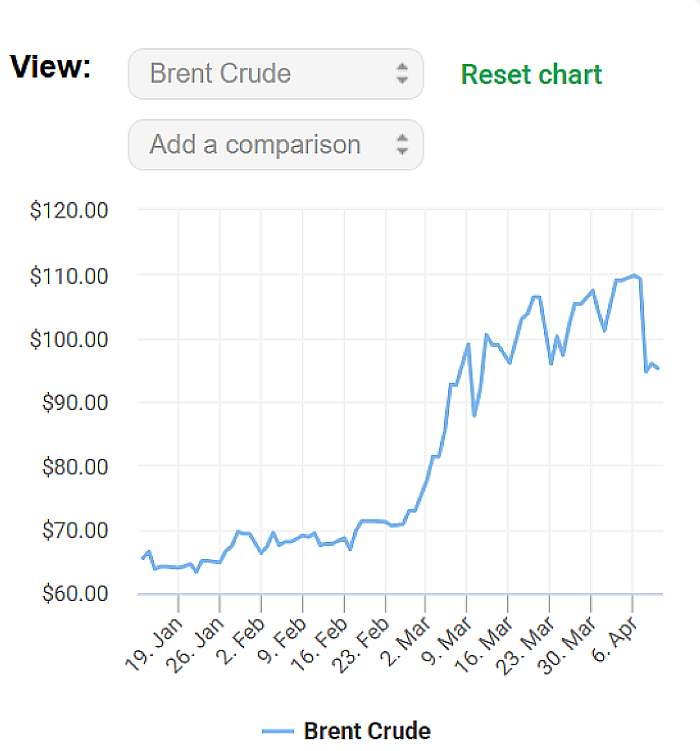
A positive consequence of Trump’s actions for the Russians has been significantly better conditions for earning revenue from oil exports. The price of oil not only soared instantly but also, despite the current truce between the USA and Iran, remains very high and is unlikely to return to pre-war levels anytime soon. Here is the price of Brent oil over the last 3 months for you to get an idea. Even considering the recent decline, prices have increased by about 50%.
In addition to this, the Trump administration has effectively not only lifted all sanctions against Russian oil but also signaled to the whole world that buying Russian oil is now entirely free. India, for example, with renewed vigor returned to buying Russian oil and states: whatever happens in the future, it is not going to stop buying. And why should it stop, if the Trump administration makes it clear that it will not reimpose any sanctions against Russian oil.
The financial gains from this in early March appeared staggeringly large. According to calculations, in the first two weeks of U.S. bombings, Russia earned almost 7 billion dollars in additional revenue.
Then Ukrainians really targeted Russia’s export facilities in the Baltic, launching new attacks on Russian refineries, ships, storage tanks, etc. This didn’t stop the process but significantly reduced the amount of additional funds Russia could receive. Here’s an article that discusses this campaign.
This Ukrainian campaign somewhat reduced Russia’s excess profits but did not bring them to an end. Russia still exports, though in smaller volumes. If you weigh the economic advantages for Russia (significantly higher prices and easier sales) and the disadvantages (reduced export capacities and repair costs), here’s the pessimistic calculation I made regarding Russia’s monthly revenues.
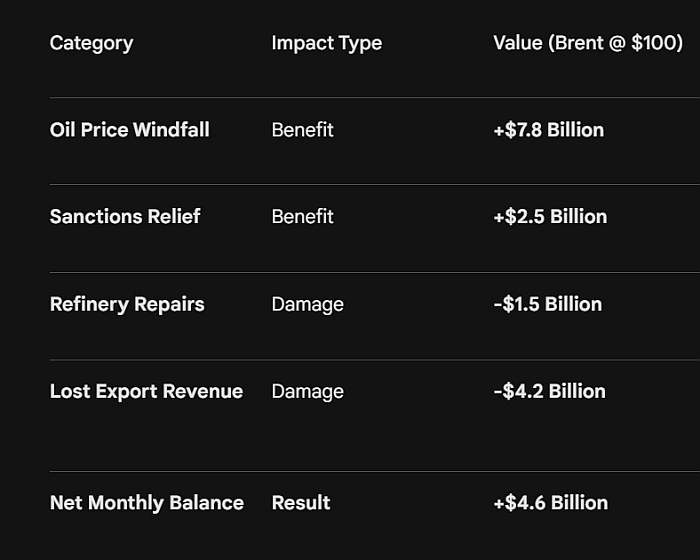
Clearly, the situation is not stable. Further developments in Ukraine could cause even more harm, and oil prices may continue to fall. However, Donald Trump did Putin a great service, which Ukrainians are now trying to counteract.
Russian Spring Offensive: The First Three Weeks
The Russian spring offensive began around March 20, 2026. The Institute for the Study of War selected March 21 as the exact start date, noting that it was then that the Russians began a coordinated assault on the Ukrainian defensive belt in the Donetsk region.
The net area of territory captured by Russia during this time seems close to zero or even negative. In the first week, Russia captured about 40 square kilometers. During the past week, if the Russians moved at all, it was backward, losing a small amount—about 2.5 square kilometers. It is worth noting that three weeks after the start of a large-scale offensive, when it seemed Russian advantage in mass and manpower should have impacted the Ukrainian defense, which was constantly described to us as positions without a single soldier, the Russians are losing territory.
And if we add to this the fact that overall in March Ukrainians gained more territory than they lost, even though the Russian spring offensive began in the last ten days of the month, it is noteworthy that overall Russians still lose more than they capture.
I could provide maps of the front from Deep State, but what’s the point? The lines have barely shifted. To show the changes, you need to zoom in so much that you lose perspective on how small this territory is.
This is not the Battle of the Somme—it’s something entirely different. Four years of war have passed (during which both sides should have drawn various conclusions about the battlefield), and the larger and supposedly mightier side seems to have no answer and cannot move forward.
Zelensky even stated that the Russians are taking what seemed to be a serious risk, throwing their strategic reserve into battle to try to compensate for the colossal losses and inability to move forward. Here’s a quote from one of his press conferences.
If he is right, this is exactly what Ukraine should strive for. The willingness to ruthlessly sacrifice its own people has always been a characteristic trait of Russia in this war. If this tactic no longer works, as the depletion of reserves confirms, it means that at this moment the Russians truly have no answer to the Ukrainian defense. We have not yet reached the level of Mussolini’s offensive on Greece in 1940 (which led to the near-instant loss of territory by the attacker), but if the Russians use their reserves and gain nothing from it, the initiative will increasingly return to the Ukrainians. This defeat was a direct result of Mussolini seeing the Greeks as he wanted them to be, not as they were. He believed the Greeks were weak and divided, and that within weeks of fighting he would organize a victory parade in Athens. This is reminiscent of Putin, who planned his 2022 victory parade in Kyiv.