
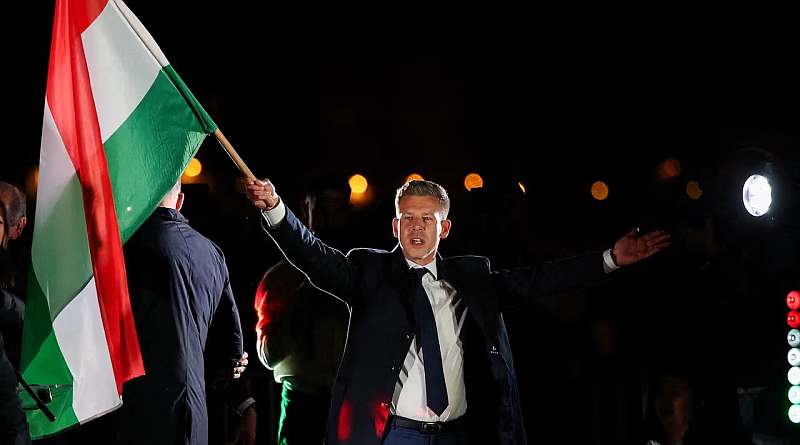

Orbán built his election campaign almost exclusively on hatred towards Ukrainians. His political technologists created a parallel reality for voters in which Hungary was supposedly under threat of invasion from Ukraine, and only Orbán could prevent it.
From the very beginning, it was clear that this was nonsense, and the election results only confirmed it. The only rational explanation as to why Orbán built his campaign around Ukraine is the influence of Russian political technologists.
World media repeatedly wrote that the Kremlin helped Orbán in the campaign by sending its technologists. Russians are so fixated on Ukraine that they decided: in Hungary, it would work the same as in Russia.
But unlike Russia, Hungary has democratic elections where the government, if making mistakes, risks losing. Orbán’s government decided that they could build a “little Russia” with the help of Russian political technologists — and predictably lost.
In fact, it was Russia that lost in Hungary, which now won’t be able to sell spots in the sanction-exempt lists to its oligarchs, buy politicians with discounts on oil, and receive sensitive information from closed sources.
It is obvious that the new Hungarian government will not become significantly more pro-Ukrainian. The election results showed that a part of Hungarians still believed the anti-Ukrainian propaganda and feared a mythical Ukrainian invasion. Therefore, the new government is likely to take these sentiments into account.
At the same time, the mere fact of its arrival after the defeat of forces associated with Russia, who worked too openly against the current winners, gives grounds for cautious optimism: the new government is likely not to be as pro-Russian as the previous one.
Ruszkik, home!
Budapest enchants you.
Lived there for a year in 1997-98 while studying at the Central European University. Since then, I’ve been very close to the events in that country…
Back then, the Hungarians, who had just escaped the clutches of the Soviet empire, were sailing full speed toward the EU and NATO. Viktor Orbán of those times was the leader of daring young people who disrupted the planned “deal” between the moderate opposition and communists. They forced a referendum where Hungarians firmly said no to communists, backroom deals, and the “thugs” from the “working militia.” Hungary became a European parliamentary republic and, after several years of searching for a “glorious past,” plunged into a European future as part of Pokrosha’s mid-1990s reforms.
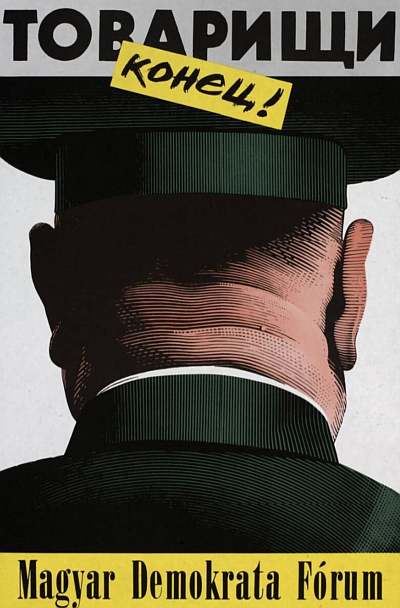
But the thirst for power plays a cruel joke even with the leaders of youth movements. The same poster that Orbán used to break the mold over three decades ago is thrown in his face. “Comrades, the end.” Because you can’t call on a monster to help you keep the throne. It will take away the throne, the country, and the soul.
Today, populism, fueled by Russian money, has been dealt a severe blow. Europe is resisting. Europe is returning to common sense.
We, on the front line of resisting the horde, must endure. We must hold strong and send our own populists and their deceptions, which lead to the darkness of Siberia, far away.
Hajrá Magyarország!
Ruszkik, haza.
Now, the task for Ukrainian diplomacy is not to miss the opportunity that may arise with the change of power in Hungary.
The party of Péter Magyar obtains a constitutional majority in the Hungarian parliament. From now on, full power on the “Tisza.” Orbán’s “Fidesz” suffered a crushing election defeat, with no help from Russian political consultants, American VIP agitators, and administrative and media resources. Friends who worked in the observation mission for these elections in Hungary say that in the evening a carnival began in Budapest, breaking the record for voter turnout in the country; more than 80% of voters went to the polls.
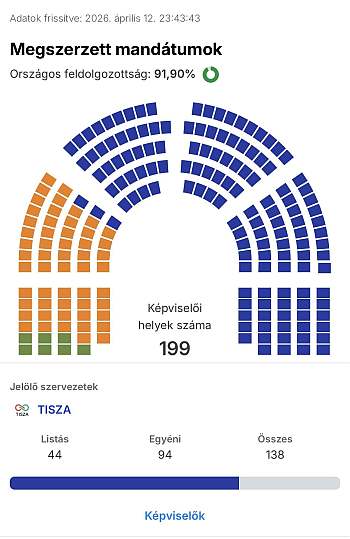
Orban ruled the country for 16 years, coming to power in 2010 as a proponent of European integration and a fighter against corruption, but over the years he has become a pariah in Europe, disregarding principles and basing his latest election campaign on openly anti-European slogans. I can imagine how much champagne will be drunk in Brussels now 🙂 .
To be frank, considering the complex electoral system in Hungary, I understood that Magyar’s party would certainly win the list vote, but I thought Orban’s people would win in the districts, and he would maintain a large faction in the future parliament and cause trouble during the coalition formation. I’m glad to be mistaken. Democracy and common sense in the European Union are alive, and that’s good news 🙂 .
Many thanks for the professional coverage of the election process in Hungary by true experts Svyatoslav Khomenko and Sergiy Sydorenko, I recommend their articles to everyone.
Regarding Ukraine and our relations with Budapest, Peter Magyar is not a pro-Ukrainian politician. He is pro-Hungarian and will defend the national interests of his country. However, he has visited Ukraine after the start of the full-scale invasion, was impressed by the scale of destruction and crimes by Russians, so we hope for a warming in bilateral relations between countries that have certainly felt the wounds from Soviet-Russian tanks.
The “Tisa” party belongs to the European People’s Party family, so European Solidarity sincerely congratulates the election winner!
* * *
By the way, on the eve of the Hungarian elections, a scandal erupted in the western media, including the Hungarian opposition media, around the OSCE PA observer mission, where, in a strange way, someone named Daria Boyarskaya from the secretariat was included, who is currently working there as staff and used to be Lavrov’s interpreter. Articles about this woman appeared in German and Finnish publications, causing a heated discussion in the Assembly, and deputies even sent a letter to the OSCE PA president demanding the withdrawal of the notorious lady from the mission.
In general, the integration of Russians into international organizations remains very high. It seems that western politicians should have long realized how much the FSB influences all spheres of life in the Russian Federation, and how in modern Russia, it is impossible to make a career in any state institution without cooperating with the secret services. And what risks these “Darias” inspired in the secretariats pose for international institutions.
The Ukrainian parliamentary delegation at the OSCE PA summer session will once again demand to discuss the presence of Russian citizens in the organization’s secretariat, to which the Russian Federation has contributed to discreditation and destruction. If we prohibited the participation of Russian deputies in observation missions, what are Russians doing there as staff?

The Tisza Party of Peter Magyar not only won the elections but won with a constitutional majority. Now Peter Magyar has free rein for reforms and can implement his policies despite Orban and his opposition.
Viktor Orban, despite his caricature-like pandering to Putin, is actually a very powerful politician with huge influence in Hungary. He lost these elections not so much to Magyar or Zelensky, who Orban generously involved in the Hungarian elections, but to himself.
Hungary is one of the POOREST countries in the EU. This state was brought about by Orban and his years of governance. That’s why people voted against Orban, that’s why the Hungarians wanted change so much.
For Ukraine, a window of opportunity has opened in Hungary. Now we have a chance to reset relations with Hungary. This will not be easy. Orban involved Ukraine too heavily in his elections, and Ukrainian officials were too careless, failing to restrain themselves and responding to Orban’s provocations.
Most likely, Magyar will be restrained on the Ukrainian issue, as he does not need the image of being a great friend of Ukraine among Hungarian voters.
Peter Magyar is the Prime Minister of Hungary, and he will defend Hungary’s interests. He will also demand Russian oil, Hungarian Transcarpathia, and other concessions. But Magyar appears more rational, and he can be dealt with.
Relations with the new Hungary must be built very pragmatically and cautiously, so as not to cause harm. Hungary is an important transit country for us, as we remember how unstable Poland can be.
Zelensky congratulated Magyar on his victory, and this is the right step. Now other steps must be taken to bring closer ties, as it is in our national interest.
I congratulate the Hungarian people on the long-awaited changes and wish for Hungary to be prosperous and stable, and for Ukraine-Hungary relations to be friendly and mutually beneficial.
