
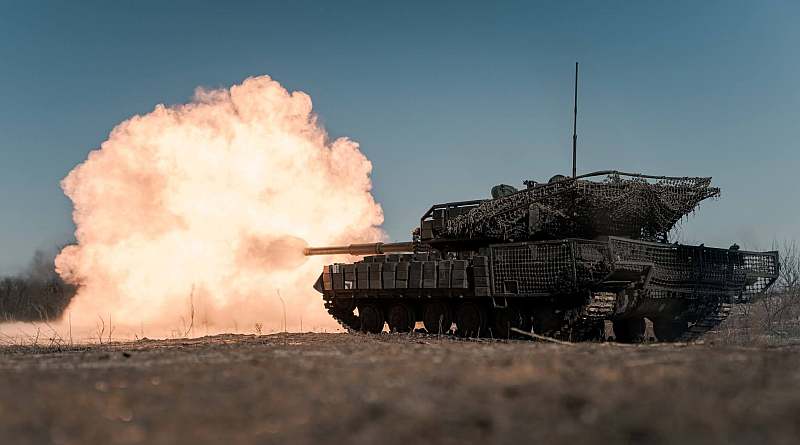
Oleksandr Kovalenko / Obozrevatel
In an interview with The Guardian, President of Ukraine Volodymyr Zelensky stated that Russia will not stop if it captures the Donetsk region and will continue the occupation of our country’s territories. Dnipro and Kharkiv could be under threat as the next targets chosen by the Kremlin. We’ll try to figure out how realistic such a scenario is and which area is under greater threat by examining the worst-case development of events that could unfold on the battlefield.
This is discussed in the joint project material by OBOZ.UA and the “Information Resistance” group.
The Most Fortified Bridgehead
First of all, it is important to understand that Russia has never abandoned its plans for the complete capture of Ukraine, which it set for itself at the beginning of 2022. Any statements suggesting that if Russia is given the entire Donetsk region, it will stop, are nothing but manipulation aimed at gaining control over the most fortified bridgehead in the entire Ukrainian theater of military actions without fighting. Then, move on to the phased implementation of the plan in other regions.
It is quite telling that the Russian side, which regularly voices its demands, uses the term Donbas, which is already a geographical camouflage trap.
In the article on OBOZ.UA “Withdrawal of Troops from Donbas and Slovyansk-Kramatorsk Bridgehead: What Trap Lies Behind Russia’s Demands”, I detailed not only the mistake of using the term “Donbas,” which refers to a geological region rather than a territorial unit, but also the potential of the Slovyansk-Kramatorsk bridgehead, which can ultimately exhaust the Russian occupiers’ troops, marking a turning point in the war.
Today we see that the Russian Armed Forces have indeed exhausted their former striking potential and are not only incapable of carrying out large-scale combined-arms offensive operations but on several fronts even unable to hold previously occupied positions.
For the first time in 2023, the Defense Forces of Ukraine are conducting tactical-level counterattacks, resulting in the liberation of our country’s territories at a pace faster than the Russian Armed Forces’ occupation efforts—despite the fact that the spring-summer offensive campaign by Russian invaders should be starting.
It is evident that Russian troops are unable to capture more than 5,300 km² of the Donetsk region by the end of 2026, which is currently controlled by the Ukrainian Defense Forces and is the most fortified bridgehead in the entire theater of operations.
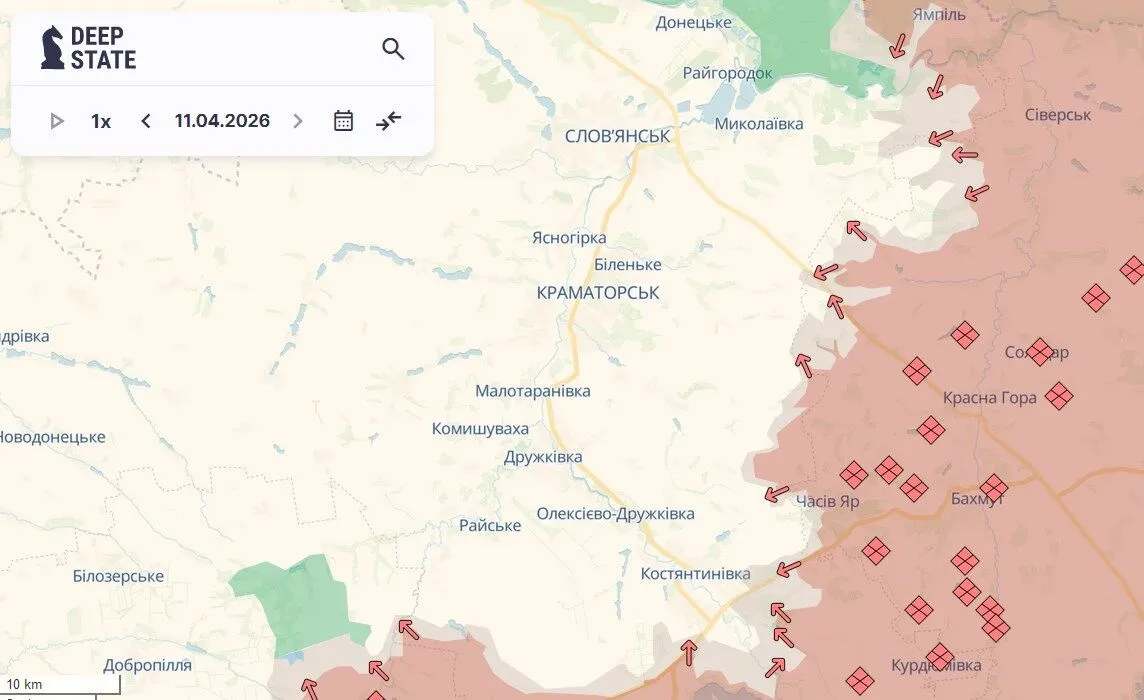
But to be ready for any threats, one should prepare for the worst-case scenario of all possible ones, and therefore let’s assume: what if the Donetsk region does not withstand the pressure of the Russian Armed Forces? Which region and which regional center are under the greatest threat?
Apocalyptic Scenario
In the event of a fall of the Donetsk region’s defense, the Russian army would reach the administrative borders of the Kharkiv and Dnipropetrovsk regions. This would allow the Russian command to unite and concentrate the forces and means of the largest strike group of the Russian Armed Forces in Ukraine more organized.
We are currently talking about the potential of the 2nd, 3rd, 8th, 20th, 25th, 41st, 51st, and other general military armies, army corps, brigades, divisions, and separate forces and means, attached from other directions. In total, this is about the concentration of a group of over 300,000. But these forces and means will face the choice of where to move next, considering the terrain-landscape and other features of the Kharkiv and Dnipropetrovsk regions. And here it should be noted – the Kharkiv region is not the best, most convenient direction for the Russian Armed Forces.
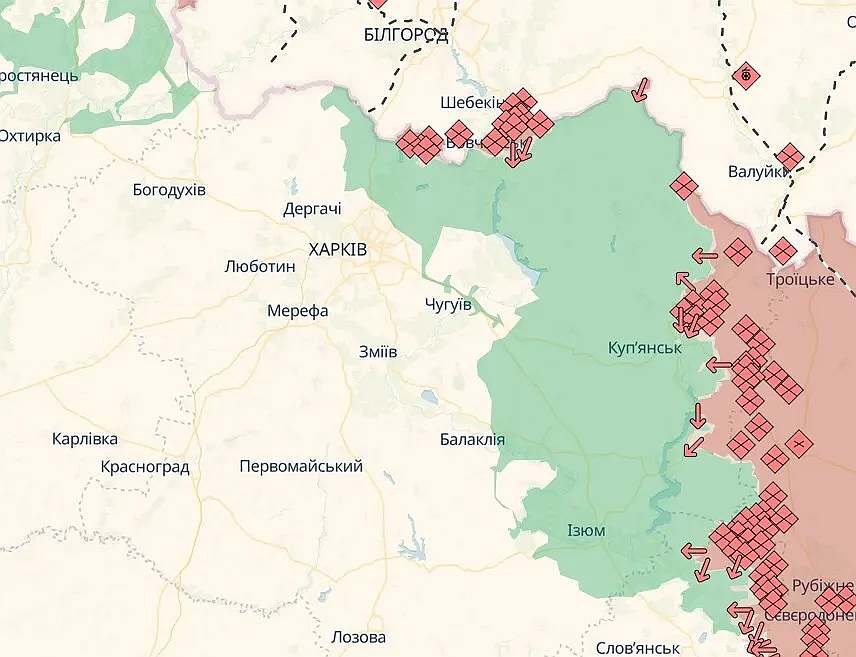
The fact is that beyond the Donetsk region begins a difficult relief for an offensive, as well as large forest areas such as “Sosny,” “Izium Forest,” “Luka,” and others. Even the M-03 highway, which provides direct access to Izium and, potentially, to Kharkiv, is not an auxiliary element given the anticipated protracted battles (as, for example, was in the Srebniansky forestry), which could drag on for the Russian Armed Forces not for months, but for years.
At the same time, in case of the fall of the Donetsk region, the command of the Russian Armed Forces will not be able to simply transfer forces and means in sufficient quantity, for example, to the Kharkiv direction in the Belgorod region.
From the experience of the 2022 invasion and the failed offensive in the Vovchansk direction in May 2024, it is clear that for an offensive on such a large city as Kharkiv, as well as storming it at least head-on, without encirclement from three directions, not to mention encirclement, a concentration of forces and means of at least 300-350 thousand people is necessary. Roughly speaking – this is practically all the grouping concentrated by the Russian Armed Forces today in the Donetsk region.
This is yet another factor that works against the RF Armed Forces – the lack of sufficient quality and quantity of resources to conduct such combined arms operations. On the other hand, the quantity, though not quality, can be addressed through a general mobilization.
Kharkiv region and Kharkiv itself are the most challenging directions where the RF Armed Forces might dare to advance after exhausting, bloody battles in the Donetsk region.
However, this does not mean they won’t act by the principle of creeping progression, clawing territory meter by meter. Especially if they are not prepared for this threat, and therefore, the formation of defense remains not just relevant, but mandatory for the region regardless of how realistic this scenario is.
Based on all of the above, if the Donetsk region falls, the main focus of the RF Armed Forces will be concentrated on advancing deep into the Dnipropetrovsk region, which is most favorable for such actions.
Yes. And the probability of this is much higher than the increased focus of the RF Armed Forces on Kharkiv region.
Russian occupiers had a very difficult time reaching Dnipropetrovsk region in 2025 at the interfluve of Vovcha-Varona, along the Yanchul River, as well as the N-15 highway to Pokrovske. Moreover, the RF Armed Forces have practically lost control over the situation on this front, and the 29th and 36th armies are forced to switch from offense to defense.
Nevertheless, this does not mean that the Russian occupiers are abandoning their tasks, as control over Pokrovske, the N-15 and R-85 highways – is an important element in forming a foothold for a future advance on Zaporizhzhia. Therefore, in the southern underbelly of the Dnipropetrovsk region, the Russian occupiers will continue trying to establish control over the pivotal town of Pokrovske and expand the control zone on the right bank of the Haichur River.
In turn, if resources of the 2nd, 41st, and 51st Combined Arms Armies are freed in the Donetsk region, they could focus on the Novopavlivka direction, the northern bank of the Solona River, as well as the Mezhova highway 04-06 and the Pavlohrad highway M-30.
The absence of serious topographical and landscape obstacles up to Pavlohrad, except for the Chaplyna River, facilitates moderate, tactical level advancement of a group with 3-4 Combined Arms Armies and a number of attached forces and assets.
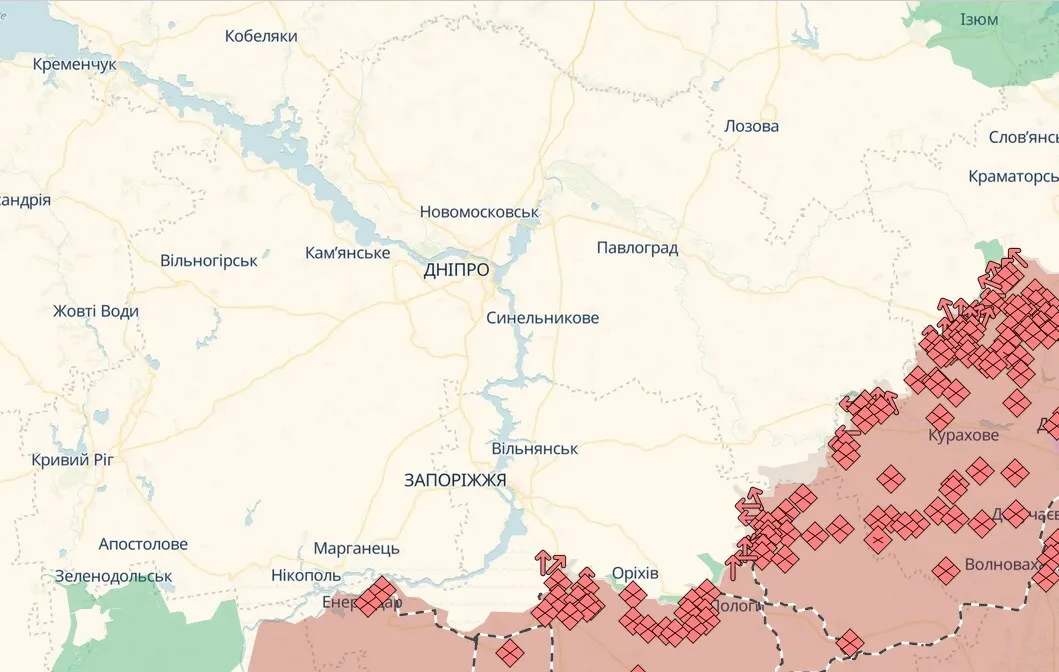
In the case of the Dnipropetrovsk region (under the development of events according to the apocalyptic scenario) the enemy can only be slowed down or stopped by multi-level, echeloned defense focused on anti-personnel barriers of both passive and active types.
Assessing the defensive capabilities of the regions, regardless of artificial obstacles, defense lines, and exclusively considering the relief and landscape features, it becomes obvious that it is the Dnipropetrovsk region that may be under greater threat of ROV advance in case of the defense fall in Donetsk region.
But as in the case of the Kharkiv and Dnipropetrovsk regions large cities such as Izium, Pavlohrad, not to mention Kharkiv and Dnipro, will serve as serious obstacles for ROV. At the same time, the operation to storm Dnipro involves even greater difficulties than Kharkiv, requiring ROV to concentrate up to 500,000 personnel in the combat zone to start a frontal operation.
Conclusions
Once again, I have described a scenario above that even I consider unlikely, but which (as any hundredth of a percent probability) deserves to be taken into account.
Russian troops are significantly exhausted today as a result of the grueling 2025. The defensive strategy of the Ukrainian Defense Forces, whose main task is to exhaust the enemy, is working and yielding results. But this does not mean we should relax and take it easy.
Currently, the enemy is focusing on the terror of regional centers. Kherson, Kharkiv, Zaporizhzhia, Sumy… Strikes are becoming systematic and as the catastrophe for ROV on the battlefield escalates, they will only scale up. The more disastrous the situation for the occupiers on the front, the more intense the terror of the civilian population.
However, the formation of multi-level, echeloned defense remains an essential component of security for each of the regions located in close proximity to the combat zone or bordering Russia.
Photo: 31st Separate Mechanized Brigade named after General-Cornet Leonid Stupnytskyi
