
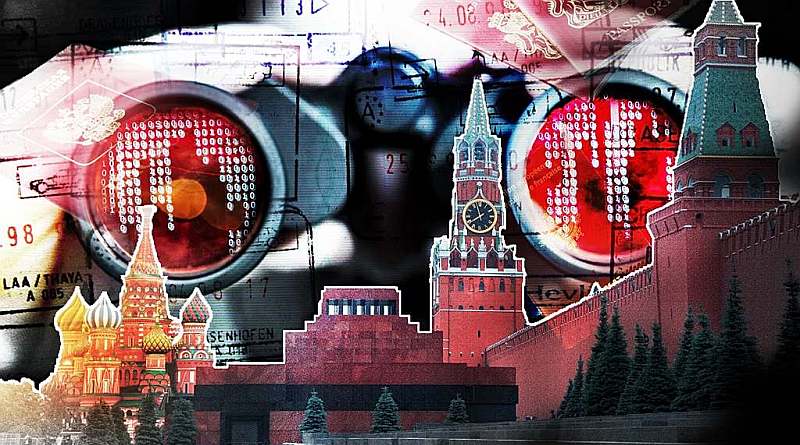
A CIA Veteran Discusses Moscow’s Spy Arsenal. How Will the West React?
“Tradecraft, Tactics and Dirty Tricks: Russian Intelligence and Putin’s Secret War” (Tradecraft, Tactics and Dirty Tricks: Russian Intelligence and Putin’s Secret War), Sean Wieswesser, Publisher: Naval Institute Press, 288 pages, $36.95, April 2026
The US and UK intelligence agencies never believed the Cold War ended. Even during the height of the “love” between East and West in the 1990s, when US Presidents George H.W. Bush and Bill Clinton invested heavily in supporting Boris Yeltsin’s fragile authority in the Kremlin, Russian spies were attempting to steal secrets, exert influence, identify potential agents, and infiltrate foreign intelligence services.
In Sean Wieswesser’s recently published book, there are only veiled hints about the details of his 30-year career in the American intelligence services—primarily in the CIA. However, it becomes clear to readers that he recruited Russian intelligence officers, managed these agents, and helped expose those attempting to spy on the United States and its allies. Now, having stepped out of the shadows, he continues the fight against what is referred to in US spy jargon as the “Russian Intelligence Services” (RIS). Wieswesser writes that his book (incidentally, his debut) is aimed at “limiting the capabilities of the RIS… and enabling our services and those of our allies to more effectively counter the RIS.”
This concise 200-page book is written captivatingly and with a modesty uncommon among these professionals who love to boast. On one hand, it serves as a useful guide to the tradecraft of espionage—primarily, but not exclusively, its Russian version—and its jargon. According to the author, unlike what the CIA calls “bricks and beams” for secret compartments, Russian spies prefer rural areas, hiding secret materials, for instance, in soda cans. Wieswesser also vividly describes the daily lives of Russian intelligence officers in diplomatic missions abroad. Typically, their day begins by checking whether they are being followed on their way to work; if they are, the rest of the day becomes complicated. The author briefly, teasing the reader, mentions the “ubiquitous technical surveillance” that uses digital traces to detect anomalous behavior, making old-fashioned espionage significantly more difficult.
In describing the working day of Russians, Wieswesser pokes a bit of fun. From the day they’re recruited (often accompanied by harassment) until retirement, Russian spies face rampant abuse, corruption, and favoritism. Everywhere—drunkenness and marital infidelities. Their professional priorities include juggling accountable travel expenses, fabricating sources, and marketing media articles as secret intelligence.
(Does the same occur in other countries’ intelligence services? Wieswesser does not report, but from the stories of other CIA veterans, a picture emerges of grueling underfunding and bureaucratic machinations).
Viswesser writes that when Russian spies do have time for real work, they are usually not very skilled. He speaks sharply about the dozen “illegals” detained in the USA in 2010, among whom Anna Chapman is a bright example. After her arrest, media attention focused mainly on her glamorous lifestyle. A young woman! Redhead! In a miniskirt! On dates! In reality, she was an amateur: she was unable to use a secret communication channel, fell for an FBI provocation, and then panicked and called her father — the head of intelligence — on an open line. Chapman and her colleagues are far from the dedicated “sleeper” agents of Soviet times, like Rudolf Abel, portrayed in the Hollywood thriller “Bridge of Spies.” Representatives of the new generation of spies are greedy, careless, and unproductive. Thanks to years of FBI surveillance of their activities, reprimands from superiors in Moscow are known, and they seem to carelessly ignore them.
Among Viswesser’s many stories is one about how an American “spy hunter” makes a stunning mistake and calls the “illegals” he was supposed to monitor, confusing their home number with a secured government line. He even introduced himself, to which the Russian replied, “You have the wrong place,” and hung up. Any properly trained undercover spy would have immediately stopped the mission and hurried home. But these Russians did nothing: as it seems, they enjoyed living in the USA, no matter how ridiculous and risky the mission was.
According to Viswesser, despite the time and money spent on them, Russian spies abroad are mostly “apathetic” and “incompetent.” In fact, all spy wars since 1991 have been mostly successes for NATO countries and their allies and failures for Russia.
The most effective penetration of Western intelligence services by Russia was associated with people like Aldrich Ames (a high-ranking CIA officer exposed in 1994) and Robert Hanssen (who led the FBI counterintelligence team on Russia until his arrest in 2001). Both worked during the peak of Soviet espionage in the 1980s. Few of their successors can boast of such effectiveness.
So why should we worry? First of all, Viswesser warns, because Russia continues to consider the United States the “main enemy” (a term borrowed from Soviet times) and has the resources to turn this hostility into reality. The Russians still have great potential: the world’s largest nuclear arsenal and conventional armed forces, which, at least for now, can pose a threat to Europe. Russia allocates so many resources to intelligence that at least part of the effort is sure to bear fruit.
In 1995, Russia recruited Estonian Herman Simm, who later became the highest-ranking official in his country responsible for defense secrets, allowing the Kremlin access to information on regional defense plans (or their absence) and internal processes within NATO. The German payment company Wirecard, led by a fugitive allegedly Russian agent named Jan Marsalek, was not only involved in massive financial fraud but also gained invaluable access to its clients’ data, including governmental institutions. One of the many conspiracies associated with Marsalek almost ruined Austria’s intelligence service. Russian undercover spies who carried out a nerve agent attack in the British city of Salisbury in 2018 failed to kill their target — former Russian spy Sergei Skripal — but endangered the lives of dozens, if not hundreds, of innocent civilians.
Illegal agents may reside for long periods in foreign countries not only for espionage but also to perform other tasks, such as passive surveillance. One such spy, exposed in Germany (this story is not covered by Viswesser but was told to me by an intelligence officer from another country), had the unassuming and likely rather dull task of watching a Bavarian car plant for any signs of transitioning to military production.
Alternatively, the mission can involve “spotting”: identifying individuals whose vulnerabilities (financial problems, loneliness, inappropriate behavior) make them susceptible to recruitment by other specialized intelligence officers. Russian military intelligence, GRU, sends illegals abroad whose sole task is to organize sabotage in case of war. No one should take lightly the agents of a hostile foreign state moving unnoticed in the West.
Another cause for concern is that RIS is a key component of Russia’s unconventional gray zone arsenal, including cyberattacks, sabotage, disinformation, and other means applied on the brink of full-scale war. Viswesser emphasizes attempts to sow distrust in the American political system ahead of the 2016 U.S. presidential election, particularly by spreading fake news that voting machines were vulnerable to hacking. Another successful Russian operation fueled frenzy by exploiting splits in American society over racial, religious, and political views. Most of these operations were conducted online from outside the United States.
On the ground, there is considerable worry about the use of intermediaries. Russian sabotage operations in Europe are now typically carried out not by professional spies, but by occasional mercenaries — “disposable” agents, as they are called in intelligence — who are paid in cash or cryptocurrency through intermediaries. They may have no idea who orders them to burn something or beat someone, and why. Last year, European intelligence services arrested dozens of such agents.
Many others will take their place. No one should take this lightly.
Like most observers of Russia, Visvesser is fascinated by its language and culture. But he does not idealize the adversary. In the dedication to the book, he mentions his Lithuanian wife Diana, whose family “experienced the repercussions of Russian imperialism firsthand.” Such a perspective is a commendable contrast to the views of some of his former CIA colleagues who, in recent years, have focused too much on Kremlinology (the intricacies of high-level Russian politics) and Moscow’s relations with the West, while neglecting the threat Russia posed to its neighbors. Looking back, one can say that the real story of Russia after 1991 was not a clash between supposed reformers and hardliners, but revanchism. This was all too obvious to the countries of the former Soviet empire, but their warnings were ignored by the know-it-alls in the major Western countries.
Visvesser does not detail the failed policies of the West and generally speaks cautiously about the shortcomings of his former employer. He notes with regret that the modern CIA encourages generalists rather than specialists. There is an increasing lack of deep knowledge of languages and cultures, as well as the methods of the adversary. In a broader sense, the inability to counter Russian aggression (in Ukraine) and subterfuge (everywhere) significantly fuels the Kremlin’s confidence to do even more. The author could also mention the blatant disregard of moral principles by the Trump administration and its impact on the prestige of the US and its alliances.
However, the transition of Russia to banditry and thievery also has a devastating impact. Visvesser’s main message is that Russia and its agents are, in essence, an easy target. His call to former colleagues, their counterparts in other countries, and political leaders: more risks need to be taken, and more efforts need to be made. Not just for security’s sake, the author argues. For the sake of the faster collapse of the ruling kleptocracy in Russia and, ultimately, the return of the country to the civilized world.
Edward Lucas — Senior Fellow at the Center for European Policy Analysis (CEPA). He was formerly a senior editor at The Economist. Lucas has covered Central and Eastern Europe since 1986. A long-time foreign correspondent in Berlin, Vienna, Moscow, and the Baltic countries, he is an internationally recognized expert on espionage, subversion, use and misuse of history, energy security, and information warfare.
