
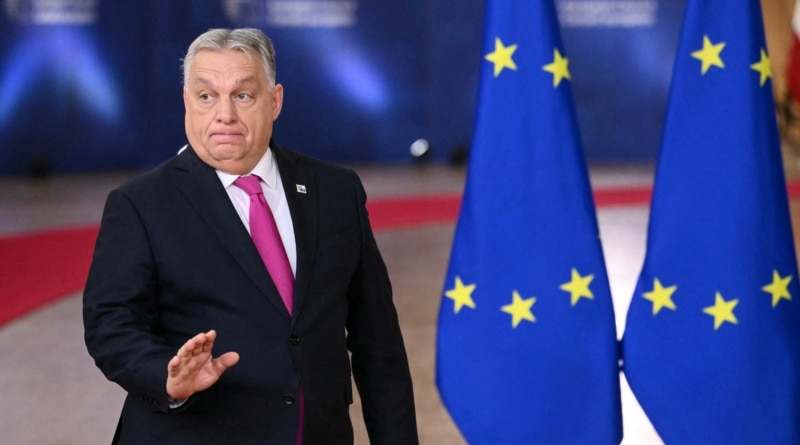
Due to Hungary’s position, Brussels still cannot agree on providing Ukraine with a 90-billion loan, the first tranches of which were supposed to arrive in April. How critical will the halt in funding be for us? Will Ukraine be able to compensate for the lack of funds on its own?
Waiting for Hungarian Elections
April 12, 2026, is set to become a real judgment day for Ukraine and the whole of Europe. That’s when the next parliamentary elections in Hungary will take place, after which the party “Fidesz” and Viktor Orban might lose power for the first time in 16 years. According to Politico, the opposition party “Tisza” had a 12-point lead at the end of March (it may garner 51% against Fidesz’s 39%).
Only after Orban’s defeat, as Brussels hopes, will the EU finally be able to unanimously make the final decision to provide Ukraine with a €90 billion loan. Hungary is the country officially vetoing it, while Slovakia only expresses opposition without using legal mechanisms.
In any case, the pro-Moscow position of the Hungarians has put Ukraine on the brink of an extremely difficult financial situation. According to Bloomberg, without aid, we will face an acute cash shortage in two months. This situation is especially frustrating given that Russia is simultaneously receiving significant benefits due to rising energy prices as a result of the war in the Middle East.
Orban and the Pipeline — A Russian Operation?
The decision on the €90 billion “loan that does not need to be repaid” (according to the document, it will have to be repaid from future Russian reparations) was triumphantly made at the end of 2025. Since Ukraine had enough savings to fund its expenditures in the first quarter of 2026 (IMF loan, remnants from ERA G7 and Ukraine Facility programs), the start of EU payments was planned for April.
However, Hungary, which initially agreed to the loan, blocked the decision on February 20 after the “Druzhba” pipeline incident. It’s hard to shake the feeling that all this was planned by the Kremlin: a blow to its own pipeline not only deprives Ukraine of funding but also gives Orban a tool for pre-election propaganda.
As Budapest is not expected to change its position at least until the new government takes office, we will certainly not receive the funds in April. In an optimistic scenario, the first payments will come in June. A catastrophic scenario — Orban retaining power — would delay the loan provision even further.
The President of the European Commission, Ursula von der Leyen, assures that the funds will be provided anyway: “The loan is blocked because one leader does not keep their word. But I will repeat what I said in Kyiv: we will fulfill our promise one way or another.”
However, we already need to prepare for a difficult interim period when accumulated funds run out and new ones have not yet arrived.
Budgetary Firefighting Tools
However, there is no reason to panic just yet. It’s worth immediately reminding that Ukraine’s own budget revenues, which finance slightly less than half of all expenditures, will not disappear.
In such a situation, the state has two fiscal (budgetary) tools.
- First — expenditure reduction (budget sequester). For example, through temporary freezing of capital projects, delaying payments to public sector employees, or social support to the population.
- Second — tax increases. The government is currently trying to lobby through the Verkhovna Rada for major changes to the tax legislation, ostensibly required to continue support from the International Monetary Fund. This includes taxing income from digital platforms, abolishing duty-free postal allowances, introducing VAT for sole traders, and fixing the military levy rate at 5% after the martial law ends.
Raising taxes is always a blow to the national economy, especially during a major war. Measures like VAT for sole traders threaten to effectively destroy the simplified tax system, which allows Ukrainian small and medium-sized businesses to survive. Paradoxically, the IMF and partners supposedly want to help us with loans, but instead ask to destroy our economy.
Consequently, the tax tool is undesirable, ineffective, and simply harmful. The option of temporarily reducing budget expenditures is more attractive, especially if the delay in funding is not prolonged.
Printing Press, Government Bonds, and Other Measures
The most obvious way to survive a difficult period is monetary emission (printing money). The head of the National Bank, Andriy Pyshny, recently mentioned in an interview with Bloomberg that the NBU is ready to increase lending to the Ministry of Finance in case international aid is halted.
Emission is the quickest way to get funds, but it is extremely dangerous due to the threat of rising inflation. The NBU was forced to “print” hryvnia in 2022, which ultimately drove inflation to over 26%. Clearly, returning to such a practice is highly undesirable but a realistic prospect.
Another measure could be the activation of domestic borrowing through government domestic loan bonds. The government may try to attract more money from banks and citizens by raising the interest rates on these bonds. However, considering that these rates are already at high levels (14-17%), it is unknown how demand for bonds will increase with another rate hike.
Finally, there is always the option of attracting loans or grants from individual partners. Germany, the United Kingdom, the Netherlands, Scandinavian countries, and other consistent partners can provide funds outside the general European budget if our situation becomes truly catastrophic. They shouldn’t find it difficult to find the additional 4-6 billion euros we need monthly. President Zelensky also mentioned this: “They will find ways to partially finance us. I believe that in any case, even by finding alternative, temporary steps, the EU must find a solution.”
Resilience Until the End of Summer
The critical duration of lack of funding is 2–3 months after exhaustions in June. That is, if EU funds do not begin flowing by September, an apocalyptic scenario could be discussed. Ukraine would then risk facing devaluation of the hryvnia and loss of the economic stability that has been meticulously built over the past four years.
It is important to understand: the resilience of the Ukrainian budget is at least until the end of summer. With this reserve, along with the above-mentioned measures, Ukraine should wait until 90 billion euros are unlocked.
Again, much will become clear on the night of April 13, when the first results of the Hungarian elections are announced.
