
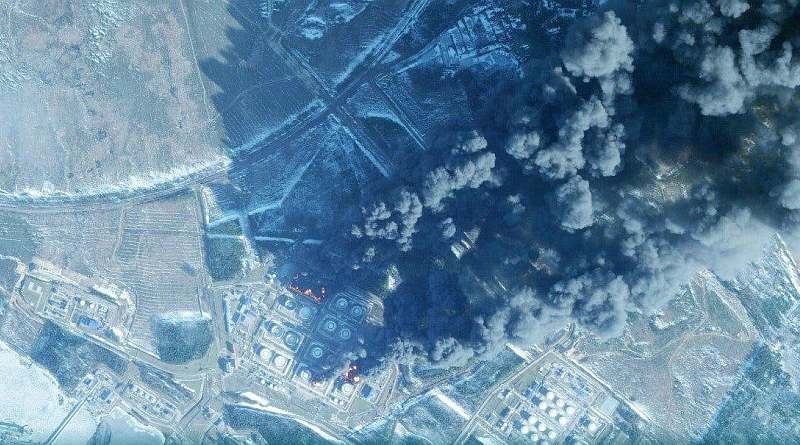
On the night of March 22-23, 2026, we once again employed swarm tactics and targeted the Primorsk port in the Leningrad region for the Russians. To give you an idea of the scale: this is not just some provincial oil depot hit by a random drone.
This is the endpoint of the Baltic Pipeline System (BPS), the main terminal of Transneft, and their largest export hub on the Baltic. It handles 60–75 million tons of oil per year. That’s over a million barrels of Urals crude oil and about 300 thousand barrels of diesel per day. Essentially, these pipelines account for almost 60% of Russia’s maritime oil exports.
We didn’t just hit the infrastructure; we used loitering munitions on the main financial artery pumping currency into Russia for war.
Breaking Through Air Defense and Machine Vision
The FP-1 has a claimed range of up to 1600 km. Flying from our border to the Leningrad region is like a morning stroll for it, with enough fuel left for complex maneuvers over the Baltic to bypass air defense zones. Our long-range kamikaze drones were in action again, and the scale of the raid was historic. The Russian Ministry of Defense officially whined in the morning reports that they ‘shot down’ 249 drones across Russia’s territory. The governor of the Leningrad region, Drozdzenko, stated that over 60 UAVs were targeted by air defense over the region.
For St. Petersburg and the region, this is an absolute record for the entire time of the full-scale war (the previous peak was back in July 2025 when 51 drones arrived). The distance from our border is over 1000 kilometers, but the density of the strike was such that the layered defense of the Baltic Fleet with their S-400s and ‘Pantsirs’ simply choked and let the strike group through.
The classic breakthrough scheme was implemented — channel capacity is overloaded, part of the raid consists of decoys and dummies approaching from different directions to prevent focusing fire. Plus, in several videos where drones dive toward the terminal, there is no typical blind fall by GPS coordinates. They make a characteristic climb or turn right before the strike. This indicates that terminal machine vision (DSMAC/optical correlation) was being used.
In St. Petersburg itself, chaos ensued at night: the “Pulkovo” airport came to a complete halt, and Plan “Carpet” was announced. Over 30 departures were canceled, with many planes just circling, burning tons of expensive aviation fuel, and disrupting the entire logistics.
While the civilian sky was paralyzed and air defense crews panicked trying to fend off the first wave of dummy drones, our main craft with machine vision calmly reached Primorsk and began to precisely dismantle the terminal infrastructure.
Results on the Ground
Our General Staff has officially confirmed the target was hit. The strikes were smart and precise: they hit both the tank farm and the oil-loading infrastructure. Governor Drozdenko mumbled the standard mantra around four in the morning: “one fuel tank was damaged.” But that’s classic deceit to calm the masses.
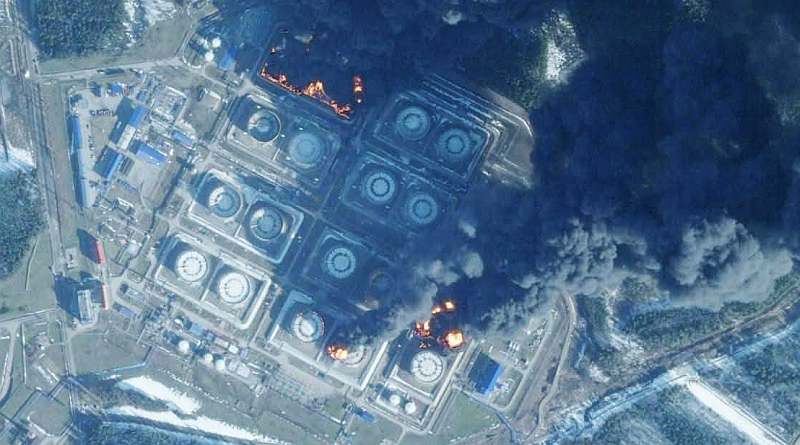
According to our monitoring and the thermal maps from NASA FIRMS satellites, the strike was very concentrated. The satellites recorded that there were initially several hotspots, which spread as the fire intensified. Local authorities acknowledged the massive fire, and the entire port staff had to be evacuated urgently.
Moreover, both debris and direct hits affected the water area. Russian media confirmed that a ship near the pier caught fire (though they later reported that the “open fire on the vessel was extinguished”).
To understand the level of destruction, one must comprehend the architecture of Primorsk. There aren’t provincial tanks there, but giant VSTs (Vertical Steel Tanks) with a capacity of 50,000 tons each. These are quite monstrous structures. When such a “tank” catches fire and starts boiling over with oil discharge (boilover), it’s practically impossible to extinguish it. Foam attacks do not work, the temperature melts the steel and destroys the protective embankments — firefighters can only wait until it burns out completely, while simultaneously spraying water on neighboring tanks to prevent them from exploding due to heat radiation.
We will see the exact number of destroyed tanks a bit later, when the smoke dissipates completely and high-resolution daylight satellite images emerge, but the park has burned well. At least five tanks burned either from strikes or from the fire spreading after the explosions.
The Economy of the Wreckage
They, as always, do not acknowledge human casualties — they write “no victims.” But the main loss here is not the personnel but the macroeconomy. The export hub physically halted operations. We knocked out the loading nodes through which they fill their shadow fleet’s tankers with oil. And here, the mathematics begin to hit them in their most vulnerable spot.
The raw material burned: 50,000 tons of oil in one such tank is approximately 365,000 barrels. Even if calculated at a discounted price of 75 bucks per barrel, that’s over 27 million dollars in pure cash that evaporated from just one tank. If even three of them burned, it’s already close to minus a hundred million overnight.
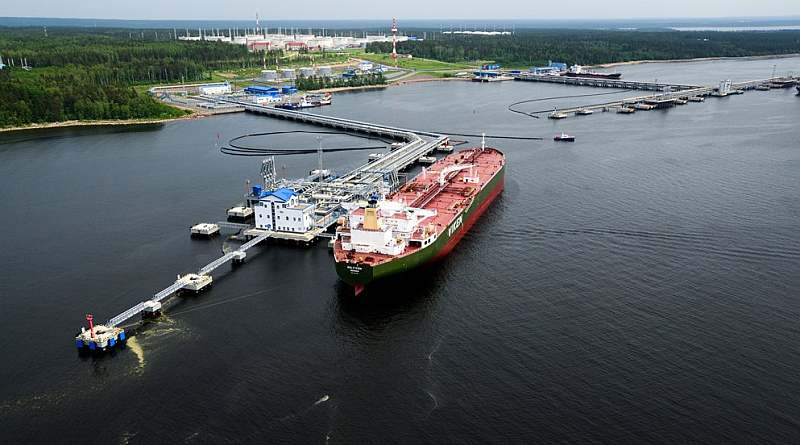
Next comes the iron. The storage tank with all the fittings costs millions of dollars. But the weakest link is the specific high-performance pumping stations, filling systems, and management automation (SCADA). Historically, all of this is of Western production — Siemens and its analogs. Repairing or replacing these units under strict sanctions is a wildly long and incredibly expensive story: you can’t order a main oil pump on AliExpress.
And the main thing — the lost profit. The port consistently shipped oil worth 70–85 million dollars a day. Every day of downtime is a huge hole in their military budget. A week of repairs will cost half a billion dollars in lost revenue.
Global Context and Fuel Crisis
And here comes the cherry on top. Reuters reported: Russia has halted oil export through the Baltic Sea ports due to a drone attack. Tankers are standing still, no transshipment. This stoppage at Primorsk critically exacerbates the global oil deficit, which is currently caused by the Strait of Hormuz operating at 10–15% of pre-war levels.
While everything is burning in the Middle East, tankers are standing, oil prices are skyrocketing, and the red-haired old man flexes his muscles, the Russians should have been raking in windfall profits with a shovel. But we have physically cut them off from the opportunity to profit from this global crisis surge with our drones.
They are sitting on a huge barrel of oil, the price of which is rapidly rising, but they physically cannot sell it because we are simply taking out their taps — in the Black Sea region and the Baltic. Methodically and systematically cutting their ability to earn money for this war.
The export of gasoline and diesel has not yet resumed. Russia, which for decades wanted to be an energy superpower, now critically depends on gasoline imports from Belarus. Supplies from Belarusian refineries (Mozyr and Naftan) have tripled compared to last year. The share of diesel in the cost of sowing in 2026 is up to a record 25%. At the beginning of 2026, the price of gasoline and diesel in Russia exceeded the US average. These are markers of a chronic fuel crisis being swept under the rug.
Everything is going according to plan, demilitarization on the march.
In the image: Aftermath of the strike on Prymorsk. Photo: Radio Svoboda
Copyright © 2021 RFE/RL, Inc. Reprinted with permission from Radio Free Europe/Radio Liberty
