
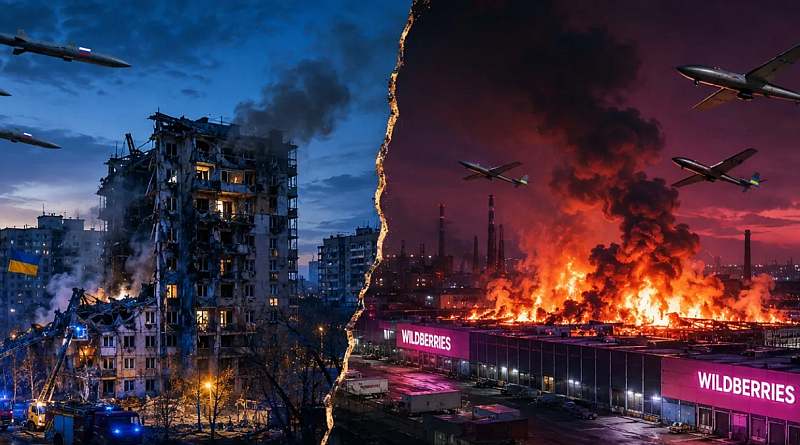
When the front freezes and doesn’t move an inch for weeks, armies sooner or later turn to another target—not the enemy’s trenches, but their cities. This is not a new ingenuity of the Kremlin. The world has already seen such logic during the Iran-Iraq war, which contemporaries aptly named: the war of cities.
By the mid-1980s, the positional war on land had become permanently stuck in a years-long “war of attrition”—the front hadn’t shifted in either direction for years, and the cost of every meter was measured in tens of thousands of lives. Saddam Hussein then tried to achieve with missiles what he couldn’t with tanks. Iraqi aviation and ballistic missiles struck Tehran and other Iranian cities, and Iran responded with its own “Scuds” on Baghdad. Both dictators counted on the same thing: that the civilian population would not withstand the constant fear and would pressure their government to capitulate.
The most terrifying period was the spring of 1988, when Iraq launched dozens of “Al-Hussein” missiles with an extended range at Tehran and the capital’s population, fearing chemical warheads, fled en masse. Over the eight years of this war, thousands of civilians on both sides were killed, tens of thousands were injured, and both capitals suffered serious destruction. And there was no capitulation due to a broken will to resist.
The war ended in August 1988 not because any capital surrendered. It ended because both armies were exhausted at the front.
Iraq regained control over lost territories, Iran acknowledged that continuation was futile, and the ruins of cities became the backdrop of this war, a heavy and bloody backdrop, though not its victorious finale. Neither Tehran nor Baghdad were broken by the missiles; what broke was the ability of both armies to continue their offensive.
We observe the same logic today. When the battles for Kostyantynivka or Pokrovsk are measured in meters per week at the cost of thousands of lives, Moscow again seeks victory not in the trenches, but in the rear: in strikes on power substations, residential areas, and port infrastructure. The calculation is the same as Saddam’s forty years ago: where tanks cannot pass, missiles will fly, and sooner or later a society tired of darkness and cold will force its government to capitulate.
But there is something that has never been in wars with Russia—this is what is new in this war. For years, Russia had practically a monopoly on striking civilian objects in the deep rear, while Ukraine could only respond to border areas with a few types of long-range weapons of its own production. This asymmetry gave the Kremlin a sense of total impunity: destroying without fear of seeing the same in its own mirror. Today, this monopoly is ending—and ending faster than Moscow could have imagined even a year ago.
The night of August 9 made this particularly evident. Russia launched one of this year’s largest attacks on Odesa—using ballistic, anti-ship, and anti-radar missiles, along with dozens of attack drones. The energy infrastructure was damaged, leaving residents of three city districts without power, and there was destruction of residential buildings. On that same night, Ukrainian drones massively attacked Belgorod: fires broke out in several areas of the city, including the center, damaging apartment buildings and private houses. According to the acting regional governor, Oleksandr Shuvaiev, there were thirteen casualties.
This is no longer a war where only one side burns while the other watches from a safe distance. It is a mirror reflecting back to Russia the same image it regarded for decades as solely Ukraine’s fate, which, seemingly, has taken the Kremlin by surprise with its repetitiveness.
Does this mean the Kremlin will make concessions sooner? The experience of Iran and Iraq warns against excessive optimism: there, mutual city strikes lasted for years and did not bring peace by themselves; peace was achieved only by the exhausted resources at the front, not by the broken psyche of the rear. Both capitals endured much more than was expected before the war. The same scenario could easily repeat itself here: Moscow might sustain hits on Belgorod or Kursk just as long as Tehran withstood Saddam’s missiles.
But there is one significant difference that offers grounds for hope. In Iran and Iraq, decisions about war and peace were made by dictators for whom the suffering of their own rears was never a primary argument. Ayatollah Khomeini and Saddam Hussein deemed the price acceptable as long as the army held the front. Putin’s regime is built on the same logic of tolerance for others’ pain. But it also relies on the myth of its own invulnerability, on the belief of the Russian commoner that war is something that happens far away, to someone else. For Russians, war is only what happens on their own territory, which gave rise to the date June 22, 1941, even though World War II involving the Soviet Union’s army was already in full swing. Thus, it is the myth of invulnerability, not the army’s fighting spirit, that is shattered every time Belgorod burns just like Odesa does.
There is also another dimension here that was not present forty years ago in the Persian Gulf. The Iran-Iraq War remained essentially a private matter between two dictatorships—the world watched, sometimes supplying weapons to both sides simultaneously, but had no direct interest until shipping in the Gulf itself was threatened. The Russia-Ukraine war is different: Ukraine is aided by a coalition of democracies supplying long-range strike technologies. The very symmetry—the fact that Ukraine can respond not only on the battlefield but also in the adversary’s airspace—provides Western partners with an additional argument for continued support.
It is easier to justify supplying missiles when the weapons not only deter an advance but truly alter the enemy’s calculations. The symmetry of cities is not only psychological pressure on Moscow but also a political resource for Kyiv in negotiations with its own allies.
Putin began this war convinced that only Ukrainian cities would burn. Now Petersburg, Cheboksary, Voronezh, Belgorod, and even Moscow itself are ablaze. This does not yet bring the Kremlin’s capitulation closer: the history of Iran and Iraq teaches not to rely on this. But it destroys the main illusion on which Russia’s willingness to continue the war indefinitely was based—the illusion of impunity.
Illustration generated by AI on request from Hromada
