
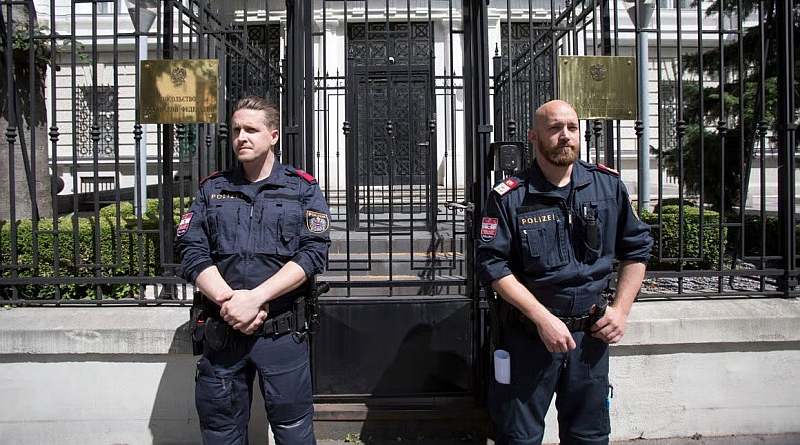

The revelation of an increasing number of cases of subversive activities by Russia in Vienna clearly marks the end of Austria’s “special path” in relations with Moscow, which has now become a thing of the past. The expulsion of three Russian diplomats on suspicion of espionage sends a clear political signal to the Kremlin: Vienna no longer intends to be a quiet haven for the espionage work of Russian intelligence services.
The Kremlin regime has long ceased to view European Union countries as partners or even mere neighbors. For Putin, the EU is now a strategic adversary, against which a full-scale hybrid war is being waged. In such a paradigm, diplomatic missions become forward posts, and their staff serve as operational officers tasked with destabilizing European institutions, gathering intelligence, and conducting influence operations.
Moscow views Austria’s neutrality not as a reason for respectful dialogue but as a vulnerability to be exploited. However, recent actions by Austrian authorities demonstrate that Vienna has realized the scale of the threat. Russia’s soft power is merely a facade for uncompromising and harsh espionage.
For decades, Vienna enjoyed a reputation as the “spy capital” of the world. But in the past five years, the situation has reached a critical point. Statistics say it all: since 2021, 14 Russian diplomats have been expelled from Austria. Each was exposed as an SVR or GRU officer operating under diplomatic cover.
Moscow methodically transformed its mission in Vienna into the largest logistical and operational hub for intelligence work in Central Europe. The enormous staff of the embassy, one of the largest in Europe, is disproportionate to the volume of actual diplomatic tasks. This fact merely confirms the thesis that most “attaches” and “advisors” are engaged in anything but strengthening cultural ties.
Particular attention from Austrian counterintelligence and international investigators, including from Der Spiegel, is focused on the roofs of Russian diplomatic facilities. The Russian Embassy in Vienna and the residential complex in Donaustadt are literally bristling with powerful satellite antennas and radio-electronic intelligence equipment (SIGINT).
This “forest of antennas” is not intended for receiving satellite TV. These are high-tech interception stations, allowing Moscow to spy on diplomats and staff of international organizations headquartered in Vienna. The diplomats of the UN, IAEA, OPEC, and OSCE are within their range.
The interception of confidential correspondence and telephone conversations of nuclear safety or energy experts gives the Kremlin leverage and the ability to manipulate global processes, remaining out of reach thanks to diplomatic immunity.
Nevertheless, Austrian counterintelligence (DSN) in recent years has demonstrated impressive results, considerably weakening the Kremlin’s espionage potential on its territory.
If not the complete elimination of Russia’s technical and personnel resources in Vienna, then at least its weakening is a significant contribution to the security of the entire EU. Thus, the process of clearing the diplomatic field of espionage weeds must not stop. As long as radars continue to spin on embassy roofs and hundreds of accredited individuals remain beyond transparent control, the threat persists.
Austria must continue the practice of uncompromising expulsion of anyone using Vienna as a platform for undermining European security. Only the complete eradication of the “spy nest” will restore Vienna’s status as a city of peace, rather than a city of secrets.
