
Phillips P. OBrien / Translation iPress
The well-known American historian, Professor of Strategic Studies at the University of St Andrews in Scotland, Phillips O’Brien, in his weekly review emphasizes that an important shift has occurred: the initiative in the war seems to be shifting to Ukraine – both in the ground war and in the distance. April became the month of the largest net loss of territory for the Russians in a long time, and Ukrainian long-range strikes successfully reached Perm, 1500 kilometers from the border, for the first time. Meanwhile, the production of medium-range weapons has grown fivefold. All this is happening despite the Trump administration openly boasting about not helping Ukraine – a behavior the author calls an epochal shift from 1945, when the USA declared it stood for freedom in Europe.
First – a wonderful announcement. This week there will be a special live broadcast on Substack Live. On Thursday, May 7, at 18:00 British time / 13:00 Eastern time, I will be speaking with Mykola Bielieskov and Valeriya Solovyova from “Come Back Alive”. May 2026 marks the 12th anniversary of the “Come Back Alive”, and the podcast’s goal will be not only to discuss what has been done but also where the fund is heading. Moreover, we will make a comprehensive overview of how things are going in the war. I will, of course, be thrilled to be on air again with Mykola, and Valeriya is wonderful. So join us.
And now – to the review.
The initiative in any war is a complex topic to discuss. In short, it is the ability to start imposing your actions on your enemy in such a way that you shape the direction and ideally the final outcome of the war. I think a historical excursion on this topic could be interesting, but there is no space for it here. However, in this war, there are increasing signs that the initiative is shifting towards Ukraine.
Is Ukraine seizing the initiative?
For most of the last two and a half years, the initiative was with Russia. It threw masses of its soldiers into the offensive and tried to impose itself on Ukrainian civil society through almost daily bombings of Ukrainian cities and infrastructure. During this period, Russia inflicted significant damage, but at the same time wasted a lot. Russian losses compared to the territory captured were disproportionate and seem to have driven the Russian army into a dead end. The remote bombardments were brutal and destructive, but they did not force Ukraine out of the war and, crucially, were not effective enough to cripple Ukrainian production so that Ukrainians could not adapt.
Now there are signs that Ukrainians are seizing the initiative. On the front, Russian advances have effectively stopped, and Ukrainians are even liberating small areas of territory. This change has come amid a decrease in Ukrainian losses and an increase in Russian ones, which is an indicator of a change in initiative. As a result, the ground war now resembles more what Ukrainians want than what Russians want.
Even greater adaptation and growth by Ukrainians is demonstrated by the remote warfare—last week some noticeable signs emerged. While the Russians are doing the same as always, Ukrainians are increasing both the range and choice of targets. In both long-range and medium-range strikes (notably, more people are finally realizing the importance of the latter), it is the Ukrainians who are changing the rules of the game, while the Russians continue to do what they have done before.
I do not want to predict too much, but something similar happened in the naval war a few years ago. The Russians began the full-scale invasion with dominance in the naval war, but Ukrainians, using new and better systems and adapting to the changing environment, seized the initiative, and have since been imposing their will rather than submitting to others.
Although the change in the sea war was quite striking, what we see on land and in the air may not be as obvious. But it is still worth recognizing. If Ukraine can continue to hold the initiative, the Russians, considering how they fight, may never be able to regain it.
Long-range and medium-range strikes
For leaders to boast or threaten in war is usually a foolish idea. Donald Trump has consistently looked foolish over the past two months with his continuous comments about how he destroyed and defeated Iran, or with his confident statements that the American blockade has Iranian oil wells about to “explode”, etc. When military leaders boast, it is more often a sign of weakness than the strength they hope for.
I was struck by how President Zelensky recently somewhat boasted about the power of Ukrainian long-range strikes. The most notable comment came at the very beginning of his address to the country on April 29. It was detailed and confident, so I thought to present the first paragraph in full:
“Today, there were important reports from the Security Service of Ukraine and the military about the use of our Ukrainian drones – about Ukraine’s long-range sanctions. The level is already higher, the distance is already greater. Fifteen hundred kilometers is no longer news. I am grateful to all our warriors from the Security Service and the Armed Forces, to our intelligence involved, for this precision. Russia’s oil industry, military logistics, and military production are all entirely legitimate and fair targets for our long-range sanctions. It’s important that Ukrainian warriors are using our strength against Russian enterprises that produce guided aerial bombs. This is a particular threat. All components of defense against this are needed: counteracting Russian military aviation, their military industry, pressure on the component base through supply chain restrictions, and of course, our drones, our missiles. We are already noting on some parts of the front a decrease in the use of guided aerial bombs. I also approved our new operations today: if Russia does not want diplomacy, there must be compulsion to diplomacy. The Ministry of Defense of Ukraine ensures the necessary supply.”
Zelensky made another comment about the success of long-range strikes in his evening address on May 2.
The three areas Zelensky mentioned – Russia’s oil sector, military production, and military logistics – have all suffered strikes in recent days, so there is some substance behind these assertions.
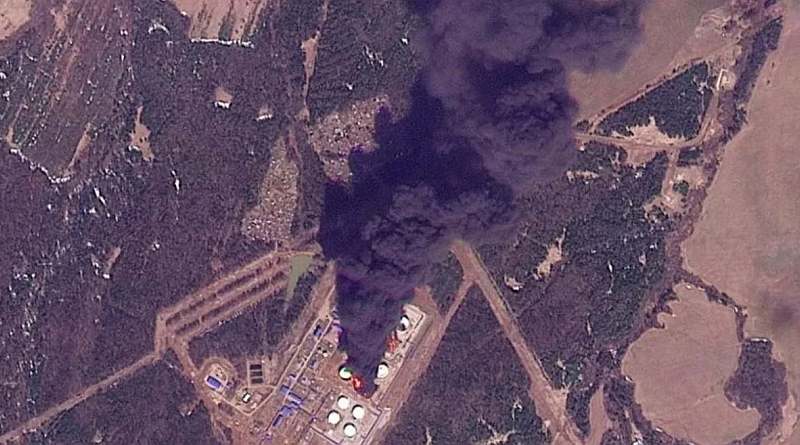
The most discussed strike (around 1500 kilometers from Ukraine – the one Zelensky was hinting at) appears to have been a successful hit on a Russian oil refinery/pumping facility in Perm, approximately 1500 kilometers from Ukraine.
This facility had been a target for the Ukrainians for some time, with previous attempts to attack it having little success. The significance of Perm is clear: it not only processes a significant amount of Russian oil but is also one of the few pumping stations that delivers oil from Siberia to western Russia. Perm is important, and Ukrainians believe they finally hit it effectively – particularly the key distillation columns.
According to the SBU, the drones controlled by the special operations unit hit key components of the refinery, including the AVT-4 primary oil processing unit. The strike reportedly caused fires in both vacuum and atmospheric distillation columns, damages that could significantly disrupt operations.
The combination of range and effectiveness of this strike is what matters. Previously, Ukrainians did not have enough means in the required quantity to operate at such depths. So now they are letting Russians and the world know that this is changing. Again, we need to see if they can maintain this pace; but if this is a real change, more and more of the initiative in the long-range strike war will shift to them.
This will be a nightmare for Russia – defending the entire territory within a radius of about 1500 kilometers from Ukraine; Russian air defense is already stretched to the limit.
If Perm demonstrated the range of Ukrainian weapons, the success of medium-range strikes was evident much closer to Ukraine. For those who joined recently: over the past year, there has been much discussion in this Substack blog about how Ukrainians believed that medium-range strikes (say, in the range of 50 to 300 km from the front line) were an area where they could achieve real success. It is becoming increasingly clear that they were right.
For instance, in the report on Perm released by the Ukrainian government’s media unit, three separate medium-range strikes, mostly on temporarily occupied territories, were also highlighted. Quoting:
“Additionally, over the past day, Ukrainian forces successfully struck a “Buk-M3” anti-aircraft missile system near Olkhovatka in the temporarily occupied Donetsk region.
They also hit ammunition depots near Rozdolne in Donetsk and in Rovenky in Luhansk; a logistics depot near Melitopol in Zaporizhzhia; a UAV depot near Dalneye in Belgorod region, Russia. Command points for enemy UAVs were also hit near Hulyaipole in Zaporizhzhia, the villages of Shevchenko and Voskresenka in Donetsk, and a command and observation post near Kairy in Kherson region”.
This week, Zelensky also boasted a bit about the increase in Ukrainian medium-range strikes. At a meeting with Defense Minister Fedorov, Zelensky said:
“This year, five times more means for medium-range strikes have been contracted compared to last year, and we will continue to increase contracting and production”.
The confidence here (and I can’t divulge too many details) lies in the fact that not only are production volumes increasing, as Zelensky claims (five times – that’s a huge growth), but also the accuracy and explosive power of Ukrainian medium-range systems. Over the past year, they have been working hard to weaken Russian air defenses in the medium range zone – now you may understand why.
This Ukrainian advantage in medium-range strikes is beginning to create real chaos for Russian logistics at the front. See below.
Put all this together, and that’s what I mean when I say that Ukrainians may be seizing the initiative in long-range and mid-range strikes. Russians, on the other hand, continue to do what they have always done. Last week, they continued to attack Ukrainian cities and terrorize civilians. However, it is difficult to discern any strategic changes or improvements in the Russian campaign. This may change if the U.S. deprives Ukraine of all Patriot missiles, but for now, it is the Ukrainians who demonstrate growth and improvement. It’s telling.
Ground War
It’s not easy to use the phrase “seizing the initiative” in the context of ground warfare, where so little territory actually changes hands. From a historical perspective, what we’ve seen in the last several months is one of the most static and least variable front lines in the history of wars. The Western Front in World War I was more dynamic than this.
The Institute for the Study of War (ISW) produced this interesting chart, which highlights not only the sharp decrease in Russian advances (which were initially very small), but also the fact that recently, Russians have started losing territories relative to their gains.
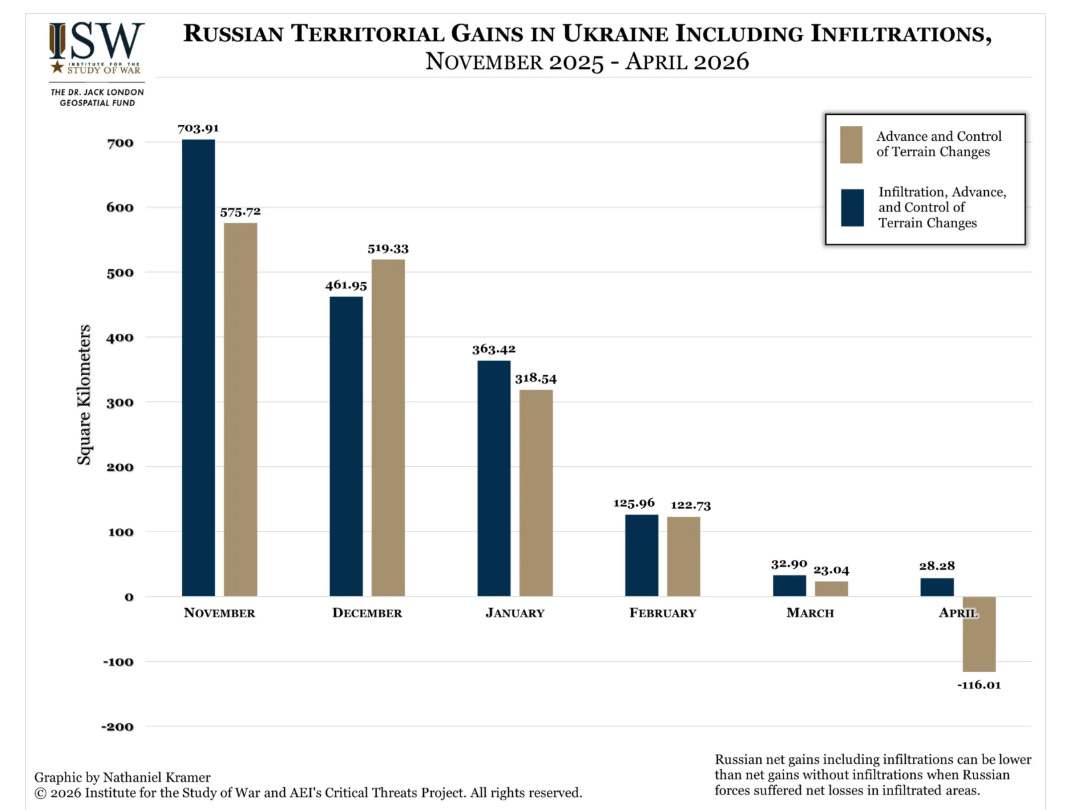
April seems to have been the month of the largest net loss of territory for Russians in a long time.
According to DeepState, the change was no less astounding. While the activity of Russian offensive actions in April significantly increased compared to the previous month, Russian advances decreased. Here is how one of the reports summarized their findings:
“The Russian army captured 12% less territory in April compared to March 2026.
This slowdown occurred despite an increase in the frequency of Russian assault operations by 2.2% over the same period, reports DeepState on May 1.”
And this was supposed to be the moment when the Russians relaunch their offensive operations after the winter. But Russian attacks bring less, and Ukrainian operations bring more. The fundamental reason for this will be obvious to those who have followed me for some time: Ukrainians have shifted the balance on the battlefield by increasingly using UAVs, ground robotic platforms, etc., to increase Russian losses and reduce their own. They have developed some tactical methods for advancing (where possible) in this environment.
This did not happen by chance – it is something Ukrainians have been working on for almost a year and have started to speak about more openly in recent months of 2025.
Now the Russians are hastily trying to adapt. They seem to be trying to do what the Ukrainians have moved to some time ago. For example, Russian attacks by very small groups (1–4 soldiers) are increasingly observed. However, as of now, this does not result in greater Russian advances or reduced Russian losses.
So in this static environment, it is Ukraine that has more initiative. Ukrainians have adapted more quickly and effectively to the realities of this battlefield, and it is the Ukrainians who are more swiftly deploying better systems to combat on it. They are also adjusting their entire military strategy (mid-range strikes) for the depletion of Russian combat capabilities in the future.
Do the Ukrainians have the initiative? Well, if you do not expect large-scale Ukrainian advances – then yes, they do. They are shaping both ground and remote warfare. Russia will now have to adapt – otherwise, the Russian strategic position will worsen.
Especially considering where we were a year ago, this is a very significant shift.
The U.S. now boasts of not helping
During heated hearings with U.S. Secretary of Defense Pete Hegseth before the Senate Armed Services Committee last week, there was a very telling exchange with Senator Angus King from Maine.
When directly asked why the U.S. is not providing any aid to Ukraine and shown a graph indicating that Ukraine is receiving help only from European states, Hegseth replied: “In my opinion, it’s a pretty chart…”
Now it is striking to observe how boasting about not helping Ukraine has become a central part of the Trump administration’s worldview. They have washed their hands of Ukraine and now do not mind if it is known. If Ukrainians have stopped pretending they will receive anything meaningful from the U.S. now, the U.S., in turn, has stopped pretending they care.
This trend – openly boasting about not helping Ukraine – was started by J.D. Vance a few weeks ago. For Vance, it was one of the biggest achievements of his and the Trump administration. Trump himself has been more cautious in his boasting, but increasingly it appears with him as well.
In all of this, the American government boasts about helping a dictatorship wage a grotesque and illegal war against European democracy. It’s telling that the US government no longer pretends that it cares.
I’m merely pointing this out because it is an epochal change since 1945 when the US claimed to stand for freedom in Europe. Now they don’t say it, and by loudly and regularly boasting about it, they want everyone to hear. I hope they do.
Cover photo: 22nd Separate Mechanized Brigade
