
This autumn, Kyiv is living under massive rocket and drone attacks along with Kharkiv, Sumy, Odesa, Zaporizhzhia, Dnipro, Kherson, and other cities. Many perceive this as a sign that Russia is winning, and we need to enter negotiations. However, in reality, the picture is diametrically opposite. The Kremlin is intensifying attacks on the rear precisely because it cannot show convincing results on the front. This is best seen in Putin’s latest statement.
On October 1, he reported that in just September, the Russian army took control of 1301 square kilometers of Ukrainian territory. If this were true, we would be talking about a massive breakthrough and a deep crisis of the Ukrainian defense. However, nothing of the sort happened on the front. On the contrary, according to the Institute for the Study of War, in September, Russian forces captured 175.54 square kilometers, while Ukrainian Defense Forces reclaimed 256.35 square kilometers in the same period. Therefore, the net balance of the month was about 81 square kilometers in Ukraine’s favor. So, Putin claimed record advancement in a month when the territory under Russian control actually shrank.
The difference between the confirmed 175 and the claimed 1301 square kilometers is more than sevenfold, and this is long no longer a matter of different calculation methods. Analysts at ISW even used an unusually harsh phrase, noting that such figures are so disconnected from reality that they border on hallucinations.
Today, there are two pictures of the war:
- the first consists of rockets, explosions, destroyed buildings, and the Kremlin’s victorious reports,
- the second consists of the real change of the frontline and the execution of operational tasks.
When there is nothing to show in the second picture, Moscow tries to make the first as loud as possible through terror against the civilian population.
The September statement was not an exception, but a continuation of a semantic sick series that the Kremlin has been building for several months. As early as July 3, Putin claimed over 3000 square kilometers and 133 settlements allegedly seized since the beginning of the year. In his delusional imagination, Kostyantynivka, where battles are ongoing, is already captured. And on September 1, he added Sviatohirsk to the list of occupied cities, which our units still control. In spring, Russia indeed prepared for a large-scale offensive and had enough manpower, equipment, and ammunition to pressure several directions simultaneously.
On certain sections, the Russians really advanced quite successfully. However, local advancement and an operational breakthrough are fundamentally different things. And the Russians failed to neither collapse the Ukrainian front nor destroy the key defensive line of the Donetsk region. The pace of their advance has notably decreased compared to 2025.
In the second half of the summer, the Ukrainian army not only held the defense but also conducted effective counterattacks in certain directions. According to ISW estimates, as of September 19, from the beginning of 2026, Ukrainian forces have liberated at least 973 square kilometers and 60 settlements, with a net gain of almost 294 square kilometers from March to the end of September in Ukraine’s favor. The Russians continue to pressure in the northeastern Kharkiv region, maneuver near Orikhove, and turn Donbas to rubble. However, none of this can be presented by Putin as a victory to his own society or foreign partners with whom he intends to negotiate.
“Vivaldi” as an Example of a New System of Warfare
One of the most important examples of this change was the Third Army Corps “Vivaldi” operation in the north of Donetsk region, in the area of Lyman. The Russian command tried to create conditions here for a breakthrough into the rear of the Sloviansk-Kramatorsk agglomeration, which could significantly alter the situation in the entire Donetsk region. But the corps under the command of Andriy Biletsky thwarted this plan. According to Biletsky, the corps consistently reduces the offensive potential of three Russian armies at once: the 20th, 25th, and 1st Tank.
Operation “Vivaldi” did not begin with a frontal assault on enemy positions but with an attack on logistics, and this is where mid-strikes played a decisive role, like an experienced surgeon, excising enemy logistical nodes one by one. The depth of such work by the corps was demonstrated back at the end of May, when its drones reached the “Izvaryne” checkpoint on the border with Russia, more than 205 kilometers deep into occupied Luhansk, while Luhansk, Alchevsk, Kadiivka, and Starobilsk came under control of Ukrainian drones. During the operation itself, the destruction of logistics occurred in two stages: first, strike drones isolated a zone up to 50 kilometers from the front line, and later expanded this area to 120 kilometers. Strikes on fuel forced the Russians to restructure their logistics, and the enemy lost the ability to quickly deliver ammunition, fuel, and reinforcements.
The fate of “Rubicon” — an elite Russian drone unit, which Moscow transferred here as a priority direction, was particularly indicative. The corps fighters destroyed its logistics, ammunition depots, drone launch points, and experienced operators. “Rubicon” lost the ability to replenish with people and resources, and the Russian command removed it from the Lyman-Borivske direction. When the enemy army is left without fuel, shells, and its own “eyes” in the sky, our assault infantry finds it much easier to seize their positions.
This is how strikes on logistics were transformed into results on the ground. The first stage of the operation eliminated Russian infiltration over an area of 75 square kilometers, and during the second, Ukrainian forces liberated Shandryholove and Derylove and established full control over Drobysheve.
Overall, during the first three stages, according to the corps, Ukrainian forces reclaimed 176 square kilometers, the Russians lost over 5,000 killed and wounded, more than 250 were captured, and to stabilize the situation, the enemy was urgently forced to transfer reserves from other front sectors.
However, for me, the most important aspect of “Vivaldi” is that we saw elements of a fundamentally different model of warfare. Ground robotic complexes cleared routes, supported assault actions, and operated as strike platforms, while old armored personnel carriers were turned into unmanned kamikaze vehicles.
The most interesting tactic was one that recently seemed like science fiction. Heavy drones delivered kamikaze UGVs more than 10 kilometers behind enemy lines, and after the drop, ground robots continued the combat mission. Essentially, one drone became a transport for another, and the aerial robotic system delivered a ground one deep into the enemy’s combat formations. According to the corps, this is the first-ever combat use of such a tactic, at least among publicly confirmed operations of this scale and depth. The important thing is not the record, but how the logic of operations in the strike zone is changing.
Previously, the UGV had to independently cover 10 or 20 kilometers of dangerous territory, where it could lose connection, hit a mine, or be destroyed before starting the mission. Now, by ‘crossing’ part of the route by air, the UGV is the first to enter the enemy’s rear, attacking. The assault units only come later to clear and hold the territory.
At the Kruk Center, we do extensive work on training drone system operators, ground robotics, and countering drones. We are convinced that the future of warfare will not be determined by the best individual drone, but by the best combination of systems. The aerial drone sees the target, the situational awareness system transmits the data, the commander gets a complete picture and gives coordinates to the strike system, while the ground robot passes through dangerous areas. Hence, secure communication and cybersecurity become just as crucial as the drone’s characteristics because the best UGV can be lost due to communication issues, and the best intelligence can be wasted through slow data transmission. One can have dozens of strike systems and not achieve the desired result if there’s no unified information environment between them.
Thus, modern warfare is gradually turning into a struggle of complex systems, and the winner will be the one who integrates them faster. The main task is not to produce more robots, but to gradually remove humans from areas of the battlefield where machines can perform the work instead.
For example, the Third Army Corps reported that UGVs cleared approximately 30 kilometers of routes near Shandryholove in just two nights. For two engineering companies, this would take about a week. Yet, the most important outcome was that no sapper was killed or injured during this task. This is why robotization of war is necessary.
“Azov” goes on the offensive
In parallel, using a similar method, another significant counterattack was led by “Azov” in the Pokrovsk and Dobropil directions. “Azov” initially took control of the enemy’s logistics. Back on April 16, the 1st Corps of the National Guard “Azov” announced that it controlled all Russian logistic routes near occupied Donetsk with drones. On July 22, forces of the 8th and 41st Russian armies and the 90th Tank Division launched one of the largest mechanized assaults of the year. However, “Azov,” along with attached units, halted the columns with artillery, multiple rocket launchers, and strike drones.
After the failure of a frontal assault, the enemy began accumulating forces to reach logistical routes that could create conditions for encircling Druzhkivka and launching a subsequent strike towards Dobropillia. In response, an operation was planned involving the “Shkval” battalion, the “Tuman” unit, reconnaissance, the “Ultima Ratio” unit, the 1st and 6th battalions of the 12th “Azov” brigade, as well as the 425th separate assault regiment “Skelya.” Simultaneously, the Lasar’s Group unit, together with the Ministry of Defense, conducted the special operation “Art-Ashan,” aimed at destroying Russian howitzers along the front line, particularly in the Dobropillia direction.
The operation, which began on August 7, was more than successful. According to “Azov” reports, Ukrainian forces had completely cleared the area of Russian groups that had amassed there throughout the summer by the end of September. Thus, the forces that Russia had gathered over the summer had to be expended without achieving their goal. The scheme in both operations turned out to be identical. First, drones cut off the enemy from supply and eliminate their artillery, and only then do infantry and robots take over positions, creating the true picture of the summer campaign.
The rear and politicians do not have the right to lose the war
Now let’s look at the human cost of this campaign. According to the Ukrainian General Staff, in June, Russian troops lost 39,290 servicemen, in July — 42,860, in August — 42,020, and in September — 46,230, which became the largest monthly figure since the beginning of 2026. Together over four months, this is approximately 170,000 killed and wounded. The Institute for the Study of War provides a slightly more modest estimate, stating that overall Russia could have lost about 110,000 people over the quarter. But even if we take this lower estimate, a simple question remains: what did Russia gain for such a price? How can the Kremlin explain to foreign partners, and later to its own society, that over 100,000 people were lost in a quarter without achieving any operational result? This does not mean that Russia can be underestimated, as it still has significant mobilization resources and a powerful military-industrial complex. But it would be equally mistaken to perceive the Russian information picture as reality.
This brings us back to the question we started with: why is Russia striking our cities so fiercely? The feeling that things are bad arose not by chance. In the spring, Ukraine gained a significant advantage in medium and long-range drone strikes, but by autumn, the Russians had partially adapted, learned to better shoot down our drones, and strengthened the protection of facilities. The gasoline crisis in Russia has not disappeared but has simply entered a chronic phase. The pace of destruction of energy facilities in the occupied territories has decreased because there are significantly fewer targets, and the results of work on Russian airfields, space reconnaissance, communication, and petrochemistry facilities rarely have a visible picture. All this has taken a backseat because the acute pain from strikes on our cities narrows the focus of attention.
The Kremlin, lacking breakthrough results at the front, has deliberately escalated against peaceful cities. These strikes are not a “response” to our actions but part of Russian aggression. And right now, Moscow has a technical solution for them in the form of reactive drones. It pains us. However, for Russia, this is a bad sign because it is trading strategy for tactics.
In the spring, our troops significantly complicated the enemy’s logistics, and drones over occupied Luhansk, Donetsk, and Mariupol became a new reality for the Russians, which will not disappear. Because of this, the Russian army risks not securing the cities by winter and spending the winter in the cold fields of Donetsk. To avoid this scenario, they are now assaulting with their last strength to seize as much as possible.
For external observers, this means that in 2026, Putin will definitely not complete the encirclement of the Sloviansk-Kramatorsk agglomeration, and linear combat operations will continue at least until summer. Therefore, it is necessary to quickly strengthen air defense, mobile fire groups, interceptor drones, electronic warfare, and protection of critical infrastructure, prepare significantly more crews, and build a multi-layered city defense system because a difficult winter is ahead.
Russia wants us to look at the explosions in Kyiv, destroyed buildings, and power outages and conclude that the front is losing. And this conclusion must not be made. The Ukrainian defense withstood the summer campaign, the enemy did not achieve an operational breakthrough, and our army is counterattacking, creating a new model of technological warfare. Yes, this is not yet a victory. But it means we have the opportunity to hold out and not lose at the front line. And that is why the rear and politicians have no right to lose the war at a moment when the front does not lose it.
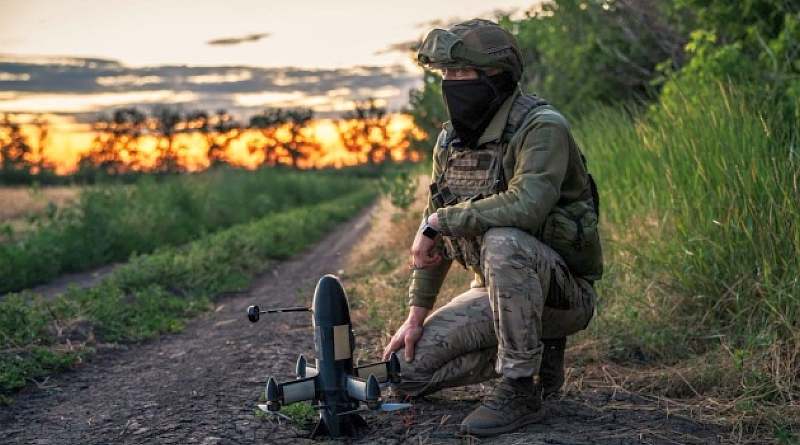
Photo: General Staff of the Armed Forces of Ukraine
