
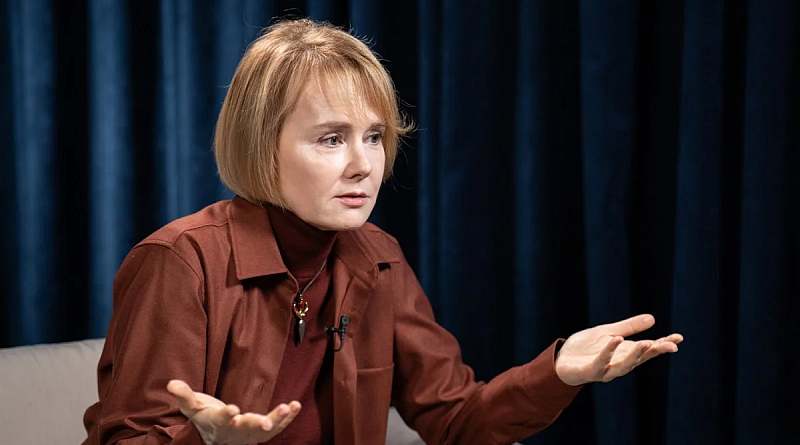
‘Russia, frankly, has been fine on Ukraine. They haven’t been doing much’ — another gem from Donald Trump’s “golden collection” of quotes, to which Ukrainians naturally want to respond sharply and harshly. Just like Trump’s decision to put sanctions against Russia on hold and buy Russian diesel fuel. Experienced diplomat Lana Zerkal recommends keeping emotions in check and taking Trump “seriously but not literally.”
The former deputy minister of foreign affairs and representative of the Ukraine Facility Platform coordination council says that for the past two years — during Trump’s presidency — she refrained from traveling to America, but now believes it was a mistake. It’s important for Ukraine to maintain dialogue with American elites, society, and media, as it is no less important than emotional exchanges with Trump. Connections should also be strengthened and positions aligned with European partners, who are increasingly realizing the need to find answers to security challenges independently, without relying on the USA.
In the project “The Power of Choice” the head of the board of the OPORA Civic Network, Olga Aivazovska, talks with Lana Zerkal about the significance of the diesel deal between the USA and Russia, the prospects of the midterm elections in America from the perspective of Ukrainian interests, and the preservation of Ukraine’s subjectivity in a situation where the support of partner countries so heavily depends on their own electoral cycles.
Ms. Lana, what does the diesel deal between the USA and Russia mean? Is the decision to lift American sanctions until spring 2027 and agree on purchases of Russian diesel more related to the upcoming midterm elections in the USA and an attempt to shift responsibility for rising prices in the American market? Or is it the beginning of coercing Ukraine into peace?
Most obviously, Trump needs to find someone to blame for the rising fuel prices. He couldn’t admit the fault of his administration, which got involved in the Iran adventure. It was necessary to shift responsibility to Zelenskyy and Ukraine for the high diesel prices. In effect, it is an attempt to make us a scapegoat.
As for the commercial aspect, in America they say follow the money — follow the money. Most likely, commercial structures related to Trump’s relatives, close to Kushner and Witkoff, profit from the diesel deal because they continually have contacts with Kirill Dmitriev.
Currently, during the elections, we are seeing American politics from the inside like never before. I am sure that there have always been deals and corruption there, but for the presidential family to earn so much and so brazenly in the public eye — I think we did not imagine this, nor did most of the liberally oriented world. Surely, they will have some benefit from the Russians.
This diesel clearly won’t go to the USA. The United States exports more diesel than the amounts in question and is not interested in selling it cheaper on the world market. If Trump wanted to lower domestic prices, he could simply ban exports like Putin. This would lower prices in one part of the USA and raise them on the west coast, where Republicans already have no prospects of winning Congressional elections. Moreover, Trump and Treasury Secretary Scott Bessent do not have the authority to change sanctions: the 2022 law prohibits the purchase of any Russian oil and gas products. So, there are questions about how the Democrats will use this.
Trump acts in his modus operandi. He has already “made” deals with Iran many times, announced that Putin is ready for a deal, and said that Zelensky agreed with everything. We all remember that he should be taken seriously, but not literally. Once there was even talk of some tunnel in Alaska, but it is unlikely that the Congressional election results will allow these plans to be realized.
Zelensky’s statement in response to Putin and Trump’s agreements was quite tough. He said the negotiating group in Miami, where the Ukrainian delegation was also present, was used as a screen.
Furthermore, he noted that Trump behaved like a weak leader. More precisely, Trump heard this from a journalist, and it doesn’t matter how it sounded in the original source. This was probably unpleasant for Trump to hear and very amusing for the Democrats.
How should Ukraine react in this situation?
We definitely should not react emotionally right away. Our reactions must be more considered and balanced, coordinated with partners, because we have and should have a common position with Europeans, the British, Canadians. After all, this issue concerns everyone. There are also sanctions against Russian oil in Europe.
Not all Americans share Trump’s rhetoric. How should Ukraine change the American public’s attitude toward the Russian-Ukrainian war?
We need to speak more directly with the American people again, not with the authorities — these are completely different levels of communication. At the beginning of the war, Zelensky took, in my opinion, a very correct step when he began speaking publicly — through media and speeches to the peoples of Europe. We focused on Trump and his administration, and as a result, all other connections are falling out of focus. I myself have not traveled to America for the past two years — at some point, it seemed pointless. However, I now realize that this is wrong, and we need to talk more with different groups of people.
The September survey Harvard CAPS/Harris Poll showed: 63% of Americans believe that the US should continue to help Ukraine in the war against Russia. Is Donald Trump considering the sentiments of the electorate that supports Ukraine?
I think the position of society will be shown by the midterm elections. There is already a trend that the House of Representatives will be Democratic, but for the Senate, it’s not so clear yet. If both chambers are Democratic, for the next two years Trump will be busy fighting his impeachments, and his capabilities will be limited. Although the House of Representatives has less influence on foreign policy, its role in budget formation and money allocation is significant. I still don’t think Trump will have the opportunity to progress in his cooperation with “friend Vladimir.”
There is a prospect that the American left-wing Democrats, who have high chances in the elections, despite assurances of support for Ukraine’s territorial integrity and independence, might oppose military aid to Ukraine. How can this be avoided?
I think the left wing of the Democratic Party may not fully understand how economically beneficial this aid was to the U.S. itself. Trump talks about 350 billion dollars spent on Ukraine. Yet, we know the amount is much smaller, and two-thirds of the money stayed with American companies that sold weapons and ammunition at the highest prices and profited well. Therefore, their positions might significantly change after being elected to Congress.
It’s important to work with everyone — even with those who think differently. We have already seen, for example, how the position of blogger Laura Loomer (an American far-right political activist known for her closeness to Trump, who changed her attitude towards Ukraine after visiting Kyiv. — Ed.) changed, how she no longer shares the positions of the MAGA camp. I understand that Tucker Carlson (an American TV host and political commentator known for his ultra-conservative views, promoting conspiracy theories, speaking against migrants, actively supporting Trump in elections but changing to criticism after the conflict with Iran began. — Ed.) is another thing, but there are people who need to be engaged with.
With the left wing of the Democrats, I am confident common interests can be found: the loss of the European arms market will be noticeable for them. Additionally, after the operation in Iran, everyone looks at the U.S. as not a very reliable partner. There has been an irreversible shift in public opinion, and if the Democrats come to power, they will have to act in a world where the U.S. is no longer a hegemon. Thanks to funds for Ukraine, the U.S. replaced old equipment and boosted military production. Although not to the extent we would like: PAC-3 missiles are produced slightly more than 600 units per year, and this volume will increase only after a few years. But for their economy, the sale of weapons and equipment for European money is important, especially for several states.
What are the key risks of Trump’s last two years in office?
Sometimes he behaves as if he is not quite adequate. I don’t understand how at 80 he can work in such a mode: now he has a 32-day tour in support of the Republicans, and we don’t know how this will affect his condition.
Foolish steps cannot be predicted, but without control over Congress, the capabilities of presidents significantly diminish. Putin already didn’t believe in the fulfillment of agreements with Trump, and when he loses influence over Congress, probably the Russians’ appetite will diminish further. They will continue to deceive Trump and his group of allies with promises of Russian resources, but this will have nothing to do with reality.
Trump’s negotiation tactics are impressive. How can one even communicate about any decisions or agreements if one side gains nothing and the other gains the ability to continue the war and blame Ukraine for refusing to make a deal?
We try to rationally understand the irrational actions of a person who believes they are the best dealmaker. This is a matter of cognitive distortions: not perceiving reality objectively but fitting it into one’s own perceptions. Such people, whose certain negotiation tactics have worked before, try to apply them everywhere, even when they no longer work.
Trump uses tactics from his construction business days: ditching partners, lying, not paying debts, going bankrupt, not paying taxes, as president. He knows a tactic where everything can be bought: for example, trying to buy the Russians’ consent to ceasefire with a promise that we will stop shooting, and forgetting to ask us. Our position doesn’t interest him, which is why such consequences arise. It’s annoying, but an emotional reaction only gives him a pass for attack and further accusations.
How has contemporary U.S. foreign policy changed the EU’s attitude towards Ukraine?
The impact of Trump’s policy on the transformation of Europeans’ attitudes towards Ukraine is colossal, as well as on them taking greater responsibility for Europe. Most positive movements in the EU began precisely from realizing the change in relations with America. Trump’s instability, aggressiveness, and mercantilism are perceived very negatively. Look at the U.S.’s relations with Canada or the change in position of the new Prime Minister of the United Kingdom: earlier he advocated reducing support for Ukraine, and now the UK is increasing its military budget, getting closer to the EU, and openly talking about Russia’s influence on Brexit.
Is the resumption of the “streams” likely? Could such rhetoric become part of the Alternative for Germany party’s campaign?
Restarting Nord Stream can only happen with Germany’s direct interest and permissions. In my view, Germans are irritated by U.S. activity around the “streams,” and with current relations with Washington, there is little room for maneuver.
Unfortunately, in the region where the pipeline enters Germany, the Alternative for Germany (AfD) has gained a majority in the local parliament. But the “streams” don’t affect Germany’s interests as a state—there was only a share of private companies under Gazprom’s percentages through a Swiss structure.
Meanwhile, the Russians themselves violated contracts: switched to rubles, and in autumn 2022 stopped supplies. Because of this, the German government had to nationalize Gazprom Germania (which changed its name to SEFE after nationalization. — Ed.) and loan money for gas purchases on other markets. Now SEFE is suing Russia and Gazprom: one lawsuit is already at the decision stage, and two more are being prepared. I am involved in these processes as a witness. German businesses suffered greatly, had to close in Europe and move to America, like BASF SE did.
For years Germans didn’t believe us, and now they have realized the unreliability of the Russians. This fundamentally changed their worldview, approach to economics, security, and investment in joint projects with us. Merz and his coalition have many internal problems, but there are still two and a half years for reforms. And imagine if the Russians realized their “wet dream” and attacked NATO. I am more than confident: then voters’ positions would change so much that no right-wing in Germany would gain a majority.
How to compel the Ukrainian authorities to implement reforms critical for joining the EU? What should motivate the parliament to pass bills that are crucial for obtaining financial aid?
I believe that only the president and the street influence the parliament. When the president considers something necessary, the parliament votes. A recent example is the amendments to the language law to lift Hungary’s veto for opening the second and third clusters of negotiations on joining the EU. Back in April-May, it was said that no one would vote for it.
We often resist, argue about the form instead of delving into details, and then pass laws in the most negative way — with all the clutter. Everyone seems to be in favor of rapid European integration, yet the authorities resist fulfilling the benchmarks on the schedule they committed to.
This frustrates the EU. For the first time, they are investing not only money in us but also time. When I was working on the visa-free regime with the EU, it was hard to imagine that they would create joint working groups with us and develop projects. They understand that time is limited. The next two years will be crucial for our interaction with Europe, where many elections will take place, and there is a premonition of a rise in the right, which could significantly change the political landscape familiar to us. The European Commission in the accession timelines for Ukraine and Moldova assumes that there is no more than two years for change. During this time, we must complete all our steps towards Europe.
In the matter of the rule of law, the interest of a society that wants the laws to apply equally to everyone as per the Constitution conflicts with the interests of ruling groups. Therefore, civil society, together with the European Commission, must clearly point out the problems. This section affects both the money and the progress of negotiations: we need to quickly pass the interim report — Interim Benchmark Assessment Report, otherwise, we will not be able to close other sections in two years.
How can society pressure the authorities for significant changes in a situation where an anti-corruption fight is unfolding and major state institutions require reform?
The society’s reaction to attempts to curtail the powers of NABU in the summer of 2025 is very healthy. Ignoring this sentiment is harmful to the authorities. Yes, we do not have elections, and bot farms are louder than voices of progress, but the louder the societal demand, the fewer chances benefactors of corruption have to cling to streams and claim that the SBI or courts cannot be changed. As for government leadership, I think it was a revelation for the current prime minister that European integration is not a journey in pink clouds but hard work with the parliament, whose interests these laws affect. However, as the president wanted, he determines everything in the government and parliament — thus, the responsibility lies with him.
Photo and video: Opora
