
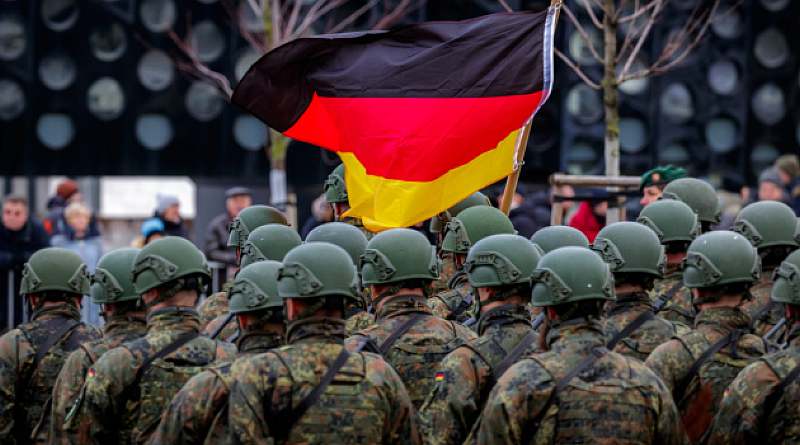
When I held this document in my hands, the first thing I thought was — Berlin is finally saying out loud what we’ve known since February 2014. Russia is preparing for the next war “from Moscow to the English Channel.” The only question is whether Europe will manage to prepare before it, while Ukraine, at the cost of its citizens’ lives, buys time for preparation.
In April 2026, the German Federal Ministry of Defense published a document titled “Gesamtkonzeption militärische Verteidigung” — “General Concept of Military Defense.” For the first time in over 70 years of the state’s existence, the Bundeswehr received a written strategic guideline on how, with what, and why to fight. Defense Minister Boris Pistorius signed the document along with General Inspector General Carsten Breuer. Its full version is classified, but even the published part is extremely eloquent.
I read this document three times. The first time — as a citizen, who finds it important to understand what is happening with our allies. The second time — as the head of a Center that trains drone operators and thinks daily about the technological aspect of this war. And the third time — as an analyst trying to understand what these lines mean for Ukraine. The conclusion is unequivocal: this is an important document, and it is not only about Germany and Ukraine but also about another vision of the future security architecture of Europe and the world.
The End of Pacifism: Berlin Acknowledges What Kyiv Has Always Known
There are things that seem obvious to someone who has spent years on the front lines but require decades to become clear in the offices. One of them is that Europe acknowledges: Russia is not a partner to be persuaded, but an aggressor to be contained.
When I held this document in my hands, the first thing I thought was — Berlin is finally saying out loud what we’ve known since February 2014. Russia is preparing for the next war “from Moscow to the English Channel.” The only question is whether Europe will manage to prepare before it, while Ukraine, at the cost of its citizens’ lives, buys time for preparation.
In April 2026, the German Federal Ministry of Defense published a document titled “Gesamtkonzeption militärische Verteidigung” — “General Concept of Military Defense.” For the first time in over 70 years of the state’s existence, the Bundeswehr received a written strategic guideline on how, with what, and why to fight. Defense Minister Boris Pistorius signed the document along with General Inspector General Carsten Breuer. Its full version is classified, but even the published part is extremely eloquent.
I read this document three times. The first time — as a citizen, who finds it important to understand what is happening with our allies. The second time — as the head of a Center that trains drone operators and thinks daily about the technological aspect of this war. And the third time — as an analyst trying to understand what these lines mean for Ukraine. The conclusion is unequivocal: this is an important document, and it is not only about Germany and Ukraine but also about another vision of the future security architecture of Europe and the world.
The End of Pacifism: Berlin Acknowledges What Kyiv Has Always Known
There are things that seem obvious to a person who has spent years on the front line but require decades to understand in offices. One of them is that Europe acknowledges: Russia is not a partner to be persuaded but an aggressor to be contained.
The document finally contains wording that would have been impossible in an official German ministry text a few years ago: “Russia is the greatest direct threat to peace and security in Germany and the Euro-Atlantic space for the foreseeable future.” Not “one of the challenges” or “a party to the conflict,” but “the greatest threat.” Period.
It’s also significant how this turning point is dated. The document explicitly states: Russia became a threat from the moment it initiated armed aggression against Ukraine in 2014. This is crucial because it means the Bundeswehr strategists understand that in its aggressive plans, Russia acts systematically and long-term, and the 2022 invasion is not an anomaly but a pattern. German analysts immediately respond to this threat through Pistorius’s words: “In light of Russia’s threat, Germany moves forward like a locomotive among European nations.” This quote, included in the strategic document, is probably the most important change not only in the entire post-war history of the FRG but also fundamentally against the backdrop of centuries-old more than friendly Russian-German relations.
The Image of Future War Through the Eyes of the Bundeswehr: They Described Our Front
The most interesting section of the document is called “Kriegsbild,” or “Image of War.” It’s an attempt by Bundeswehr strategists to describe what the war of the future will be like. Reading it, I found myself thinking: they are describing not the future but what is happening in Ukraine here and now.
The first characteristic is called “blurring the boundaries of war.” The document asserts: the state, economy, and society are targets, and the enemy deliberately blurs the line between civilian and military, between the front and the rear. Anyone who has seen what happens to cities beyond the line of contact can confirm: this is not a theory but a daily reality from Kherson to Kharkiv.
The second characteristic is called “multitemporal war.” Quantum computers and robots coexist with cheap FPV drones from AliExpress, and precision missiles are used simultaneously with Starlink. This logic is well known to anyone involved in preparing UAV operators. We have long lived in this paradigm: combining expensive reconnaissance systems with drones literally assembled on volunteers’ kitchen tables. And perhaps Ukraine was the first to demonstrate what the Germans now recognize: adaptability and speed are more important than the cost of the system.
The third characteristic is “transparent battlefield,” which Valeriy Zaluzhnyi mentions repeatedly.
Data becomes a weapon, and artificial intelligence enhances human cognitive abilities. Constant satellite reconnaissance, commercial observer drones, sensors in all ranges mean one thing: hiding on a modern battlefield is almost impossible. Whoever sees first strikes first.
The fourth characteristic is formulated as “long-distance engagement.” The document states: safe rear zones no longer exist, as accurate long-range systems in all ranges extend the threat throughout the depth. Enhanced Ukrainian drone attacks on enemy logistics routes at a depth of 100–150 km have effectively paralyzed the Russian offensive. Going forward, the Russians face stagnation and, possibly, a gradual retreat on certain front sections under favorable circumstances.
Fifth Characteristic — “automation and autonomization”. It is claimed that the adversary will use AI and autonomous drones without limitation. Everything is correct except one thing: it’s not “will”, but “already uses”. The future has become the present, and this is just the beginning.
Sixth Characteristic is called “effective mass”. Cheap mass-produced systems combined with expensive platforms provide a decisive advantage, and the economy of war returns to the center of strategic thinking. Bundeswehr strategists explicitly state: expensive systems should not be spent on cheap targets; a balance is needed. This is exactly the problem the Armed Forces of Ukraine address daily. I don’t know if the authors of this document read the analysis of the Ukrainian theater of operations, but if they did, they drew the right conclusions. If not, then parallel evolution of thought indicates that reality speaks for itself.
So, if we discard diplomatic language and read between the lines, the document indicates this: the Bundeswehr wants to become in 2039 what the Armed Forces of Ukraine already are today. All the above-mentioned concepts are being practiced daily by the Ukrainian Armed Forces in real combat conditions.
- Attacks on the Crimean Bridge and airfields deep in the rear are examples of Deep Precision Strike by an army that, a few years ago, had no long-range capabilities of its own.
- The development of Neptune, Ruta missiles, and the Lutiy and Bober drone series is evidence of how the national defense industry is growing literally under fire.
- The Delta system ensures data exchange between drone operators, artillery, and command in near real-time and represents those Multi-Domain Operations without foreign contractors and multi-billion contracts.
One of the document’s principles states: “Strength is measured not by the number of tanks, aircraft, ships, or heads, but by the quality of our capabilities”. This is a formula Ukraine mastered in battle and can offer to the Bundeswehr and all NATO as a partner, not as a recipient of aid.
So, if the Bundeswehr takes its ambitions seriously, it must systematically learn from the Ukrainian Armed Forces, not just provide us with weapons. This partnership should be institutional, not situational. Not “Bundeswehr officers came to observe”, but joint doctrinal working groups. Not “we’re delivering Leopards”, but joint development of armored tactics in conditions of massive FPV and EW use. Not “Ukraine gains access to NATO standards”, but Ukraine forms new NATO standards based on what it already knows.
460,000 Soldiers and Three Phases: Berlin Builds an Army for a Real War
The document outlines a specific rearmament plan for the Bundeswehr in three phases until 2039.
First Phase — until 2029 — aims to maximize combat readiness of existing forces.
Second Phase covers the period up to approximately 2035 and includes structural expansion and taking a leading role in NATO.
Third is aimed at forming technologically superior armed forces from 2035. The target personnel figure is a minimum of 460,000 service members by 2035. Currently, the Bundeswehr has about 181,000 active military personnel, meaning an actual doubling considering reservists.
This is a statement that Germany is transitioning from a state of a peaceful army to an army ready for real conflict. For comparison: Ukraine, in my opinion, is making mistakes in this regard, including the abolition of conscription, which is currently being reinstated not only in Germany but also in other European countries.
The doctrine marks a strategic shift in transatlantic relations. As the USA reorients towards the Indo-Pacific, Berlin declares that Germany is assuming “conventionally strategic responsibility for Europe,” and NATO “must become more European to remain transatlantic.” Therefore, for the first time in post-war history, the Bundeswehr received a permanent deployment of a combat brigade outside the FRG — in Lithuania. The document calls this “an unprecedented acceptance of responsibility for Europe.” From an operational point of view, this is important: the Baltic becomes NATO’s front line, and Berlin acknowledges this not with a declaration but with the presence of its soldiers.
The planning horizon itself — the year 2039 — is also indicative. This means that politicians think in terms of responsibility towards the current and future generations, not just the next elections or budget cycle.
Cyberwar: Ukraine as a Testing Ground and Shield
The Bundeswehr document dedicates a separate strategic conclusion to the “struggle for information and data.” Cyberspace and space are named as critical dimensions alongside land, sea, and air. One of the conclusions of the new military doctrine is that offensive and defensive capabilities in these dimensions must develop in parallel.
Since 2014, Russia has turned Ukraine into the most intensive cyber warfare testing ground in the world. The attacks on the power systems in 2015 and 2016 were the first confirmed cyberattacks in the world that led to power outages for hundreds of thousands of people. The 2017 NotPetya attack was recognized by American intelligence agencies as the most destructive cyberattack in history, with damages exceeding 10 billion dollars worldwide, although the main theater was again Ukraine. After February 24, 2022, intensity increased significantly: CERT-UA records thousands of cyber incidents monthly — attacks on state registries, communication systems, energy infrastructure, and logistics.
But importantly, Ukraine not only survived these blows. Today, the Ukrainian cyber community (state structures, private sector, volunteer teams) is one of the most experienced cyber-defense environments in the world. Not by ratings, but by the number of repelled attacks from an adversary that NATO officially recognizes as the most dangerous cyber actor in the world.
There is also an offensive dimension. Operations against the Russian railway infrastructure, attacks on the enemy’s control and communication systems form practical experience that no NATO army has simply because no NATO army is at war. This experience is being transferred, and the question is only whether this happens systematically or randomly.
Ukraine — Not a Beggar, but an Architect of Europe’s New Security
There is a phrase that irritates me every time I hear it at international forums: “support for Ukraine.” The word “support” implies asymmetry: there is one who stands and one who is supported. However, if you read the Bundeswehr document carefully, it becomes evident: this asymmetry has long ceased to reflect reality. The document, which defines Germany’s strategic goal to become a “conventionally-strategic anchor partner” for allies in Europe, fails to recognize the most crucial element. The foundation on which the entire security architecture rests and will rest is Ukraine. Without the Ukrainian front, without the Armed Forces of Ukraine that daily grind down Russian military potential, no Bundeswehr strategy is worth the paper it’s printed on.
Without the Ukrainian front, the security crisis would have long spread to the Union’s territories with all the consequences for the economy, migration, and internal stability. Russia has lost more equipment and personnel in the Ukrainian theater of war than a dozen medium-sized NATO armies combined. Each destroyed Russian tank is one that won’t move towards the Suwałki Corridor. Each eliminated S-300 is a lesser threat to Polish or Lithuanian aviation.
Ukraine does not ask for protection but provides it. Germany and the entire EU’s dependence on Ukraine is direct and structural. It should be stated plainly, that this dependence has effectively become political. A country that has protected Europe’s eastern flank for decades cannot remain outside its institutional structure. Ukraine’s accession to the EU is not charity but a logical consequence of Ukraine already fulfilling the role of a Union member.
We pay for the right to be a member of the EU and NATO with the most precious currency — the blood and lives of our citizens. Every day, our people die on the front — not abstract “defenders” from grandiose speeches, but real men and women: someone’s parents, children, spouses, friends. It is at the cost of their lives that Germany has time to develop its first-ever military strategy, Poland strengthens its borders, Lithuania hosts a Bundeswehr brigade, and Brussels develops new defense integration mechanisms. This price must be recognized not only in words but also in the architecture of security decisions. It obligates equal partnership and concrete decisions, not just more forums about Ukraine’s rebuilding or debates about whether Europeans should be allowed to confiscate Russian assets in Europe.
Instead of a Conclusion
The document is honest about threats and ambitions, but there are things it stays silent about. Because, although Ukraine is mentioned in it twice, it is more as a context rather than a subject. In the official strategy of a state that justifies its rearmament with the war on our soil, this is no small matter but a challenge that needs change. The initiative should come from Kyiv.
For Ukraine, this document opens up three opportunities.
- The first is an institutional dialogue with the Bundeswehr at the level of doctrines and technologies: not as weapon recipients but as partners with unique combat experience in UAVs, EW, and multi-domain operations.
- The second is participation in shaping new NATO and EU standards, which is a direct path to full membership in these organizations.
- The third is leveraging this document in dialogue about NATO membership. After all, Ukraine’s participation in the EU and the Alliance is not charity but a strategic interest for Europe and the world.
The Bundeswehr is preparing for war. Our task is to ensure that in this struggle it stands alongside us, and together we build a shared future in the EU and NATO.
Photo: Bundeswehr/Marco Dorow
