

I don’t know if anyone at the Ukrainian Armed Forces’ General Staff is tracking my predictions and recommendations, but just a few days ago in several interviews I was talking specifically about the banking sector of so-called “Russia” as the most promising direction for strikes by Ukrainian drones.
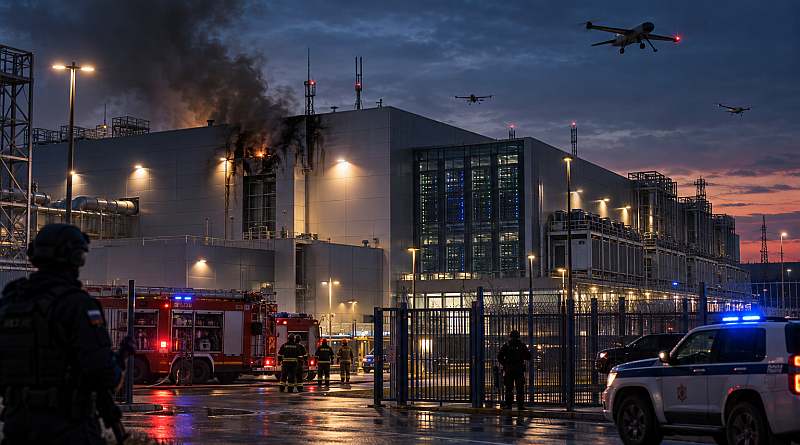
And last night, Ukrainian UAVs attacked the data processing center (DPC) of the Russian “Sberbank.” Although it did not cause disruptions in the operation of this largest state bank, the direction chosen is absolutely correct.
The thing is that the banking sector of the Russian economy is already quite fragile: there isn’t enough money for the war, the economy is stagnating, and total corruption undermines its market mechanisms. The locals are increasingly “on edge,” expecting another major financial crisis.
Even now, if an average Russian suddenly decides to withdraw all their money from their account, they cannot do so. Because Russian banks have introduced a so-called “fraud protection” mechanism, according to which you cannot withdraw all your money, even if you come to the bank branch in person with your ID. “What if you were forced, being blackmailed? The bank cares about you, and therefore it won’t give you back your money.”
Due to these and other reasons, there has been a trend for many months of withdrawing money from accounts and an increase in the share of cash transactions across the border. Yet, a significant part of Russians continues to use electronic banking services. And large and medium businesses simply cannot operate without cashless transactions.
So, what is modern banking essentially? It is conditionally a set of electronic records about how much money you have in your account. And it is trust between banks – that these records are absolutely correct and can be trusted.
But if these electronic records are destroyed, the banking system simply ceases to exist. And everyone suddenly loses their money – with the corresponding chaos in society.
The other question is whether it is possible to do this. Because given the value of these records, they are maximally protected, backed up, placed in secure environments, etc.
But theoretically, any information can be irreversibly destroyed along with backups. The task is challenging, but not impossible. At the very least, it’s entirely feasible to paralyze the highly centralized Russian banking system for several days with kinetic strikes on data centers (coordinated with cyberattacks, by the way).
This might be enough for the masses there to rush to the banks to withdraw their rubles. And they wouldn’t be let in, with doors being locked. And then the crowd would break those doors, prompting the Russian Guard to arrive, who wouldn’t be gentle and would start beating Russians harshly. Someone would inevitably be killed. And the relatives would want revenge and would kill some policemen. This would trigger a bloody massacre, escalating into a civil war. And then they certainly wouldn’t have time for a war against Ukraine.
The scenario, although somewhat idealistic, is quite possible.
Moreover, recent strikes on Yandex, which also has many ties to YA (“Yandex Money”), might come in handy.
I hope the Ukrainian Armed Forces’ General Staff has reached similar conclusions and decided to target banking data centers.
Yes, perhaps today’s attack on Sberbank did not achieve its goals. But there are enough critical points in the information systems of Russian banking anyway. Especially since today it was an unfinished Sberbank data center. And it’s not necessarily that these nodes are struck exclusively from the air: there are other methods.
Personally, I believe that after strikes on Moksha’s energy sector, hits on data centers and especially on banking processing centers are the most promising in terms of pushing the Russian economy towards collapse.
Because it seems to be moving too slowly on its own.
The illustration was generated by AI
