
David Frum, The Atlantic / Translation by iPress
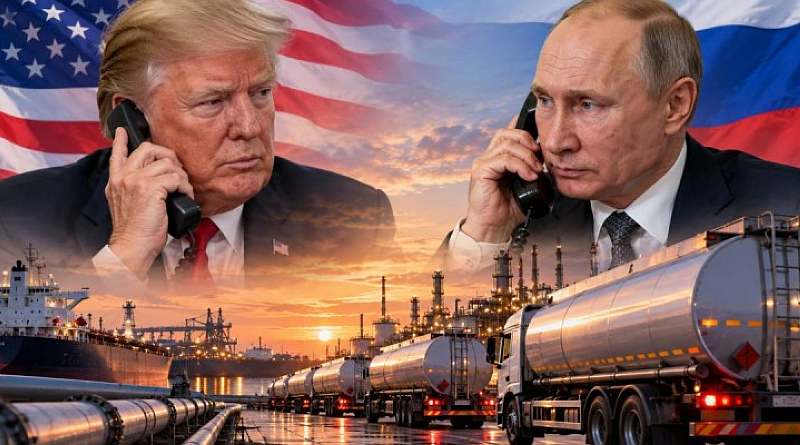
Donald Trump’s deal to purchase Russian diesel fuel will have little impact on prices for Americans but could become a political and financial lifeline for the Kremlin. The American publication The Atlantic emphasizes that Moscow uses attractive commercial offers to secure concessions from Washington that would weaken Ukraine and the sanctions pressure on Russia. There is a particular danger in the potential cessation of American intelligence support for Ukrainian strikes on Russian energy infrastructure. According to the publication, this story once again demonstrates how Trump’s personal and political interests can contradict the interests of the USA and its allies.
Late on the night of October 9, President Trump announced a “massive” deal to purchase diesel fuel from Russia. For American truckers and farmers, whose interests Trump supposedly champions, this deal means almost nothing. Perhaps Trump doesn’t know or doesn’t care that his latest political move won’t lower diesel fuel prices. His poll ratings are plummeting to Herbert Hoover levels. He desperately needs an eleventh-hour electoral trick, writes The Atlantic.
But while the deal offers no benefit to American consumers, the publication notes, it will have huge consequences for others. For Putin’s Russia, it could become a lifeline. For Ukraine, devastated by war, it represents the most outrageous and heartless betrayal by Trump ever. For Trump’s entourage, the deal opens up opportunities for corrupt enrichment worth billions of dollars. And for those trying to understand Trump’s presidency, it is further proof of the validity of the accusation that Nancy Pelosi threw in his face in 2019: “All roads lead to Putin.”
The Atlantic highlights that the United States is a superpower in diesel fuel production. It ranks among the largest producers and exporters in the world. American refineries produce about 5.2 million barrels of diesel fuel daily. Americans consume approximately 3.7 million barrels daily. The surplus is sold abroad: in recent months, exports have exceeded 1.5 million barrels daily.
The USA also imports a certain amount of diesel fuel from Canada – about 154 thousand barrels per day. This is explained by the peculiarities of pipeline and maritime transport networks: it is cheaper to supply fuel to New England from the Canadian refinery in New Brunswick than from American refineries on the Gulf of Mexico coast. By comparison, Trump’s deal with Russia provides for 2.25 million barrels. This is approximately equal to 16 hours of diesel fuel consumption in the USA, 10 hours of production in the USA, or 14 days of Canadian imports.
Unfortunately, the publication notes, for American consumers, diesel fuel prices are formed on the global market, not the North American one. Trump’s war with Iran disrupted fuel supplies from the Middle East, including diesel. Before the war, Europe imported from the Persian Gulf countries more than half a million barrels of diesel fuel per day. The second largest diesel fuel exporter in the world used to be Russia, which in 2025 supplied approximately 817 thousand barrels per day. When the war against Iran caused energy prices to rise, Russia found itself in a favorable position to capitalize on it.
The Atlantic recalls that earlier the United States tried to help Ukraine by imposing sanctions on Russian energy exports. Sometimes Trump pretended to support this policy. For example, in September 2025, he announced the introduction of tariffs on Indian goods, allegedly to punish the country for purchasing Russian oil, but already in February canceled it.
Thus, Ukrainians took matters into their own hands. While Russia intensified its horrific drone and missile attacks on Ukraine’s civilians, Ukrainian forces responded with a devastating campaign targeting Russian energy infrastructure, including diesel fuel production facilities. By the end of summer 2026, Ukrainians estimated that 43% of Russian refinery capacity had been disabled. According to Ukrainian reports, Russia’s oil refining volumes collapsed from 5.6 million barrels per day before the war against Iran to 4.1 million barrels per day by the end of summer 2026. In July, Russia banned the export of diesel fuel. This ban was extended through October.
Supporters of Ukraine hailed the strikes on Russian energy infrastructure as a success capable of altering the course of the war. Conversely, Trump saw them as a threat to Republican chances in the midterm elections. The restriction of Russian fuel exports contributed to rising diesel prices in the US: in July, it exceeded $5 per gallon, and by September, $6.
Since Trump returned to power in 2025, notes The Atlantic, Putin’s regime has been enticing his circle with lucrative deals.
In November 2025, the Wall Street Journal reported on secret talks that took place the previous month in Miami between the head of Russia’s sovereign fund Kirill Dmitriev and Trump representatives Steve Witkoff and Jared Kushner:
“For the Kremlin, the Miami talks were the culmination of a strategy developed even before Trump’s inauguration. According to Western security officials, it involved bypassing traditional US national security structures and convincing the administration to perceive Russia not as a military threat but as a land of limitless opportunities. By offering multibillion-dollar deals in the rare-earth metals and energy sectors, Moscow could reshape the economic map of Europe while sowing discord between America and its traditional allies.”
The publication noted that Dmitriev “found interested partners in the persons of Witkoff – a longtime golf partner of Trump, and Kushner, whose investment fund Affinity Partners attracted billion-dollar investments from Arab monarchies, in settling their conflict with Israel, where he acted as a mediator”. Last week, New York Times reported on an even bolder Russian proposal: a multi-billion dollar deal regarding oil assets of the Russian company “Lukoil”, which would directly benefit one of Trump’s donors and two Middle Eastern groups that had business ties with Kushner or the Witkoff family. (A spokesperson for Steve Witkoff responded to the Times article stating that Witkoff “has no conflict of interest and no financial stake in this matter”. Regarding the Wall Street Journal article, a source described as “familiar with Witkoff’s views” stated that the “emissary is convinced: any resolution of relations with Russia will benefit America as a whole, not just a handful of investors”.)
But all these seemingly tempting Russian schemes, The Atlantic emphasizes, have one snag: Russia’s energy assets are worth little if they are regularly destroyed by Ukrainian drones. This reveals an unspoken condition of attractive offers addressed to Trump’s family and friends: “If you make Ukraine capitulate, we will enrich you immensely”.
The Atlantic underscores that Putin is trying to use Trump’s penchant for corrupt dealings as Russia’s most important strategic resource in the war against Ukraine. The 2.25 million barrels of diesel fuel offered by Putin to Trump would have no net impact on global energy markets or the world price of diesel fuel. However, their purchase would undermine the US-led sanctions system against Russia and put Trump on Putin’s side in countering Ukrainian air strikes on Russian energy facilities.
The publication reminds that Trump long ago stopped providing aid to Ukraine. But the US still shares critically important intelligence data with it. If Putin succeeds in tempting Trump and achieving the cessation of American intelligence sharing with Ukraine, he could seriously undermine its capabilities. Russian diesel fuel is the cheese in the mousetrap. Trump’s negotiators are already sniffing the bait: Kyiv Post reported on October 10 that Witkoff and Kushner are already threatening to halt intelligence exchange if Ukraine continues to strike Russian energy facilities. Meanwhile, FBI Director Kash Patel, reportedly, plans a trip to Russia. Members of Congress are calling on him to abandon these plans, as recently written by The Atlantic.
Many doubts remain in Putin’s diesel fuel proposal. Does Trump have the legal authority to purchase Russian oil, which was previously sanctioned? Is there even diesel fuel in Russia that it could sell? But, as The Atlantic emphasizes, one thing remains consistently clear: under Trump, all roads lead to Putin.
