
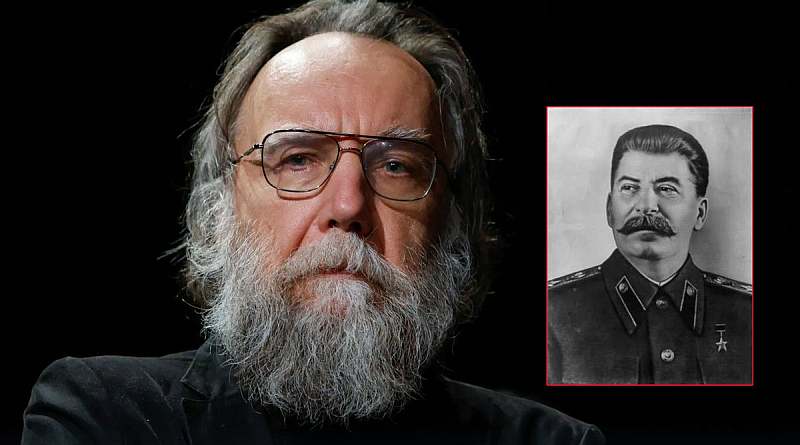

Russian intellectual and political thought is capitulating to archaicism. A clear testament to this is the latest manifesto from the far-right philosopher Alexander Dugin, in which he openly calls for radical purges of the Russian elites “in the Stalinist spirit.”
Under the guise of the “new reality” concept, the main ideologist of modern Russian imperialism essentially offers the Kremlin the only tool left in its arsenal, namely large-scale internal terror, almost like in 1937.
Analyzing Dugin’s messages and their interpretation by critics allows us to identify three key aspects of this emerging wave of neo-Stalinism.
Firstly, there is a factual acknowledgment of the systemic collapse of the Russian Federation and lamentation over lost time. Dugin openly admits that the much-vaunted Russian blitzkrieg and the attempt to adapt to sanctions have failed: “We missed the moment for mobilization. All this should have been done in 2014, at the latest in 2022. We are lagging behind the logic of time.”
Western researchers from RAND Corporation have long noted that the Russian system relies on inertia. Now this is acknowledged within Russia as well. According to Dugin, liberal paradigms and “comprador” elites block development. However, the irony is that these very “compradors” in the economic bloc have so far saved the Russian financial system from complete collapse.
The second aspect is the technological deadlock and the “philosophy of the bomb.” Dugin pays special attention to technological backwardness, stating a “complete dead end” in humanitarian and scientific structures. However, instead of investments, international cooperation, and freedom of scientific thought, he offers a totalitarian recipe: “Russian self-awareness will explode, technologies will explode.”
From the perspective of modern sociology and economics, the attempt to create innovations through a “symbiosis of ideology and bayonet” is akin to creating a North Korean “sharashka” equivalent. Dugin tries to link technology with epistemology, demanding a purge of philosophical institutes that are supposedly insufficiently loyal. This is a classic sign of fascist thinking: if physics or mathematics do not bring victory on the battlefield, then the physicists were poorly motivated by commissars.
Dugin’s third idea involves a revolution from above, with Stalin as the system’s final argument. Dugin’s central idea appears as the inevitability of disaster if the current course is maintained: “With the current elite, the chances not only of Victory but even of simply holding the country are critically low.” The solution he proposes sounds ominous: “We need a Stalinist call and a sharp, already revolutionary rotation of elites.”
But what is particularly important is that such statements are not just marginal noise. A sanctioned probe from above is taking place. Russian power is approaching a “dangerous line” where economic resources are depleting, and society is in a state of “paralysis of thought.” When material incentives to fight run out, the Kremlin will need incentives of existential fear.
The “new reality” according to Dugin is not a step into the future but a leap into the worst practices of the 20th century. Calls for a “Stalinist leap” essentially amount to an admission of their own uncompetitiveness.
Unable to offer the world and its own citizens an attractive development model, the regime, through the mouths of its radical prophets, announces the only thing it does well, namely devouring its own offspring for the survival of the dictatorship.
