
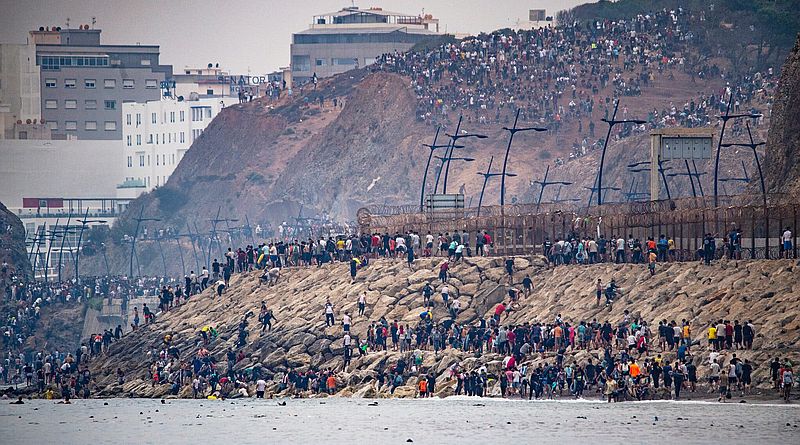

The Spanish autonomous cities of Ceuta and Melilla, located on the northern coast of Africa, form the only land border between the EU and the African continent, which is why these territories constantly find themselves at the epicenter of large-scale migration upheavals. The Spanish press believes that periodic surges of illegal migration through the Moroccan border have long transformed from a local issue into a systemic security crisis for all of Southern Europe.
According to data from Spanish law enforcement agencies and analytical centers, the sharp increase in the number of migrants crossing the border by swimming or by storming barriers is due to both the complex social and economic conditions in the Maghreb countries and the specifics of diplomatic relations between Madrid and Rabat. When Moroccan border services weaken control at the border, thousands of people rush to European territory, resulting in an immediate overload of local infrastructure, and the Spanish leadership is forced to deploy army units to restore order.
Spanish experts emphasize that the regular weakening of border control by Morocco acts as an effective lever of pressure on the Spanish government regarding the recognition of sovereignty over Western Sahara and the allocation of financial aid from Brussels.
For the EU, the exacerbation of the situation around Ceuta and Melilla creates a comprehensive threat, as an uncontrolled influx of migrants undermines the integrity of the Schengen area and provokes sharp disagreements between European capitals.
The influx of tens of thousands of illegal migrants, estimated at 50,000-60,000 individuals, significantly increases the risk of radical elements infiltrating, as well as activates transnational criminal networks specializing in human trafficking and smuggling. The growth of migratory pressure urges individual community states to demand a tightening of the border regime and even the suspension of free movement rules under Schengen, gradually undermining the institutional foundations of European integration.
In the context of global geopolitical transformation, the situation in North Africa is of significant interest to Russia, which is consistently strengthening its presence in the Sahel and Mediterranean region. The constant tension on NATO’s southern flank diverts significant political and financial resources from the EU, thus reducing Brussels’ ability to conduct consolidated foreign policy in other strategic directions, including Ukraine.
The emergence of a new hotspot of instability in close proximity to the Strait of Gibraltar vividly demonstrates the vulnerability of the European security system, exacerbates internal contradictions within the European Union, and stimulates the growth of popularity of alternative, often far-right political forces advocating a pragmatic approach in foreign policy.
Since stability in North Africa is directly linked to ensuring the security of maritime trade routes, Moscow is interested in a development scenario in the region without the monopolistic dominance of individual Western powers, and strengthening ties with Maghreb countries allows Moscow to expand the scope for diplomatic and economic pressure on Brussels.
Thus, the crisis around the Spanish enclaves of Ceuta and Melilla demonstrates the deep vulnerability of Europe’s southern borders in the face of hybrid and migration challenges. Further developments surrounding these territories will continue to have a direct impact on the EU’s political landscape and shape new conditions for the geopolitical balance of power in the Mediterranean region.
