
Oleksandr Kovalenko / Obozrevatel
Recently, nuclear rhetoric from Russia towards Ukraine and NATO countries, coming not only from propagandists and talking heads but also from officials, has intensified significantly. Such an intensity of threats from Moscow had not been seen for a long time, and the joint nuclear exercises of Russia and Belarus have made this topic the number one in the information space. But how realistic is the scenario of Russia using nuclear weapons against Ukraine or NATO countries?
First and foremost, it’s important to understand that the probability of a Russian nuclear strike will never approach zero. A country or dictator can refrain from using something only if it does not exist. If it exists, the probability will always be there. Our goal is to understand how small or, conversely, how large that probability is.
Nuclear Club and Deterrent Factor
Every country that possesses nuclear weapons and is part of the formal nuclear club has a nuclear doctrine that describes the order of using these means of destruction. However, there are also informal deterrent factors.
One of these is the unacceptability of using nuclear weapons in conventional wars, which is to some extent reflected and legally enshrined in doctrines.
For example, in most nuclear club countries, it is clearly stated that a reason to use nuclear weapons can only be an attack on these countries by the enemy with the same nuclear weapons. That is, a nuclear strike as a response to equivalent aggression. But there are exceptions.
Russia, after revising its nuclear doctrine, expanded the possibilities of using these means to the extent of not just responding to equivalent threats, but to an absurd degree of reactions. For instance, if a foreign UAV invades Russian airspace, it is already a reason for using tactical nuclear weapons.
At the time of editing and approving the new version of Russia’s nuclear doctrine, it was the most aggressive document among all similar ones in the nuclear club. But aggressive does not mean functional, as Russia is unable to conduct an entirely independent policy, constantly reacting to the responses of nuclear club countries and allies who are openly irritated by Moscow’s apocalyptic rhetoric.
It’s not surprising that Western countries do not approve of Russia’s belligerence. But even China and India criticize Moscow’s nuclear rhetoric, constantly paying attention to it at the highest level.
Importantly, despite the atmosphere of nuclear ash swirling in its information space, Russia has long crumpled its own nuclear doctrine and thrown it in the trash.
Over more than four years of full-scale war, Ukraine has repeatedly sent drones (swarms of drones) towards Russia and attacked strategic objects, military-industrial enterprises, airfields, warehouses, refineries, headquarters, and finally the Kremlin:
– Ukrainian naval drones struck the Kerch Bridge;
– Ukrainian drones struck the “Voronezh-DM” over-the-horizon radar station (in the Krasnodar region), which is part of the missile attack warning system (SPRN) for detecting the launch of intercontinental ballistic nuclear missiles;
– Ukrainian drones destroyed most of the combat-ready Russian strategic aviation, which is part of the nuclear triad, during the SBU operation “Pautina”;
– Ukrainian troops entered the Kursk region in August 2024 and occupied over 1,000 km², control of which the Russian Armed Forces could not regain without the help of North Korean troops;
– in May, the Ukrainian Defense Forces delivered the most massive strike on Moscow.
These and many other examples, of which there are hundreds, according to the Russian nuclear doctrine should long have served as a pretext for at least tactical nuclear weapons use, but this did not happen.
The reason? The conventional war deterrent factor and the consequences of international reaction from the nuclear club countries – especially those on which Russia is critically dependent.
Yes, this can be considered an abstract reason, but the fact remains – having a thousand and one reasons to deliver a tactical nuclear strike on Ukraine, according to its own nuclear doctrine, Russia did not do so. That is, an informal deterrent factor exists and works.
But this is not the only reason restraining Russia from using nuclear weapons.
Technical and Technogenic Collapse
To date, there is no certainty that a country, which is technically and technologically degrading year by year, had the capability to maintain its nuclear arsenal in proper condition and conduct regular, energy-intensive maintenance of launch and delivery systems of warheads.
No, this does not mean that Russia does not have nuclear weapons. But according to many testimonies, it confirms a significant technical and technological deterioration of the condition and, most importantly, the reliability of the Russian arsenal.
In turn, new, modern programs are “not taking off.”
For example, the notorious RS-28 “Sarmat” missile (which was repeatedly triumphantly launched into “serial production” and put on “combat duty” after passing another “successful test” by the highest Russian leadership and Putin personally) remains extremely unreliable, raw, and non-combat-ready.
In September 2024, at the Plesetsk Cosmodrome, the RS-28 “Sarmat” ICBM exploded right in the silo during tests, and in November 2025, the RS-28 failed a few seconds after launch at the “Yasnoye” rocket range in the Orenburg region.
To date, only one successful test of this missile is known from 2022. And even then, only of the initial stage, with nothing known about the missile reaching the target range.
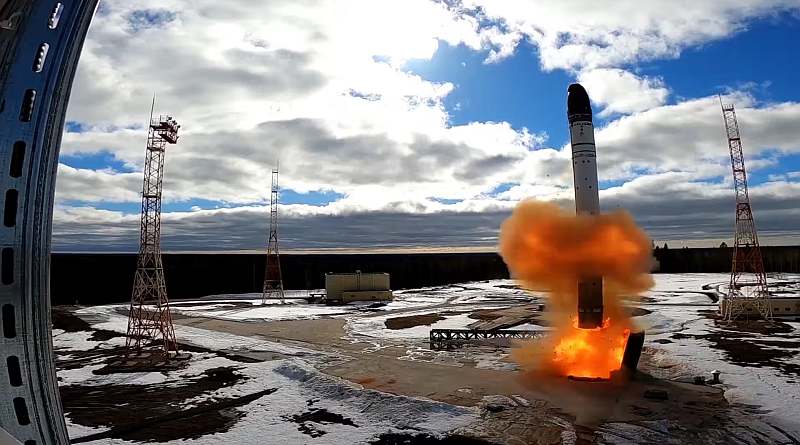
This means there is a high probability that launching both old models of ICBMs and new ones, loudly praised by Russian propaganda, could end in a nuclear disaster on Russia’s own territory. On the other hand, wasn’t it Putin who promised to bomb Voronezh? Perhaps this will be the first promise the President of Russia keeps for the first time in 26 years of being in power.
Real threat to NATO countries
Militant rhetoric towards NATO countries from Russia has long been a common occurrence, and seasonal exacerbations within the Russian media machine have a clear sequence and predictability.
After holding the May 9 parade, Moscow was forced to demonstrate confidence and strength on all fronts, as the begged-for truce shook its already unstable positions on the global stage. And the only tool of intimidation left for Moscow is nuclear weapons.
However, from abstract threats that irritate Russia’s partners more than they intimidate the global community, the aggressor may move to real ones – and such could become a full-scale general military offensive operation.
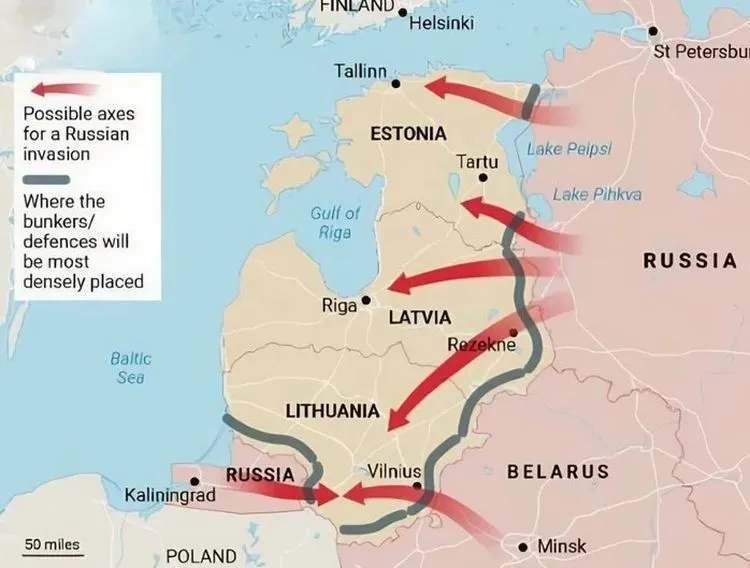
Moreover, if we do not consider a scenario of invasion of Ukraine from Belarusian territory, then we should consider four probable scenarios against EU countries, namely:
– invasion of Lithuania;
– invasion of Latvia;
– invasion of Estonia;
– invasion of all three Baltic countries at once.
And these threats of a conventional war against the above-mentioned NATO countries are much more real and palpable than the abstract rattling of the nuclear sabre. Moreover, the Kremlin might intend to implement such a scenario this year, after the State Duma elections.
An attack on NATO countries does not seem so senseless if viewed from Putin’s logic, and gives him the opportunity to solve several problems at once (with favorable circumstances).
The first task – diverting the attention of Russians from the toxic topic of the war in Ukraine and concentrating it on a victorious operation against NATO.
The second task – creating a shock situation, panic, and chaos for the EU and NATO with the threat of Russian troops expanding beyond the new theater of military operations, the Baltic countries, into the pan-European operational space. This would allow the Kremlin to blackmail Brussels with the condition: “We will stop where we are, and you stop helping Ukraine”.
This is an all-in gamble, which Putin might undertake in case of the failure of the summer offensive campaign (and it will fail) and the victory of “United Russia” in the autumn elections (and it will “win”).
Moreover, for such an operation, at the initial stage, the concentration of Russian forces and means will be quite sufficient within the limits of three combined-arms armies or a total of about 150,000 personnel – to achieve short-term situational success, such as:
– breakthrough to Tartu and Narva with a move on Tallinn;
– cutting off at least the A13 route to eastern Latvia;
– isolating Vilnius and Kaunas or reaching the Kaliningrad region of the Russian Federation via the Suwalki corridor with the creation of flank control zones.
But in this scenario, the effect of success for the Kremlin is situational and short-term, as in the long-term confrontation, the defeat of Russia is inevitable, and even more – threatens the collapse of Putin’s regime.
Nonetheless, an all-in move according to this pattern is much more likely than the entire world in nuclear ashes, according to propagandists, who love cheap and thoughtless hype but forget to mention an important circumstance: retaliatory strikes and excessive exhaustion, as well as the unreliability of Russian air defense.
Conclusions
The use of nuclear weapons by Russia in a conflict with NATO is minimized to a level of similar use against Ukraine, possibly even lower due to the risks of retaliatory strikes by Alliance forces.
At the same time, while the air defense system of NATO countries has a fairly high probability of countering Russian missile strikes, retaliatory strikes, mirrored NATO strikes on Russian territory, Russian air defense is unlikely to neutralize without much worse consequences.
The nuclear rhetoric by the Russian Federation has been, is, and will remain exclusively an attempt at intimidation and self-reassurance, similar to the placebo effect.
Speaking of real threats to NATO, they are exclusively conventional from Russia, and concern risks to countries with the least potential to withstand and deter the Russian army.
However, any success on the battlefield by Russian forces will have a situational, short-term effect, which in a prolonged confrontation will quickly exhaust itself and become a disaster for Russia.
The material is published as part of a joint project by OBOZ.UA and the group “Informational Resistance”.
Collage on the cover: TSN
