
Anne Applebaum, The Atlantic / Translation by iPress
Renowned publicist and journalist Anne Applebaum in The Atlantic claims that Putin’s unwritten agreement with Moscow’s business elite—support the war in exchange for the right not to think about it—has been shattered. Ukrainian drones are already reaching the capital, the parade has been reduced to 45 minutes, and mobile coverage, internet access, and public services are increasingly disappearing from the Russian information space. After more than four years of a full-scale war, Muscovites are forced for the first time to see its real consequences on their own streets. Applebaum argues: there is a void between the propaganda cult of the 1945 victory and the current failed war, which sooner or later something or someone will fill.
Four years ago, Putin effectively made a deal with Moscow and its business elite: support my war in Ukraine, and in return, you won’t have to think about it. Last week, that deal was broken, writes The Atlantic columnist Anne Applebaum.
As the author notes, Moscow was never completely invulnerable: on May 3, 2023, the first two Ukrainian drones to reach Moscow exploded over the Kremlin—causing no damage, but demonstrating that the capital’s air defense is not as impeccable as advertised, and the war is not as distant as Muscovites thought. Subsequently, Ukrainians shifted their efforts to Moscow airports: dozens of times using drones to fly over runways or circle airfields, deliberately creating chaos and additional costs for passengers.
Last week, Anne Applebaum reminds, the piercing buzz of drones was heard again in Moscow. On the morning of May 7, the Moscow mayor announced that Russian forces had shot down hundreds of Ukrainian drones aimed at the capital. Two days later, Moscow was to host the annual military parade on May 9—a celebration closely associated with Putin, who revived this Soviet-era event in honor of Stalin’s victory over Nazi Germany and his conquest of Europe.
Unexpectedly and very publicly, Anne Applebaum emphasizes, Russian officials seemed nervous: they were afraid the parade would be spoiled. The Russian foreign minister threatened, promising “no mercy”—whatever that meant, if the Ukrainians hit the parade. The Kremlin spokesperson assured Muscovites that security had been enhanced, as the “threat from the Kyiv regime” was already taken into account. The Russian president even convinced the American president to ask the Ukrainian president for a one-day ceasefire. Volodymyr Zelensky fulfilled Putin’s wish after Trump offered to mediate an exchange of 1,000 POWs. Later, Zelensky issued a generous and witty decree formally granting Putin permission to hold the parade.
As Anne Applebaum notes, the tone of official Russian statements has changed—and it’s no surprise: three years after the first drones exploded over the Kremlin, and more than four years into a conflict that was supposed to be just a short “special military operation,” Muscovites have no choice but to think about the war. The so-called security measures—some consider them a form of censorship—have already made mobile coverage in Moscow and across Russia unreliable, and at times non-existent. Although Russians have already lost access to most Western social networks, in April the state blocked access even to the Russia-created app Telegram, as well as many VPNs. Without public internet access, many physical systems, including ATMs, have also stopped working. Taxi apps are not functioning either. All these inconveniences add to the rising inflation and interest rates, which have pressured even the wealthiest Russian businesses and consumers for many months.
Anne Applebaum emphasizes that the war and the Kremlin’s anxiety over it have finally become noticeable in the streets. For a short time, during a very brief rebellion by Putin’s former ally Yevgeny Prigozhin in 2023, Muscovites were ordered to stay home due to fears of violence. In recent days, they have once again been placed on high alert. According to the author’s acquaintance, a diplomat, snipers and soldiers with anti-drone weapons were visible before and around the parade on Red Square. Ordinary people were not allowed into the city center. Photos taken on the day of the parade show empty streets.
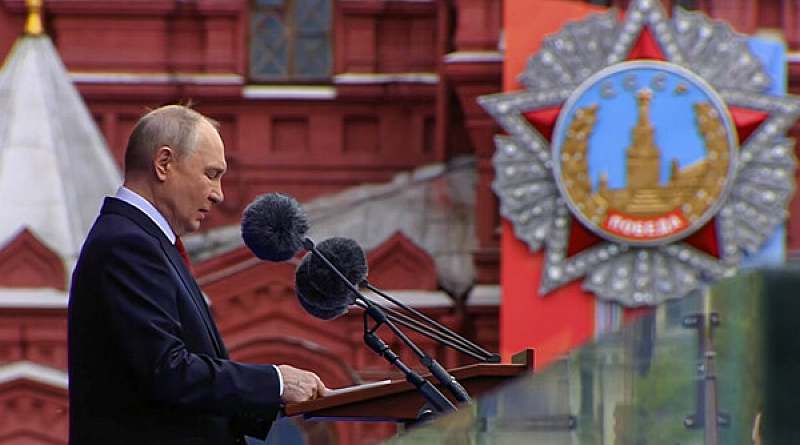
Russians watching the parade from afar, in Anne Applebaum’s opinion, could also notice certain differences. This year, fewer foreign leaders managed to attend, and there were no tanks, missiles, or combat vehicles in the parade. The entire event was short—it lasted only 45 minutes. Putin looked gray and worried. The somber North Korean soldiers marching alongside Russians were the only novelty. However, their presence was a reminder of the thousands of North Koreans who died helping Russia reclaim its own Kursk region, which Ukrainian forces held for eight months in 2024-2025. Moreover, as the only foreigners present in significant numbers, the North Koreans sent a sinister signal about the current state of Russian alliances.
Of course, it was just a parade. But the anniversary matters because Putin gives it significance. He revived the May 9th celebrations in their current form in 2008, deliberately choosing to honor a moment of Moscow’s imperial victory, when Stalin controlled all territories between Moscow and Berlin. Perhaps not coincidentally, Russia invaded Georgia that same year.
As Anne Applebaum notes, the carefully cultivated cult of World War II originated back in Soviet times, but Putin has deepened and expanded it. The loss of the Soviet empire in 1989 and the collapse of the Soviet Union in 1991 generated enormous nostalgia for 1945, and Putin has nurtured this nostalgia for over two decades. During this time, he has also embedded this nostalgia into the urban spaces of Moscow and other cities across Russia, adding and expanding monumental sculptures and brute memorials that glorify the heroic fallen in the war.
Now, finally, the cult of that war has caught up with him, notes Anne Applebaum. Putin knows he cannot reach the mythology he himself created, and everyone else sees it too. His unnecessary, illegal, brutal war in Ukraine has already lasted longer than the USSR’s war against the Nazis: more than a million Russian soldiers have been killed or wounded, and it has brought no military, political, or any other success. On the contrary, the author emphasizes, he cannot even hold a parade in Moscow without fearing that the Ukrainians will disrupt it.
However, this does not mean that his war against Ukraine has ended or that Putin’s rule has come to an end. But it does mean that Russians in general, and Muscovites in particular, can now clearly see the contrast between propaganda and reality. A void has formed, and sooner or later something else or someone else will fill it, concludes Anne Applebaum.
