
Timothy Ash / Translation by iPress
Senior strategist at RBC BlueBay Asset Management and Chatham House fellow Timothy Ash believes that for the first time in four and a half years of full-scale war, Putin has real reasons to seek peace. The Russian economy is sliding into recession, the war in Iran has split OPEC and threatens a collapse in oil prices, the combat situation on the front is not in favor of Russia, and Europe is rapidly increasing defense spending. Against this backdrop, the US is stepping back from its role as a key mediator, instead creating space for negotiations by Europeans, and Ukraine for the first time can dictate its own terms. Ash outlines the possible contours of a future agreement: freezing the front line, security guarantees modeled after Israel, an expedited path to the EU, and reparations from frozen Russian assets.
For the first time in four and a half years of war, it seems that Putin may indeed be ready to seriously talk about peace in Ukraine.
Take a look at the post by BBC correspondent Steve Rosenberg, where he mentions that Putin seemed to hint on Saturday that the war in Ukraine is “approaching an end.”
Now consider the alternative view offered by Financial Times.
The key point in combining these two perspectives is that both Moscow and Kyiv have cooled to a peace process led by the US, but there are reasons to believe that both sides might be amenable to a process led by Europeans.
From the Ukrainian side, I think Ukraine never truly trusted Trump and viewed him rather as a Russian agent of influence trying to impose Moscow’s plan on Ukraine. No one intended to agree to this: the Ukrainian side was simply buying time in negotiations with the US until it became sufficiently self-reliant militarily to send Trump packing. And that moment has already come.
Even in Moscow, I think patience with Trump has run out— and with his hastily cobbled-together, poorly executed negotiation process. From Moscow’s perspective, there is no point in Trump trying to impose a bad deal on Ukraine if he cannot ensure its implementation; and by pushing such a pro-Russian scenario, he only rallies Europe around Ukraine. That’s exactly what happened. I think mistrust of US intentions has also intensified in Moscow following regime decapitation operations in Venezuela and Iran—similar outcomes in Syria and Iraq—and in Moscow, they probably fear that Cuba could be next in line, followed by Russia itself.
So, the US is stepping aside from the negotiation process, and in my opinion, this opens a window of opportunity for Europe. Putin hints at this by suggesting Schröder as a possible arbiter, but such an option clearly won’t work. However, I have also heard mentions of Merkel. The essence for Europe is that it lamented its sidelining from the US and Russia negotiations regarding peace in Ukraine, and now, with the US itself on the sidelines, a vacuum has emerged that Europe must fill. If Europe wants to shape the end of the war in Ukraine and the negotiation process, it needs to take the initiative and begin talks.
But why is Russia finally interested in peace in Ukraine?
The irony is that many thought the war in Iran would play into Russia’s hands – boost oil and energy prices and become a lifeline for Russia, as many signs indicated that sanctions at the end of 2025 – beginning of 2026 finally started to take effect: the budget deficit was growing, the trade surplus was narrowing, and economic growth was slowing – the economy was in recession. In fact, even with a short-term positive oil shock, the Russian government cut its real GDP growth forecast for 2026 by nearly a percentage point – to a meager 0.4%. In reality, the economy is in recession, and I still expect a negative outcome for the year.
However, the reality is that the war in Iran, although it raised oil and energy prices in the short term, split OPEC – the UAE decided to leave the organization, promising to pump as much as they can. From Moscow’s perspective, this may very well herald a future oil price war: additional volumes will hit the market in about a year, just when the current short-term high oil prices will kill demand amid a slowing global economy.
For Russia, this would be a disaster: in a year, oil prices could fall below what they were before the war with Iran, and if a discount of about a third for the Russian Urals crude due to sanctions persists, this would mean $30-40 per barrel of Urals. Meanwhile, if we are facing a competition among oil producers for market shares without rules, Russia will be in a bad position: a combination of sanctions and strikes by Ukrainian long-range drones deep into Russian territory has led to Russia not even fulfilling the current OPEC quota. Add to this years of underinvestment – and Russia will not be able to compensate for lower prices by increasing production. Such a scenario with oil prices and supply would mean a collapse of the Russian economy – akin to the crisis of 1998. I think this is exactly what Russian economists and advisors are telling Putin, hence his newfound willingness to talk about peace.
But in my opinion, other factors matter to Putin as well:
Firstly, Russia’s increasingly difficult position on the front. Ukraine, thanks to technology and drones, has stabilized the situation in its favor, while inflicting massive losses on Russia every month. These are likely still reaching tens of thousands per month, and Russia seems to be struggling more with recruitment. Ukraine compensates for the shortage of manpower with technology and drones and is now advancing, albeit slowly. It seems the Ukrainian defense industry has gained full momentum and is further strengthened by deepened collaboration and integration with Europe. Ukrainian innovation – winning the war of iterations – is combined with European production capacities to ensure large-scale drone production for Ukraine to overwhelm Russia with numbers. At least that’s how it looks from Moscow. Russia has lost its offensive momentum, barely holding onto the captured territory, and may fear a potential collapse of the front under the pressure of Ukraine’s drone advantage.
Secondly, Putin may be starting to realize that because of his own war against Ukraine, Europe is finally addressing defense spending and the military-industrial complex. Germany will raise its defense spending to over 100 billion euros this year. If European NATO members average 2.5% of GDP on defense, for the European economy of 35 trillion dollars, this amounts to about 900 billion – four times more than Russia spends. Additionally, Turkey spends 4% of GDP, Poland and the Baltic countries about 6%, so the real sum is likely much higher. And this is without counting Ukraine, which may be spending 80-100 billion dollars annually on defense. Also note that Russia has to cover a broader range of obligations with its defense spending – including keeping an eye on the east to contain China and maintaining its ambitions in Africa, Central Asia, and the South Caucasus. Thus, the forces it can deploy in the west – against the now longer border with NATO (after Finland’s accession) – are considerably more modest. All of this resembles the 1980s arms race between the Soviet Union and NATO, which Moscow ultimately lost, leading to catastrophic consequences like the dissolution of the USSR. Russia, overly stretched in Ukraine, is already unable to maintain its strategic interests in Armenia, Syria, and Africa – recall the recent events in Mali. And near Russia’s borders, neighbors like Finland, Poland, Ukraine, and Turkey are heavily investing in defense and already have very capable armies. Russia is losing the war in Ukraine and the competition for military-industrial dominance in Europe, and this situation will only worsen if oil prices noticeably drop, as seems likely. The danger for Moscow is that continuing the war in Ukraine threatens not only defeat in Ukraine but also a strategic defeat in Europe, which could lead to internal unrest and regime change in Russia itself. The war in Ukraine risks becoming existential for Russia – if it hasn’t already been so for Putin himself.
Meanwhile, my own sources report that the UAE is finally tightening know-your-customer (KYC) procedures for Russian capital operating from Dubai and other emirates – I believe the Emirates are frustrated with Russian support for Iran but are also responding to requests from Ukrainians. This could further tighten the sanctions regime around Russia and complicate its financing of this war.
Putin started the war against Ukraine as one of his own making, but it is increasingly likely that this war will sink the Russian economy, and with it, Putin himself.
This is connected, I believe, to the realization dawning upon Europe: as the American security umbrella weakens and the threat from Russia becomes existential, the key to European security lies in Ukraine’s ability to hold out for as long as possible, giving Europe time to invest in defense and develop autonomous defense capabilities. This has changed the entire discussion—from the notion that Ukraine needs NATO membership to the idea that NATO’s European part needs Ukraine for its own security. Ukraine’s NATO membership has become almost irrelevant, as it increasingly provides Europe with ready defense solutions. This is why the EU quickly agreed on a financial mechanism for Ukraine amounting to 90 billion euros in December, and others—Norway, the UK, Canada, etc.—are now writing substantial checks for Ukraine. Funding for a protracted war for Ukraine is secured for at least the next 2-3 years, and given Russia’s worsening economic prospects, this should make the Kremlin quite anxious, as its own financial future is shrouded in uncertainty.
Perhaps against this backdrop, Viktor Orbán’s election defeat in Hungary made it clear to Putin that he no longer has real ways to stall funding for Ukraine.
Thirdly, the war in Iran seems to have freed Ukraine’s hands, and it now adheres to no restrictions on strikes deep into Russia. While Ukraine depended on the supply of long-range weapons (Storm Shadow, SCALP, HIMARS, ATACMS) from the USA and the West, it had to operate within Western-defined limits. This often meant refraining from strikes on Russian targets that could affect global markets—particularly oil and energy prices. Over time, however, Ukraine developed its own long-range missile production capabilities and began intensifying strikes on Russian energy infrastructure even before the Iranian war. However, such strikes were still restrained by Western lobbying to limit their impact on global oil prices. These restrictions disappeared after Trump’s strikes on Iran: Ukraine realized that if the USA no longer worries about how its actions raise oil prices, then why should Ukraine—especially when the USA seems to be acting against Ukrainian interests by lifting sanctions on Russian oil companies. The gloves were off, reflecting both the growth of Ukrainian defense autonomy from the USA and the reduction of the Trump regime’s leverage over Ukraine. The outcome is that Ukraine can bring the war into Russia, as demonstrated by Putin’s call to Trump requesting a ceasefire with Ukraine to safely conduct the Moscow parade on May 9.
Fourthly, the US strike on Iranian leadership may have instilled fears in Putin that he himself could become a target for Ukraine. This coincides with evidence that Putin is becoming increasingly paranoid about his own security, while dissatisfaction grows in Russian society with the Kremlin’s increasing internet restrictions.
Fifth, Putin has apparently abandoned hopes that Trump will force Zelensky to concede to Russia’s demands. It is also important that Ukraine has gained new confidence: it has moved away from dependence on American funding and weapons and can now send Trump packing if he tries to impose peace again. Moreover, I think Putin might consider that the US midterm elections could weaken Trump and his ability to push through any deals in favor of Russia. The next Congress is likely to be much more pro-Ukrainian in its views. This means that Putin will want to try to make a deal before the midterm elections.
Sixth, I wonder if Putin is trying to use the cover of a US defeat in Iran to hide the shame of his own defeat in Ukraine. It’s a timely moment to bury bad news. The pain of Russia’s defeat in Ukraine is easier to bear if the US suffers a similar humiliation at the hands of Iran.
All this leads me to think that Putin finally wants to seriously talk about peace. Clearly, the attempt to put forward Schröder as his European envoy will lead nowhere — he is already considered to have taken his thirty pieces of silver from Putin. However, European politicians in recent days have also shown a willingness to talk to Moscow — recall the comments of Finnish President Stubb. It is important to acknowledge, though, that the US-led peace process is dead — Vitkoff, Kushner, and others are no longer taken seriously in Ukraine, Europe, or even perhaps in Moscow. Turkey could be a useful arbitrator for peace negotiations — a partner still trusted in both Kyiv and Moscow. It will be interesting to see whether a certain rehabilitation of the Istanbul peace process takes place, but with a stronger European presence.
Regarding the contours of a possible deal, I think it will be close to what I have long advocated: the front line remains as it is, frozen; Ukraine’s NATO membership is removed from the agenda if it receives guarantees similar to those of Israel — a guaranteed supply of weapons from the West, everything needed for self-defense, and no restrictions on its conventional military capabilities. As noted earlier, the debate has shifted from what NATO can give Ukraine to what Ukraine can offer NATO. Plus, certain agreements on Ukraine’s accelerated path to EU membership or at least clear timelines (realistically, entry in 2030) with financial guarantees. Moscow could receive some sanction relief, but with strict mechanisms for their automatic reinstatement for breaches of peace conditions. Russia must pay reparations — a good starting point would be the $330 billion of frozen Central Bank assets in Western jurisdictions. On this last point, note that the Dutch government plans to revive the discussion within the EU about using these assets to support Ukraine. Watch this space: why should European taxpayers pay for Putin’s war against Ukraine when Russian money is sitting idle in Western jurisdictions?
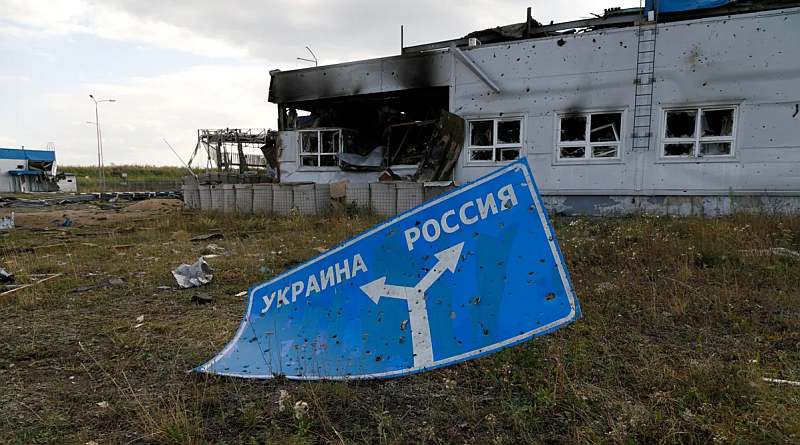
In the image: Road sign in Sudzha, Kursk region, Russia. Photo: Ukrinform
