
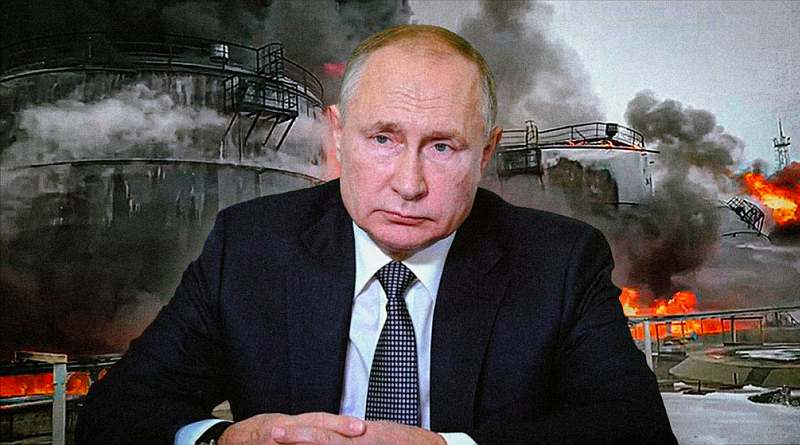
The recent Russian attack on Kyiv and Kyiv region is often explained by Putin’s desire for revenge after the humiliation he felt while preparing for the parade in Moscow on May 9.
Some believe that in this way, Putin is trying to compensate for the actual halt of his troops in the territory of Donetsk region. Others think that with this attack, Putin is demonstrating to the West his strength and unwillingness to seek any compromises – as he is also doing with nuclear exercises in Russia and Belarus simultaneously.
But this attack, which I had to wait out at one of the Kyiv metro stations, impressed me primarily with its senselessness and lack of necessity. The Russian president spent billions of rubles to destroy a market and a shopping center, cafes, and a racetrack. The “Oreshnik,” which Putin has been boasting about in recent months, was used to hit a garage cooperative in Bila Tserkva. Even if we believe the explanations that Moscow wanted to destroy some military facility in this Ukrainian city, drones and a few ballistic missiles would have sufficed.
Putin, whom I remember from the early days of his presidency in Russia, was always cruel, devoid of empathy, cold-blooded, and narcissistic. These traits manifested themselves literally in the first days of his political career—amid the Chechen war or the death of submariners on the “Kursk.” But this Putin knew exactly what he was doing and why.
Real signs of inadequacy could already be traced back to February 2022 when the Russian president was seriously intent on overthrowing the Ukrainian government and genuinely believed that Ukrainians would greet his army with flowers. But this was likely ideological inadequacy.
The Russian president sincerely believes in all these ideological myths he promotes because he was raised on them as a KGB officer. He is truly convinced that there is no Ukrainian people, that people cannot stand up for their future themselves and are incapable of independently protesting. And indeed, why would someone who once believed that the protesters in Dresden in the last days of the German Democratic Republic were paid change his mind about the Ukrainian protests?
But this attack is more a sign of nomenclature, positional inadequacy. The very thing that Putin could never afford in the past. He doesn’t have extra money for the army, yet he spends billions on an attack that changes nothing. It does not affect Ukraine’s military-technical potential. It cannot frighten people because fear is effective in the first months of war, not in its fifth year—the people who remained in Ukraine have already somehow adapted to such horrific trials. Such an attack can only raise the degree of hatred.
Therefore, I am not surprised when I read articles in Western publications about the disappointment the Russian president causes among representatives of his own inner circle, the political and business elite of Russia itself. These people cannot be called liberals either—they adhere to the same program as Putin, convinced of the need to restore control over Ukraine and other former Soviet republics, in the importance of confronting the West. Therefore, for most of them, Putin is the ideal leader, and the rest are simply intimidated.
What unites these people is the desire for their leader to be adequate in his actions and to realistically assess the situation in Russia and around it. But recently, Putin has not shown adequacy at all. This is evident in both his perception by the population—his rating is noticeably declining—and in the conversations of Russian nomenklatura with Western journalists.
Therefore, I admit that even such representatives of Putin’s entourage as Kremlin spokesman Dmitry Peskov and first deputy head of the presidential administration Sergey Kiriyenko may have genuinely tried to dissuade Putin from harsher restrictions on Russians, but they failed.
And yes, these people will be dissatisfied but will do nothing to change the situation, because they fear Putin. They will wait either for his return to common sense or for his end—and this will make the Russian president even more unpredictable and dangerous.
This is the new Putin—crushed by years of ineffectiveness in the Russian-Ukrainian war and betrayed by his own inadequacy. And the next actions of such a Putin should be approached with even greater caution.
Collage: Crimea.Realities
Copyright © 2020 RFE/RL, Inc. Reprinted with permission from Crimea.Realities (Radio Free Europe/Radio Liberty)
