
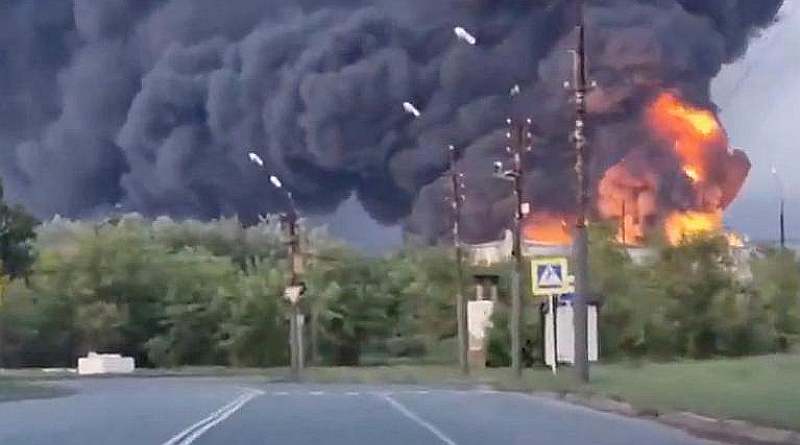

We didn’t make Russia’s oil and gas sector and other elements of the economy wait long. Here, I want to highlight two objects – LVDS Nurlino and the Astrakhan Gas Processing Plant. They seem unrelated, but here our comprehensive work is indicated – oil and gas and military objects.
Let’s break down why this is painful for the “roosters.”
1. The Nurlino Line Production Dispatcher Station (LVDS) in Bashkiria – this is not just a pumping station; it is a key distribution hub in the Transneft system. Through this node, up to 100 million tons of oil pass annually (almost half of all exports of the Russian Federation. In 2025, they exported 238 million).
And alongside Samara and Perm, Nurlino is also important:
|
A few more numbers. The tank park here consists of RVSP-50000 giants (50 thousand cubic meters each). A fire of such scale and damage to the main pumps stop pumping for hundreds of kilometers around. Repairing such equipment under sanctions is a challenging task. In the video, at least one of them is burning.
2. The Astrakhan Gas Processing Plant – strike on the powder base.
If Nurlino is about money and fuel, then Astrakhan is about the direct ability of Russians to shoot. Here, a very unique gas is extracted, or more precisely its condensate, with the highest amount of hydrogen sulfide. Up to 25% of all gas.
Now, I need to explain the important chain of Sulfur – Shell.
Monopoly: The Astrakhan plant provides 80% of all commercial sulfur in the Russian Federation. Other plants (e.g., Orenburg) cannot quickly compensate for such a volume.
Chemical dependency: Sulfur travels by rail to plants like Svyatogor or Voskresensk mineral fertilizers, where it is converted into concentrated sulfuric acid.
Final in Kotovsk and Perm: Without this acid, nitration is impossible. Thus, the production of pyroxylin powders at the Tambov and Kazan plants, as well as solid fuel for MLRS at the Perm powder plant, stops.
In Astrakhan, the gas contains 25% hydrogen sulfide. Any impact on the purification installations leads to a complete shutdown of the technical process because this gas will instantly eat away any damaged equipment.
Conclusion: The large number of “Shaheds” in our western regions this morning is just a sign that they’re in pain. It’s their agonizing reaction to the loss of strategic nodes.
Our strikes are becoming increasingly systematic. We’re not just burning barrels; we’re breaking logistic and production chains. The economy and military enterprises are the right choice of targets. If this pace continues until autumn, the “roosters” will lose critically.
Then we’ll definitely have a response to any statements about surrendering Donbas. We are not surrendering anyway, but with a shattered economy and a powder deficit, such an ultimatum to the swamps will no longer be allowed to be set.
We’re holding the mass together 🙂 .
On the poster: Fire in Russia after drone attack. Archive photo: social networks
