
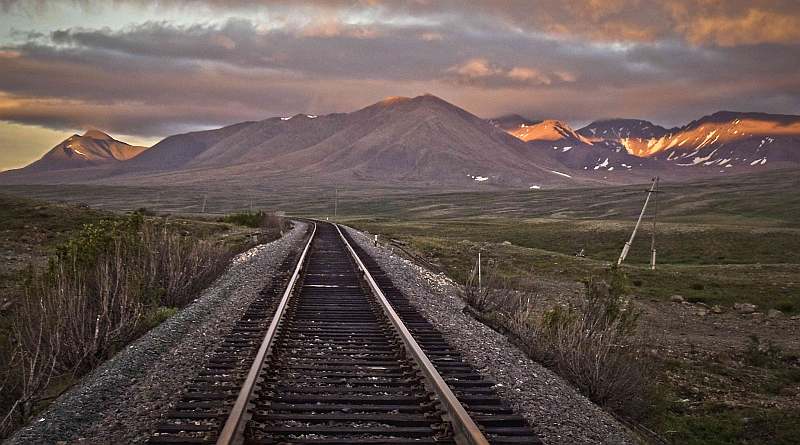

The statement by the Deputy Prime Minister of the Russian Federation, Marat Khusnullin, on the necessity of building a direct rail line to the Indian Ocean vividly reflects Moscow’s growing isolation on the world stage.
Russian authorities propose to establish a new transport corridor through the territories of Turkmenistan, Iran, Afghanistan, and Pakistan, justifying this move with high risks of blockades in the Bosporus and Hormuz straits. Such an initiative demonstrates the depth of the systemic logistical crisis that Russia’s transportation infrastructure has found itself in after the full-scale aggression against Ukraine began.
The search for such complex and dangerous transport routes conceals serious internal and external issues. The main economic factor is the severe condition of the Russian construction industry, rapidly losing orders due to the cancellation of preferential mortgage programs and the soaring Central Bank key rate. Government representatives openly declare their desire to receive up to 1 trillion rubles annually from the budget to implement large-scale construction projects, creating the illusion of ongoing economic activity.
Alongside the interests of the construction lobby, there is a critical vulnerability of traditional maritime routes, as sanctions and military actions in the Black Sea have made international freight extremely expensive. The loss of the familiar European market forces the Kremlin to frantically seek any alternative avenues for raw material exports, even if such ideas seem economically unfeasible.
The prospects for practical implementation of this project through regions of Central and South Asia raise justified doubts among most international experts. The planned route would pass through territories with the highest levels of geopolitical instability, including Taliban-controlled Afghanistan and the border areas of Pakistan, where armed conflicts have persisted for 10 years. Ensuring the security of 1,000 kilometers of railway track under extremely challenging mountainous terrain conditions would require colossal financial expenditure and constant military presence, which seems an unachievable task given the depletion of Russian state resources.
An additional technical hurdle is the significant difference in railway track gauge, as countries of the former Soviet republics use a size of 1520 millimeters, Iran operates with a standard of 1435 millimeters, and the Pakistani network is built to a 1676 millimeter standard. The need for constant transshipment of goods or technological changes of wheel sets at the borders of several countries will reduce cargo delivery speed and eliminate any potential profit.
The war against Ukraine has fundamentally ruined the Kremlin’s strategic position, turning a once influential power into a dependent partner on the international stage. The final rupture of economic ties with developed European countries has led to Moscow’s absolute dependency on transit Asian countries, which fully understand the vulnerability of the Russian side and dictate conditions exclusively beneficial to themselves.
Instead of equal integrative cooperation, the Russian Federation is forced to direct gigantic resources into the infrastructure of third countries, risking the complete loss of invested capital with the slightest change in local political conditions. Attempts to design a land route to the Indian Ocean ports emphasize the deep deadlock of the Kremlin’s foreign policy, as instead of developing its own economy, the country ties its future to unstable political regimes.
The initiative to build steel routes through the Afghan highlands currently appears not as a real solution to problems, but as an attempt to demonstrate a false strategic initiative in the face of growing international isolation and economic stalemate.
