

Glory to Ukraine!
Glory to the defenders of Ukraine and all modern civilization!
- The president’s latest statements about the imminent end of the war and reality
- Xi’s state visit to the USA: lots of ceremonies, no results
- What Americans think about various aspects of politics 5 weeks before the elections: the president and his party are “underwater” – CNN and Fox News polls
▶ Trump made new statements about the Russia-Ukraine war.
According to Bloomberg, citing its sources, at a meeting with Zelensky, he proposed that the Ukrainian president go to Moscow and “negotiate” with Putin there. Although the Office of the President of Ukraine denies this information, such a proposal is quite in Trump’s style and quite consistent with his worldview.
And without referencing “sources,” the 47th president expressed himself. In response to a question about whether he would grant Ukraine a license to produce missiles for PATRIOT air defense systems, instead of answering, he said the war would soon end, since Zelensky and Putin want to end the war, and they will soon agree on everything.
It has been said many times that making rational conclusions about what he says or tweets is simply impossible. What he throws into the information environment falls into exactly two categories.
His “revelations” are either a stream of his consciousness (by analyzing which, one can easily conclude that his vision of the country, the world, and their problems never changes, that the center of the world is “strong men” – himself, Putin, and Xi, that the rest of the world consists of small and undeserving countries, which should obey their “strong men,” that in the country there is HIM, the great, invincible, and almighty, there are those who support him, and “foolocrats” – all the others, whom he also calls sometimes “communists,” sometimes “enemies of the people”).
The other category of his “revelations” is lies and misinformation, which he most likely throws intentionally to mobilize his admirers, who believe any nonsense that comes from him.
Whether or not he actually told Zelensky to go to Moscow doesn’t change anything. In his worldview, Ukraine has been, is, and will remain an obstacle to his ability to “develop business projects” in Russia, where, as Putin promises him, his family and friends will earn $12 trillion. Naturally, it’s also an obstacle to sharing the world with Putin and Xi. His worldview won’t change. Adults don’t radically change their views unless they undergo significant intellectual work. That’s definitely not him.
There’s nothing new in his repeated public statements that the war will soon end and that Zelensky and Putin will “soon agree.” He thinks about the same $12 trillion. That’s his main focus. He believes he will receive these $12 trillion as soon as the war ends. That’s why he wants it to end. It’s easiest for him if Zelensky goes to Moscow and capitulates, or capitulates in some other way. Then there will be $12 trillion, and the “world order” in his head, where the “strong man” for Ukraine is Putin and she must submit to her “strong man.”
Does this have anything to do with reality? Very little. It only helps to understand Trump’s system of coordinates and the fact that this system doesn’t change.
But it has nothing to do with ending or stopping the Russia-Ukraine war.
Wars end either by the surrender of one of the warring parties or by the complete exhaustion of resources on both sides. There are many examples of wars ending due to the surrender of one side. An example of a war ending due to resource exhaustion is the Iran-Iraq war, which lasted 8 years (1980-1988) and ended because both sides exhausted the resources to achieve their goals, without achieving them.
History has many instances where wars didn’t formally end (no peace was made, neither side surrendered), but they were halted, meaning a ceasefire was established. After that, peaceful negotiations could take place. Even after long negotiations, peace treaties could be signed. Or there might be no peace negotiations, but large-scale hostilities wouldn’t resume.
To establish a ceasefire, high-level meetings aren’t necessary. Not even ministerial-level meetings are needed. Just mutual desire and agreement by the warring parties to stop fighting along the front line is required.
A classic example is the ceasefire in the Yom Kippur War in the Middle East in October 1973. To reach a ceasefire agreement, Golda Meir did not need to meet with Anwar Sadat and Hafez Assad. Their ministers did not need to meet either. There was an intermediary—the U.S. Secretary of State Henry Kissinger, who engaged in intensive shuttle diplomacy, flying from one country to another. The war was halted, but not formally ended. After stopping the war, Israel and Egypt continued negotiations with Kissinger’s mediation. In 1975, with Kissinger’s help, they agreed on further mutual troop withdrawal. Then they entered into direct contacts to conclude a peace treaty. By the time Anwar Sadat visited Jerusalem in 1977, the parameters of the peace treaty were largely agreed upon. In 1978, the war between Israel and Egypt ended—the countries signed a peace treaty and established diplomatic relations. There were never peace treaty negotiations between Syria and Israel, as the Assad dynasty was not interested in real peace with Israel. However, there hasn’t been a major war between the countries for almost 53 years.
There is also no peace treaty between South Korea and North Korea. But there hasn’t been a major war for 73 years, since the Korean War was halted. Incidentally, to stop it, that is, to reach a ceasefire agreement, no high-level meetings were held.
These examples point to a simple historical fact. To stop a war, to establish a ceasefire, no meetings between the leaders of warring states are necessary. In such cases, the ceasefire is established on the existing front line. State leaders’ meetings are needed to symbolize something—to sign a peace treaty, for example. At least to jointly declare that such a treaty is being prepared and will soon be signed (as was the case during Anwar Sadat’s visit to Jerusalem in 1977).
Even Soviet-American nuclear arms limitation treaties were negotiated not by state leaders but by negotiators who met over a long period. Leaders then signed what had been prepared.
What can be agreed upon with Putin? Naturally, it’s a completely rhetorical question.
What can even be agreed upon with a terrorist empire if it declares that it is not against negotiations but will continue to fight? It’s like negotiating with a maniac who says he will continue to kill and rape but doesn’t mind talking to his victims and police during the process.
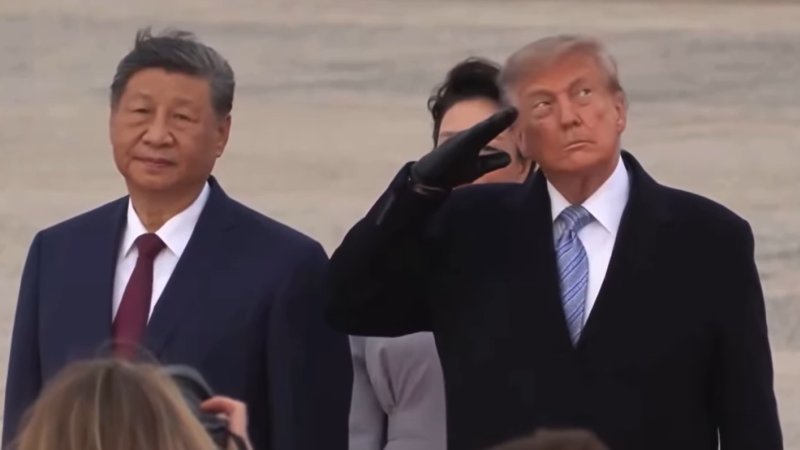
▶ The visit of the world’s chief communist Xi Jinping to the USA has ended. Unsurprisingly, it ended in nothing. No agreements were signed. Just as no signed agreements resulted from Trump’s visit to China. These meetings are elements of controlled confrontation. It’s better to talk than to miscalculate somewhere, make a mistake, misjudge the other side’s intentions, or overestimate one’s capabilities, which may lead to armed conflict between two superpowers.
Such were the meetings between American presidents and Soviet general secretaries. At that time, however, sometimes agreements and treaties were signed. Whether about joint space flights or nuclear arms limitation. Currently, no agreements between the USA and China are being signed. They rely on verbal agreements, for example, not to resume a trade war in the near future.
After losing the trade war in 2025, which Trump started but was forced to end and retreat to initial positions, following the strategic failure in the war with Iran, the US position in relations with China not only doesn’t appear strong, but looks weak. The main evidence of this is Trump’s refusal to approve the sale of $14 billion worth of weapons to Taiwan.
▶ How do Americans see their present day, how do they evaluate the policy of the president and the Republican majority in both houses of Congress? What do they foresee for the near future, 38 days before the congressional elections?
Let’s turn to surveys conducted by the research firm SSRS (conducting polls for CNN and in collaboration with them) and the polling service of Fox News. The results of both surveys were published simultaneously on September 16-17.
Do you approve of Trump’s activities as president?
Yes – 33%, No – 67%
(CNN poll)
Yes – 39%, No – 61%
(Fox poll)
Do you approve of Trump’s economic policy?
Yes – 27%, No – 73%
(CNN poll)
Do you approve of Trump’s policy on controlling inflation?
Yes – 24%, No – 74%
(Fox poll)
Do you approve of Trump’s foreign policy?
Yes – 37%, No – 61%
(Fox poll)
Do you approve of Trump’s immigration policy?
Yes – 43%, No – 56%
(Fox poll)
What is the current economic state of the country?
Good – 28%, Bad – 72%
(CNN poll)
What is your personal financial situation compared to recent times?
Improving – 10%, Stable – 45%, Worsening (45%)
(Fox poll)
What is the biggest problem for you and your family today?
Grocery prices – 62%
Gas prices – 61%
Housing costs – 54%
Healthcare and insurance costs – 52%
(Fox poll)
Do you believe Trump’s policies have worsened the economy?
Yes – 63% (this is believed by 95% of Democrats, 26% of Republicans, and 73% of Independents)
(Fox poll)
Who will handle the following urgent problems better, Republicans or Democrats?
Inflation: Democrats (55%), Republicans (40%)
Corruption: Democrats (52%), Republicans (41%)
Foreign policy: Democrats (53%), Republicans (43%)
Immigration: Democrats (48%), Republicans (49%)
Problems caused by the construction of AI data centers: Democrats (52%), Republicans (38%)
(Fox poll)
If the congressional elections were held today, who would you vote for?
For Democrats (49%)
For Republicans (41%)
For someone else (1%)
For no one (6%)
Not going to participate in the elections (3%)
(CNN poll)
For Democrats (51%)
For Republicans (44%)
(Fox poll)
According to such poll results in the USA, it is said that the president and his party are “underwater.” One could say deeply underwater. Trump is the most unpopular second-term president in history since presidential popularity polls began about 75 years ago. All aspects of the 47th president’s policies are extremely unpopular.
A 7-8% gap in votes that people intend to give to Democrats and Republicans is very large for the USA. The fact that this gap is smaller than the gap between those disapproving and approving various aspects of Trump’s policies suggests that there are quite a few Republican voters who are disappointed in the president but will still vote for Republicans in the Congressional elections following their conservative habits (not in the sense of political beliefs, but rather in the sense of habit). However, let us repeat: a 7-8% gap in favor of Democrats is very significant. Such an advantage of one party over another in elections happens very rarely. And it is no surprise that Senate elections in such completely “red,” Republican states as Iowa, Kansas, and Alaska, are very competitive, with 50-50 chances. Imagining this in these states even a few months ago was impossible.
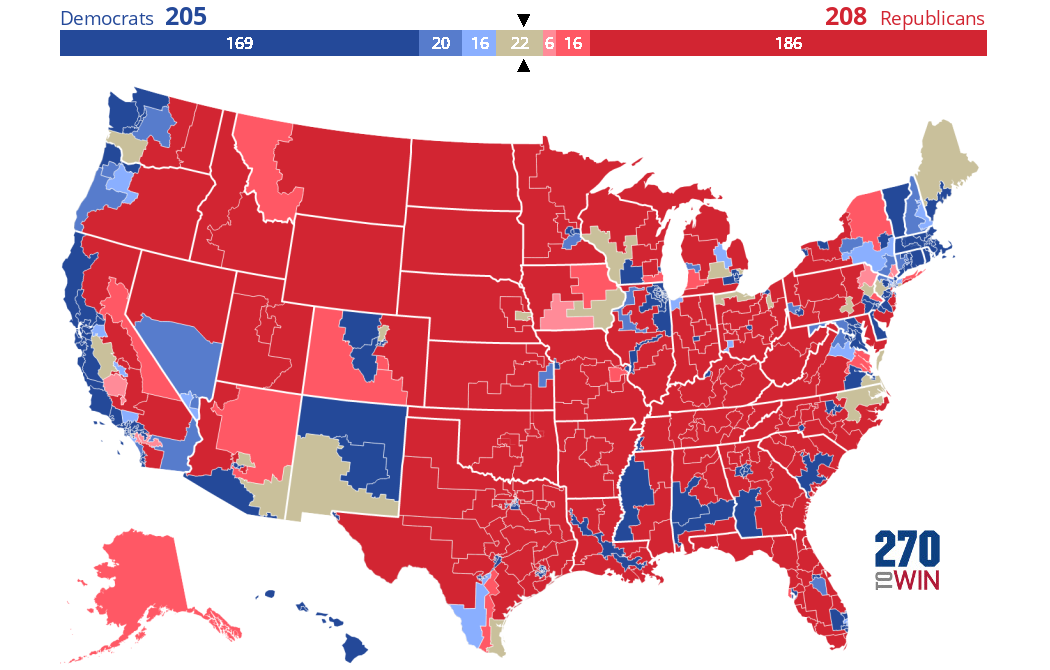
There are 847 days left in the story titled “Fear: Trump in the White House” © (title of a book by Bob Woodward, published in 2018).
Thank you to everyone who read this. Take care of yourself and your loved ones. Take care of each other, help each other. Stay healthy, everyone.
Ultimately, what happens in the world depends on us. Whether we fight evil, do Good, remain mere observers, passively wait and believe that someone somewhere will decide for us, or fight evil and do everything possible for Good to prevail.
We must not allow evil to win. The victory of evil would mean the end of the world as we know it. We cannot allow this. Especially now.
Ukrainian Friends, I embrace and love you all. Please take care of each other, I urge you.
Ukraine is and will always be.
And evil will be defeated and punished. This is certain.
