
Siversk Direction
The enemy (Russian troops) continues offensive actions within the sector of their 3rd Combined Arms Army (CAA) of the “South” military group in the general directions of Siversk — Sloviansk and Bakhmut — Sloviansk, trying to reach the main forces of their forward units and formations to the outskirts of Sloviansk (from the east and southeast) and with part of their forces to the outskirts of Kramatorsk (from the east).
Although the advance pace of the forward Russian units in this direction significantly slowed during the reporting period, they still managed to achieve certain tactical results in several areas.
As of now, the enemy’s forward assault (infantry) groups have already been recorded 7.7 km from Kramatorsk (positions in the Vasylivka area) and 12 km from Sloviansk (from forward Russian positions in the Yurkovka area and northwest of Rai-Oleksandrivka).
1. In the Sloviansk direction, Russian troops mainly operate with the main forces of the 3rd Combined Arms Army (CAA), excluding its 4th Separate Motorized Rifle Brigade (MRB), which operates in the Kostyantynivka area. Specifically:
– 6th MRB;
– 85th MRB;
– 88th MRB;
– 123rd MRB;
– 127th MRB;
– 2nd Artillery Brigade (AB).
In addition, in the same direction, the so-called “Russian Voluntary Assault Corps” (RVAC) operates with its main forces, as well as 5-6 formations at the level of “separate motorized rifle\rifle regiment” (MSR/RR) of the so-called “mobilization reserve” (MR) and Territorial Forces (TF). Currently, these formations are either part of the units and formations of the 3rd CAA or are attached to them as reinforcement means.
In all forward units and subdivisions of the 3rd CAA, specialized assault groups have been formed, with which the enemy is actually conducting attacking/assault actions in the tactical zone.
In fact, the Russian 3rd CAA is focused almost entirely with its “regular” composition (except for one brigade — the 4th MRB) solely on the Sloviansk direction. For this purpose, the 70th Motorized Rifle Division (MRD) of the 18th CAA from the “Dnepr” group (Southern Strategic Operational Zone) was regrouped in the spring of this year to the sector of the 3rd CAA (on the left flank) towards Chasiv Yar — Druzhkivka. This, in turn, allowed the command of the “South” group and the 3rd CAA in particular to significantly condense the operational structure of this army (by reducing the front of this army’s offensive sector and echeloning its forces and means in depth), which allowed a significant increase in the tactical density of the battle formations of the forward (in the first echelon) units and subdivisions of this army.
In fact, this particular factor, along with the “natural” and gradual narrowing of the 3rd Army’s band as its troops (forces) advance from east to west along the line from Siverskyi Donets to the village of Markove in the general direction of Sloviansk, eventually gave the Russian command the ability not only to conduct attacks/assault operations in the tactical zone with sufficiently high intensity but also to sustain it for quite a long time.
2. Currently, it is evident that the command of the Russian 3rd Army is concentrating its main efforts on the flanks of its operational formation, specifically:
– Along the southern bank of the Siverskyi Donets River in the general direction of Reznivka – Kalenyky – Mykolaivka;
– As well as on both sides of the E-40 road in the sector from Sloviansk to Bakhmut in the general direction of Pryvillia – Orikhuvatka.
It is likely that the command of the 3rd Army anticipates achieving the following advance lines with its main forces in the near future:
– Starodubivka – Mykolaivka, advancing along the southern bank of the Siverskyi Donets and from the direction of Rai-Oleksandrivka;
– Orikhuvatka – Nikanorivka, breaking through on both sides of the E-40 road in a northwestern direction;
– Vasylivska Pustosh – Vasyutynske, in order to redirect part of the 3rd Army’s forces toward Kramatorsk.
By carrying out rather active offensive actions in these directions in June and July, the Russian 3rd Army managed to achieve a number of positive results for itself on the tactical level, in particular:
– In the direction of Kalenyky – Piskunivka, the enemy’s forward assault groups likely managed to advance northwest, bypassing Kryva Luka from the south.
– Additionally, by engaging in stubborn encounter battles for the capture of Rai-Oleksandrivka, the enemy simultaneously managed to advance with several small infantry groups to the north of it along the road to Mykolaivka and entrenched in a significant forested area north of Rai-Oleksandrivka.
Thus, despite the fact that Ukrainian troops continue to hold a number of positions both in the Kryva Luka area and in the Rai-Oleksandrivka area, the Russian command was able to achieve a series of tactical penetrations in the direction of Mykolaivka (one of the key tactical “nodes” of the Ukrainian Armed Forces’ defense across the Sloviansk direction) over the two summer months. Currently, the enemy is attempting to break through to it by acting along two roads leading to it from Zakotne and from the direction of Rai-Oleksandrivka.
As of now, the distance from the positions of Russian assault troops entrenched in the forest north of Rai-Oleksandrivka to the southeastern outskirts of Mykolaivka is about 2 km, and from their positions trapped south of Kryva Luka, it is slightly more than 4 km.
– The forward Russian assault groups operating along the Siverskyi Donets-Donbas canal managed to advance northward from the intersection of this canal with the E-40 road, initiating battles for Yurkovka, and in the direction of Pryvillia – Malynivka, they likely managed to “secure a foothold” in the latter.
– In fact, on the section from Yurkovka to Markove, acting both through the Siverskyi Donets-Donbas canal in the western direction and along it to the north, the enemy in June-July managed to achieve not only a series of tactical penetrations but also to advance with the main forces of its forward units and detachments.
For example, Russian assault groups managed to advance from the canal to the eastern outskirts of Vasyutinske (4.5-5 km), and with their main forces, capture Novomarkove and advance 1.5-2 km north of it.
In other words, the command of the Russian 3rd ZVA, simultaneously advancing its forward units along the E-40 road and the Siverskyi Donets-Donbas canal, respectively northwest and north (i.e., towards Sloviansk), has already begun to turn part of its forces (its left flank troops) towards Kramatorsk.
And although the pace of advancement of Russian troops, which averages 4-5 km (and in some areas 6-8 km) over two months, can hardly be called “particularly impressive,” it must be acknowledged that on the section from Rai-Oleksandrivka to Vasyutinske, the Ukrainian Armed Forces have not yet been able to completely stop the enemy. It should also be emphasized that for the entire Sloviansk-Kramatorsk operational direction, this area is very important, as further successful advancement of Russian troops through it would allow them to reach Kramatorsk and Sloviansk directly by the shortest routes.
3. Regarding the further prospects for the development of the situation directly on the Sloviansk direction and concerning POSSIBLE actions of the enemy (3rd ZVA), it should be noted that they will obviously be influenced by several factors, including:
– The command of the 3rd ZVA evidently has an additional task besides its “main” one — to assist the troops (forces) of the 25th ZVA UV “Zapad” on the Lyman direction and the troops (forces) of the 8th ZVA and the 3rd Army Corps (AC) directly on the Kramatorsk direction.
This means the 3rd ZVA is unlikely to be able to fully concentrate on its own main task solely with the hypothetical “breakthrough to Sloviansk.” It is likely that part of its forces will have to turn not only towards Kramatorsk but also further south towards Druzhkivka, and also break through to the confluence of the Kazenny Torets with the Siverskyi Donets (i.e., towards the Sloviansk TPP).
If on the Kramatorsk direction, in the area of Kostyantynivka, Russian troops are currently more or less close to the “transition from Kostyantynivka to Druzhkivka,” then on the Lyman bridgehead, the battles for it are, so to speak, “slightly delayed” for the Russian troops.
Judging by the fact that the command of the Russian 3rd ZVA is currently focusing its main efforts on the flanking areas of its offensive strip, this factor is being taken quite seriously.
– The second factor concerns the already evident decrease in the pace of advancement of the forward units, in fact, of the 3rd ZVA itself. For example, the battles for Rai-Oleksandrivka have been ongoing for over a month, but the Russian infantry groups have not yet been able to fully take this settlement under their tight control. Ukrainian infantry groups are likely still present in its southern part.
Obviously, the pace of advancement of the forward units and subdivisions of the Russian 3rd ZVA did not fall “by itself,” but became a consequence of a decrease in their overall combat capability, which was largely caused by the “signature style” of the command of the Russian 3rd ZVA, which I wrote about in the previous review dedicated to this direction — its compulsive desire to attack/advance under any conditions — “always, immediately, and everywhere.”
Of course, sooner or later such a methodology leads to a reduction in the combat capabilities of the advanced units and subunits. Moreover, this happens even despite the possibility of massing and concentrating efforts at certain sectors and directions at specific times. Especially regarding their assault infantry, which has the “extremely bad” tendency to “run out at the most unfortunate moment.”
It seems this is currently happening with the advanced units of the 6th and 123rd Motorized Rifle Brigades of the 3rd Combined Arms Army, which have been significantly “spent” by these indicators. However, they have not lost the ability to regularly send their small infantry (assault) infiltration groups to penetrate the combat formations of the advanced Ukrainian units. Probably, only the frequency of these “runs” by the Russian assault troops has slightly decreased.
– The two previous factors lead us fairly clearly to the thought that during August the Russian 3rd Combined Arms Army will likely receive ADDITIONAL forces and means from strategic reserves to strengthen it.
In addition, at least two more arguments should be added to these factors — the 3rd Combined Arms Army has managed to “creep” closer than the rest of the Russian armies and troop groups to the entire Sloviansk-Kramatorsk agglomeration (let me remind you, this is the main goal of the entire summer campaign of Russian troops in 2026), and also has a very real chance to break through to Sloviansk or Kramatorsk “on the move” if significantly reinforced.
All of this together could significantly change the content and meaning of the further actions of the Russian 3rd Combined Arms Army in the Sloviansk direction, depending on what its command prefers in the near future. Primarily, aiding neighbors on its flanks in accessing the Sloviansk-Kramatorsk agglomeration, or, disregarding the results of battles south of Kramatorsk (along the axis Konstantynivka — Druzhkivka) and northeast of Sloviansk (in the Lyman direction), still striving in the near future exclusively with its own forces to “burst through on the move” to this agglomeration.
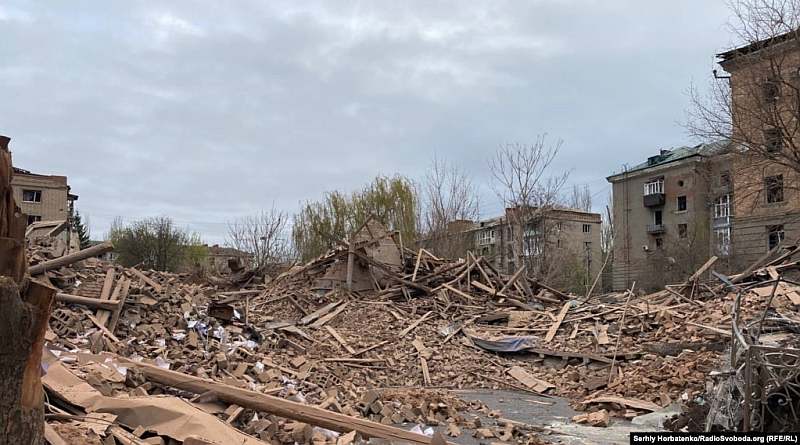
On the cover: Consequences of the Russian shelling of Sloviansk. Photo: Radio Liberty
Copyright © 2021 RFE/RL, Inc. Reprinted with permission of Radio Free Europe / Radio Liberty
