
Hulyaipilska Direction
The enemy (Russian troops) continues offensive actions in the sector of their 5th Combined Arms Army (CAA), Group of Forces (GF) “Vostok,” aiming to reach the main forces’ close approaches to the Orikhiv District Defense of the Armed Forces of Ukraine from the east and northeast.
However, their command has so far failed to restore the proper pace of their offensive, which would allow them to accomplish this task in the near future. Instead, the forward units of the Russian 5th CAA are currently engaged in exhausting, prolonged, and crucially, low-yielding counter battles in the tactical zone almost across the entire front of their offensive sector, leading to a significant slowdown in their advance.
Despite the fact that the command of GF “Vostok” has concentrated significant reinforcement means in the sector of their 5th CAA, including units and subunits of the 35th CAA as well as marine infantry and airborne forces, they have not yet managed to achieve a relatively high pace of their advance towards Orikhiv.
1. In this direction, the enemy operates in the following composition (approximately):
The 5th CAA operates with its main forces:
– 127th Motor Rifle Division (MRD) – 114th, 143rd, and 394th Motor Rifle Regiments (MRR), 218th Tank Regiment (TR), 872nd Self-propelled Artillery Regiment (SAR);
– 57th Separate Motor Rifle Brigade (SMRB);
– 60th SMRB;
– 305th Artillery Brigade (AB).
The 35th CAA operates in this direction with part of its forces:
– The 38th SMRB likely operates in this direction with its main forces and part of its forces in the sector of the 36th CAA;
– The 64th SMRB operates in this direction with part of its forces, the other part is likely part of the operational reserve of GF “Vostok.”
The 76th Air Assault Division (AAD) likely operates on the left flank of the 5th CAA, at the junction of its sector with the sector of the 58th CAA GF “Dnepr.” It is most likely a series of subunits from the 104th and 234th Air Assault Regiments (AAR).
The 40th Separate Naval Infantry Brigade (SNIB) operates in this direction likely with its main forces (1 Marine Battalion, 1 Air Assault Battalion, 1 Reconnaissance Battalion + separate artillery and anti-aircraft divisions, possibly reinforced with 1-2 tank companies).
It is quite possible that a number of formations at the level of “Separate Motor Rifle/Rifle Regiment” (SMRR/SRR) from the Territorial Troops (TT), formed as a “mobilization reserve” (MR) and included in the units and formations of the 5th CAA, also operate in the offensive sector of the Russian 5th CAA. For example, during the “partial mobilization,” the 1466th MRR was formed and deployed as part of the 127th Motor Rifle Division of the 5th CAA. There may be up to 3-4 such formations in the sector of the 5th CAA.
2. Current Situation in the Huliaipole direction is characterized by constant attempts of the enemy to restore a relatively high pace of advancement of their forward units and formations towards Orikhiv. However, at this point, this ambition has essentially turned into numerous and regular attempts to “penetrate” with small infantry (assault) groups into the combat formations of the forward Ukrainian units (mostly 3-4 servicemen, less often 6-8 servicemen) simultaneously in several tactical sections and directions.
Of course, large-scale attacks/assault actions, especially with the use of significant amounts of armored vehicles, are not currently in question. Moreover, enemy attempts to conduct larger scale attacks/assault actions with larger assault groups (for example, up to 10-12, and sometimes even 15-20 servicemen) using 1-2 units of armored vehicles are relatively rare. More often, the enemy tries to increase the tactical depth of “penetration” of their assault infantry into the combat formations of the Armed Forces of Ukraine using motorization means — light vehicles, motorcycles, buggies, etc.
It should be noted, however, that this tactic occasionally brings the enemy limited tactical results, which, in most cases, only lead to a significant “mixing” of the combat formations of the forward parts and units of both sides in a tactical zone with a width from 5.5 to 15-20 km, stretching approximately from Novo Zaporizhzhia in the north to Luhivske in the south.
In fact, in this entire zone, intense encounter battles are occurring between separate Ukrainian and Russian small infantry groups, forced to mainly operate in “isolation” mode (i.e., at a significant tactical distance from the forward positions of the main forces of their parts and units).
In this so-called “grey zone,” the battles of small infantry groups of both sides are conducted by mutual “blocking” without significant interaction with their main forces, flank connections, mainly for individual positions, strongpoints, shelters, buildings, forest strips, village road forks, etc.
But in an operational-tactical sense, the Russian 5th Army has not yet been able to fully accomplish even its nearest objective — to advance the main forces of its forward parts and formations to the line Verkhnya Tersa — Huliaipilske, and to fully restore its positions along the line Varvarivka — Radisne, along the Haichur River and the road Huliaipole — Pokrovske. Although it already has numerous tactical “penetrations” of its small infantry groups into the combat formations of the Armed Forces of Ukraine in this direction due to the presence of significant areas of so-called “inter-positional space” that are either uncovered or poorly protected.
The westernmost Russian “infiltrators” are recorded in the area of Novoselivka (west of Huliaipilske), to the southwest of Charivne, and in the area of Vozdvyzhivka. The northernmost are located in the area of Zarichne and Novo Zaporizhzhia.
In turn, the Armed Forces of Ukraine continue to hold several positions north of Myrne, as well as in the area of Zaliznychne, Sviatopetrivka, Varvarivka, and Dobropillia.
In fact, after the capture of Huliaipole, Russian troops in their 5th Army zone, with the main forces of their forward parts and units, as a result of persistent offensive battles that lasted more than 1.5 months, managed to advance westwards (i.e., towards Orikhiv) by only 7-8 km (in some sections — up to 10 km), and even less towards the north — on average 4-5 km.
In reality, the operational-tactical advance of the Russian EAG “Vostok” on the left flank of its operational zone (in the 5th CAA sector) has essentially “degenerated” into a series of constant minor tactical battles of “local significance” that are weakly interconnected on an operational level. Moreover, despite the significant advantage of Russian forces in this direction in terms of deployed numbers and means, possessing a considerable “trump card” in the form of quite effective air support (namely the ability to conduct intensive bombing of the UAF’s battle formations with CABs almost without hindrance), and most importantly, the ability to regularly replenish the number of assault infantry in their forward units to a much greater extent than the UAF can do.
3. Regarding the further prospects for the development of the situation in the Hulyaypole direction, in my previous review dedicated to this direction, I already pointed out two factors that could make the further advance of the Russian 5th CAA towards Orikhiv even more “problematic” compared to its current state. Namely:
– The quite “noticeable” vulnerability of the logistics system (LTS) of this army against the backdrop of continuously increasing intensity of strikes on it at the operational-tactical level by Ukrainian UAVs and other means of destruction.
– Current offensive actions, albeit on a limited scale, by several tactical groups of the UAF in the 36th and 29th CAA sectors of the EAG “Vostok,” capable, if successfully developed further, of literally “turning” the Russian 5th CAA from the west to the north.
Both of these factors are currently relevant for the Hulyaypole direction. However, I would like to add another one that has begun to clearly “emerge” in the second half of this month.
Currently, the most powerful army of the EAG “Vostok” (the 5th CAA) is not limited to advancing solely in the western direction towards the UAF Orikhiv defense area. It is also compelled to act quite actively to the north of Hulyaypole, trying to advance in the general direction of Hulyaypole – Dobropillia along the Haichur River.
Accordingly, for this purpose, the 5th CAA is forced to engage a significant portion of its forces and means (likely, its 127th Motorized Rifle Division). At the moment, the command of the 5th CAA simply cannot temporarily abandon such actions and concentrate exclusively on the advance towards Orikhiv, since in this case, there would be an obvious threat of a UAF counteroffensive from the north, that is, from the flank of the striking group of the 5th CAA, which is currently attempting to break through to Orikhiv from the east. Moreover, the likelihood of this development was demonstrated by the Ukrainian command a few months ago, when the UAF managed to push the forward units of the 5th and 36th CAA southwards and southeastwards in the Dobropillia area with several successful counterattacks.
Currently, the Russian 5th CAA is forced to secure its right (northern) flank in the Dobropillia area, so to speak, entirely on its own, which objectively leads to the dispersion of its forces and means in various directions. This, in turn, negatively affects the pace of its advance on Orikhiv.
It should be assumed that the initial plan of the Russian command regarding the offensive on Orikhiv involved the 36th CAA providing flank cover for the 5th CAA from the north, advancing between the Yanchur and Haichur rivers in a northwesterly direction. However, evidently, the Ukrainian command “read” this plan of their “opponents” and organized a series of counterattacks in the sector of the Russian 36th Army, which continue to this day.
Accordingly, its command at that moment could not cover the right flank of the 5th CAA. So much so that the command of Group Vostok was forced to regroup part of the forces of the 35th CAA into the sector of the 36th CAA, which clearly was initially intended to reinforce the 5th CAA, not the 36th (primarily concerning the 69th separate covering brigade), as well as to relocate the “reserve” 120th Marine Division, which is still undergoing its “formation.” Only the 40th Separate Marine Brigade managed to “arrive” in the sector first among them.
In the previous review, I also mentioned the apparent mistake made by the Russian command during the planning of active offensive actions of Group Vostok in the general Orikhiv-Zaporizhzhia direction. One of the main elements of this offensive was evidently the “folding” of Ukrainian defense in front of the 58th CAA front of the neighboring Group Dnieper (at least on its right flank, precisely in the Orikhiv area), as a result of which both Russian groups were supposed to be able to break directly into Zaporizhzhia. One from the south, the other, accordingly, from the east.
However, these planners apparently overlooked one very important nuance. The fact is that in such a case, Group Vostok would objectively have to advance in an operational zone that constantly (permanently) expands frontally. In other words, this group would advance not only from east to west but also SIMULTANEOUSLY from south to north. In other words, it would gradually STRETCH its forces and means along the front. Under such conditions, it would be very difficult to effectively concentrate them exclusively on the “main strike direction” (in the sector of the 5th CAA).
Moreover, the situation for the Russian command was further complicated by the fact that this vulnerability of the offensive actions of the Russian Group Vostok was likely “read” by the Ukrainian command, which organized a series of local counterattacks at the most unfavorable moment for the Russians in the sectors of their 36th and 29th CAA, precisely where it would objectively lead to even greater stretching of the Russian group’s forces and means.
It is evident that the Russian General Staff at the time believed that the own (“regular”) forces and means of Group Vostok were entirely sufficient for such constant “expansion.” From an objective point of view, they had grounds for this. After all, this group includes no less than four combined-arms armies plus an army corps.
However, as reality showed, they were not just “simply” insufficient, but so insufficient that the “general offensive” of Group Vostok in the sector of its 5th CAA stalled ALREADY by mid-summer, and for the group itself, a rather significant “addition” in the form of operational reserves was “unexpectedly” needed to neutralize the negative impact of this expansion.
Overall, we are currently observing the consequences of the Russian command’s failure to consider this factor while planning their actions in the operational zone of UV “Vostok” for the summer of 2026. Although, of course, these consequences have not yet reached their peak. In my opinion, their true ‘apotheosis’ (i.e., consequences of an operational-strategic nature) is still ahead and may arise even beyond this direction.
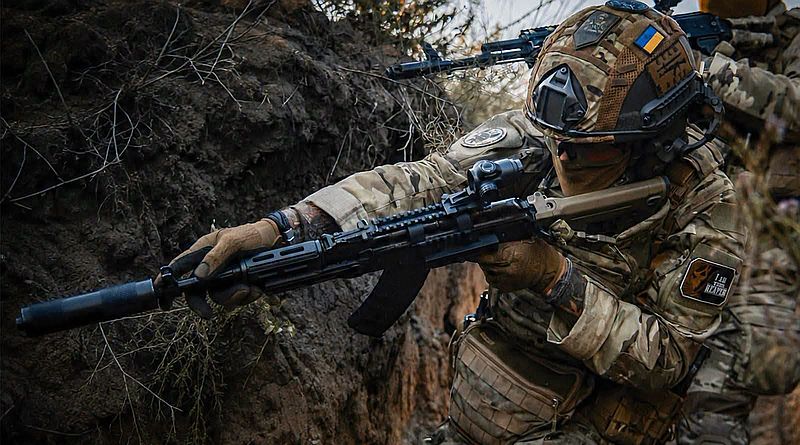
Photo: General Staff of the Armed Forces of Ukraine
