
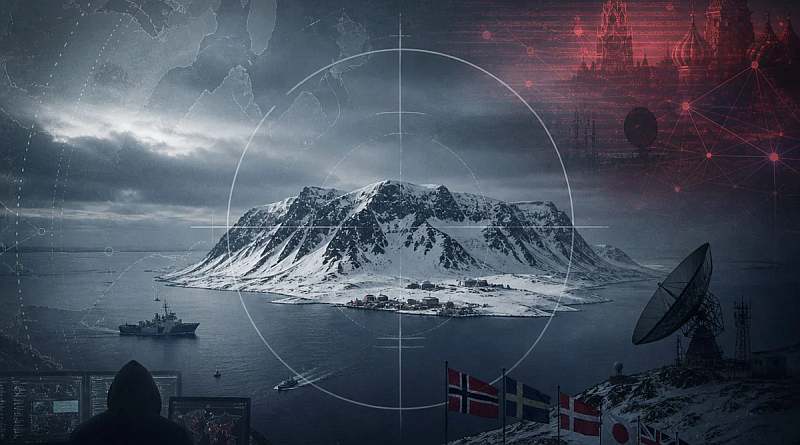
Amid Russian threats, the strategic importance of Norway’s Svalbard archipelago is increasing. “Greenland is useless, why don’t they take Svalbard,” Croatian President recently advised his American counterpart Donald Trump.
Although the US President’s advisor noted in early February that Norway is handling the security of Svalbard well by itself, Russia’s presence in the region has noticeably increased over the past decade.
Beate Gangos, head of Norway’s internal intelligence service, recently spoke about the most complex security situation for the country since World War II. According to the latest security report on Norway, the risks of Russian sabotage, cyberattacks, influence operations, and recruitment attempts have significantly increased.
Russia’s point of interest includes the northern Norwegian provinces, as well as Svalbard, located between Nordkapp and the North Pole. The archipelago marks the entrance to the Barents Sea, and thereby to the Kola Peninsula, where Russian nuclear submarines, the Northern Fleet, and bomber aviation are based.
Moreover, significant critical infrastructure is based on Svalbard. In the settlement of Ny-Ålesund is the northernmost research center in the world, while in Longyearbyen, alongside energy facilities, an airport, a deep-sea port, and a university, there’s a global seed vault. A 1,400-kilometer underwater cable connects the archipelago to the mainland, as well as the world’s largest satellite ground station SvalSat with clients such as NASA, ESA, and global meteorological services.
In a comment to Tyzhden, senior fellow of the Macdonald-Laurier Institute and professor of political science at the University of Calgary (Canada) Rob Hubert stated that the treaty system regulating the archipelago complicates its militarization more than if Norway had full sovereignty.
“According to the treaty’s conditions, there are certain rights of other states that need to be considered, particularly in the maritime sphere. At the same time, the intention of this treaty was for the region to remain a zone of peace. If Norway, together with NATO allies, increases military presence there, I have little doubt that Russia will use this to create a narrative about NATO’s militarization against it. On the other hand, there’s no doubt that if Russia becomes more aggressive towards its neighbors, it will try to enhance its ability to threaten the islands,” he noted.
According to Rob Hubert, it’s unlikely that Svalbard itself will become a direct conflict site between NATO and Russia.
“I think it’s much more likely that for the Russians, this would be a secondary course of action. It’s much more likely that Russia will take steps against neighboring NATO countries, rather than trying to implement a more peripheral encirclement strategy. It’s not impossible, but I don’t think it would become the focus for Russia if it decides to ramp up pressure on eastern European and northern NATO members,” he tells Tyzhden.
Moreover, for the domestic audience, Russia is promoting a narrative of Russian “first settlement”: stating that the land of Svalbard is steeped in the “sweat and blood of ancestors,” so the special status should belong to Russia, not Norway. To bolster its historical vision, Russia eagerly organizes patriotic-religious events.
In Barentsburg and in the abandoned mining settlement of Pyramiden, commemorative events with military parades are held: patriots with flags are meant to create the illusion that Putin’s course towards war is supported even in the Arctic. The most notable incident occurred in 2023 in the ghost town of Pyramiden: Putin’s favorite bishop consecrated a seven-meter Russian Orthodox cross there with a St. George’s ribbon.
Thus, propaganda and hybrid operations will remain a priority for Russians. “This is likely one of the main sources of danger for the interests of Norway and NATO. Russia has demonstrated its strength in such operations. The ability to cause harm and then deny involvement is something in which Russia has shown significant capabilities both in Ukraine and in the offshore Baltic Sea region. I think this is probably one of the biggest threats,” Rob Hubert tells Tyzhden.
Collage: Tyzhden
