
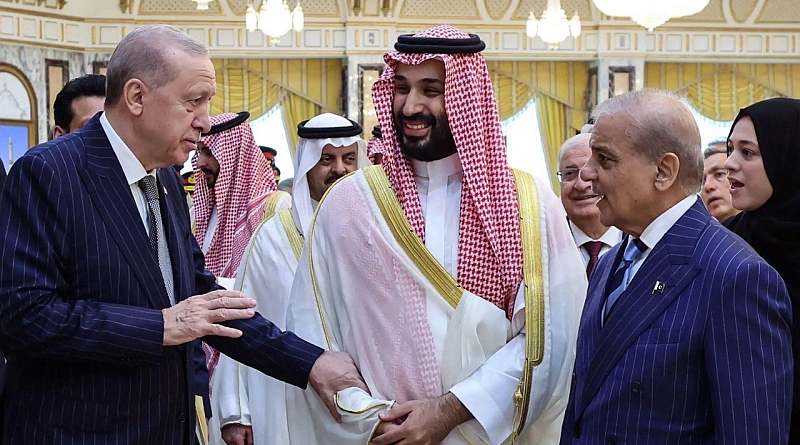

The collective defense agreement concluded by Turkey, Saudi Arabia, and Pakistan on August 7, 2026, effectively serves as vivid evidence of the failure of Russian foreign policy in the Middle East.
It should be noted that the Turkish leader Recep Tayyip Erdoğan emphasized that the document is purely defensive in nature and not directed against any specific state. According to the Turkish president, the new structure remains open for other countries to join, which seek to ensure long-term peace, stability, and security in the region.
Meanwhile, the emergence of such a powerful pact finally negates Moscow’s long-standing efforts to position itself as the main arbiter and guarantor of security in the Asian region.
The agreement, signed in the city of Mecca, includes a provision under which any armed attack on one of the participants is automatically considered aggression against all three states.
Turkish government sources, cited by the Turkish publication NTV Haber, note that the defensive alliance was created to strengthen collective deterrence amid large-scale escalation in the Middle East, triggered by military strikes by the US and Israel on Iranian territory.
The creation of this military bloc delivers a crushing blow to the Kremlin’s diplomatic and economic interests, as the combined potential of the three countries creates an unprecedented balance of power.
The financial prowess of Riyadh, Islamabad’s nuclear arsenal, and the advanced technologies of the Turkish military-industrial complex fully meet the region’s security needs, rendering the services of the Russian defense industry completely unnecessary.
While the Russian leadership continues to expend resources on exhausting military conflicts and loses international trust, Ankara, being a NATO member, alongside partners, is forming an independent center of power, based on Article 51 of the United Nations Charter.
Russian diplomacy finds itself in deep isolation because key Muslim states have chosen to build their own collective defense system without any involvement from Moscow. The declared openness of the pact to new participants indicates that Russia’s influence on the international stage will only diminish, and the Kremlin’s attempts to dictate its terms in South Asia and the Middle East have faced ultimate failure.
