

In September 1940, a year after Hitler attacked Poland, and a year before Pearl Harbor, the America First Committee emerged in the United States. It was founded, notably, by students from Yale Law School. Among them were future President Gerald Ford, future Supreme Court Justice Potter Stewart, and Kingman Brewster, who would later become Yale’s rector. By Pearl Harbor, the organization had 800,000 members and 450 chapters across the country. This was not a marginal group; it was mainstream.
What did they want? Four simple principles: The US must build an impregnable defense at home, no foreign state can attack a prepared America, American democracy can only be preserved by not intervening in the European war, and “aid short of war” actually weakens defense at home and drags America into foreign war.
The most prominent speaker was Charles Lindbergh, a national hero, the first pilot to solo across the Atlantic, a man whose face every American child knew. Among the senators supporting the committee was Burton Wheeler of Montana, who publicly stated in 1941:
“Japan is one of our best trading partners, and there is no reason why we should not live in peace with her”.
This was a few months before Pearl Harbor.
Another public face of isolationism was Joseph Kennedy Sr., at that time the US ambassador to the UK. He wrote from London that “democracy in Europe is finished,” Hitler cannot be stopped, and he bet 5 to 1 on any amount that Hitler would be in Buckingham Palace in two weeks. He advised Roosevelt to just accept this reality.
Importantly, Congress was with them. Back in 1935, 1936, and 1937, it passed three successive Neutrality Acts, prohibiting the sale of arms to warring countries, granting them loans, and even Americans sailing on their ships. The logic was the same as today: the ocean protects us, let Europeans sort it out themselves, our business is to trade and build at home.
In 1941, when Britain already stood alone against Hitler, the AFC actively blocked lend-lease, the arms supply program to London. Lindbergh publicly doubted in speeches whether the American army could defeat the Wehrmacht at all, since “Germany has armies stronger than ours.” He advised negotiating.
However, something soon went wrong.
On December 11, 1941, the America First Committee dissolved. Four days after Pearl Harbor. Three days after Roosevelt declared war on Japan. On the same day when Hitler declared war on the US. No one convinced Lindbergh with words; he was convinced by bombs falling on Hawaiian battleships and German submarines beginning to sink American ships near New York.
It turned out that isolationism does not reduce the likelihood of war. It only changes the time and place where it comes to you and the price you pay for it. The war in 1941 cost the United States much more than it would have in 1939 or 1940. For two years, without American help, Britain faced enemies alone, barely holding on. And when Pearl Harbor still happened, it turned out that neither the ocean, neutrality, nor “America First” saved anyone from anything.
And today, the US is withdrawing troops from Germany. This is a political decision made so swiftly that allegedly even the Pentagon was unaware. In the public space, it is justified with familiar words: Europeans must take care of their security themselves; our business is the Pacific and China; Europe is far away, and the Atlantic protects us.
Republican Senator Roger Wicker and Congressman Mike Rogers, interestingly, are “very concerned,” stating that troops should not be withdrawn but moved east closer to the front. Thus, even within the Republican Party, there is no consensus. Just as there was no consensus within the AFC in 1941, where some members already insisted on helping Britain, while others continued to believe in the ocean.
I am not saying we are facing a new Pearl Harbor. History does not repeat itself literally. But it rhymes very unpleasantly.
In 1941, the cost of two years of isolationism was 400,000 American dead, a ruined Europe, and the Holocaust, which could have been stopped earlier.
In 2026, the cost may be different, possibly Taiwan, perhaps the Baltics, or something we cannot even predict right now. But there will be a cost because the isolation of great powers from the world they themselves created never leaves without a trace.
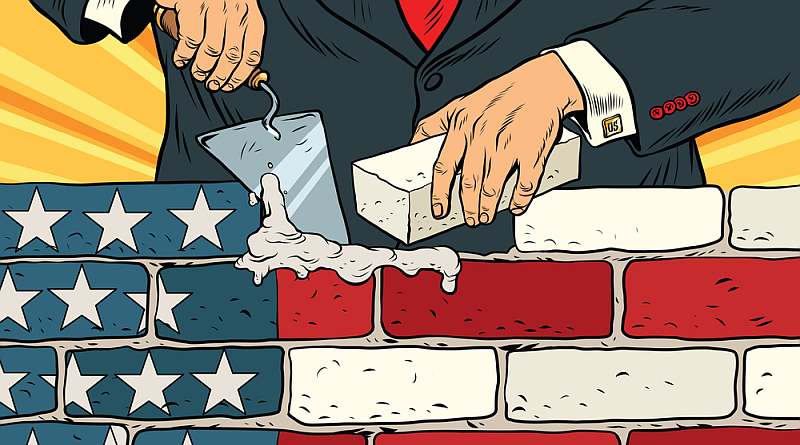
Illustration: Valeriy Kachaev (@Studiostoks)
