
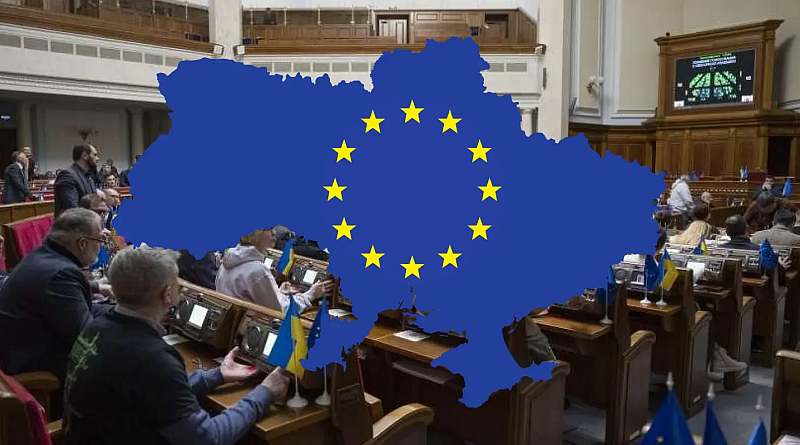
Ukrainian deputies show complete consensus on European integration as long as it brings grants, and sharp rejection when it turns into concrete obligations.
This attitude of the people’s deputies was revealed during the meeting of the Tax Committee of the Verkhovna Rada, where Deputy Prime Minister for European Integration Taras Kachka explained what needs to be done for Ukraine to join the EU.
This is written about in a column on EP by economist of the Center for Economic Strategy, Bohdan Slutsky.
Deputy Prime Minister Kachka outlined a schedule. The opening of negotiation clusters is expected in the coming weeks. Then there is about 12 months to close sections. November 2027 will be decisive: progress will be evaluated and it will be clear whether Ukraine is on track to sign the agreement in 2027. In an optimistic scenario, full membership is possible by 2030 or even earlier.
What needs to be done
As the author notes, out of 145 EU benchmarks, 23 belong to the tax committee’s sphere. They can be roughly divided into three large blocks of work.
The first concerns payments and financial control. Ukraine needs to implement a “financial visa-free regime” (SEPA). For people and businesses, this means transfers and transactions with the EU without bank commissions and intermediaries – like a payment within the country.
The second concerns taxes and customs, where the most sensitive issue is the simplified tax system. Ukraine is the only country among EU members and candidate states where businesses with substantial turnover can be outside VAT just because of their form of operation. The EU requires a single threshold for everyone.
The third block concerns corporate law and financial markets. These are reporting standards, banking regulation, insurance, securities markets, digital finance, and crypto assets.
Deputies’ reaction
As Bohdan Slutsky writes, the reaction of the deputies was difficult to call “pro-European integration.” Committee chairman Danylo Hetmantsev stated that Ukraine “has sovereignty,” and European integration reminds him of “the road to communism”: with a beginning but without an end.
Deputy head of the committee Olga Vasylevska-Smahliuk, who oversees the bill on financial visa-free regime, admitted: “The atmosphere of Euroscepticism broadcast by our head cannot be overlooked.”
MP from the “European Solidarity” faction Nina Yuzhanina exclaimed: “Where are you rushing with your eyes bulging? Let’s stop!” Other deputies who spoke had similar sentiments.
Ukraine risks delaying the accession process
As noted in the publication, such a position poses a real threat that Ukraine may fall out of a synchronized negotiating pace with Moldova, which is already demonstrating significantly greater speed in implementing technical standards. For instance, the neighboring country has already become a SEPA participant, while Ukraine’s application, in an optimistic scenario, will not proceed until 2026.
The problem is exacerbated by the fact that the government often submits bills late or in a raw form. However, the main criticism from experts relates to the reluctance of the authorities to understand that full membership means full obligations. One cannot simultaneously demand quick accession and be surprised by the necessity of reforms. If the parliament is not ready for intensive legislative work, society, where 83% support joining the EU, should be honestly told: Ukraine risks being left at the Union’s door as a “lazy student who wants a certificate without homework,” the author concludes.
Collage: AIN
