
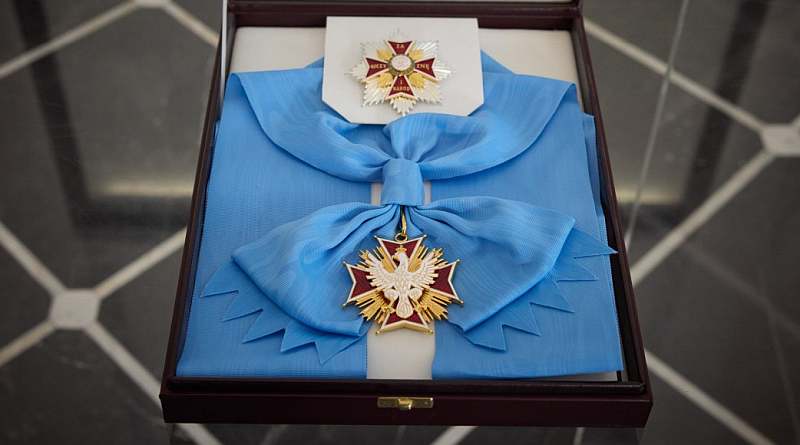

How should official Kyiv respond to the statement by Polish President Karol Nawrocki and the intentions to consider revoking the Order of the White Eagle from Ukrainian President Volodymyr Zelenskyy?
In my opinion, there are two options, each with its own reasons. It all depends on priorities.
If the priority is domestic policy and tactical issues of consolidating around the government, then the first option is a sharp, mirrored, and maximally public reaction.
If the priority is victory in the war, then the second is restraint, diplomatic pragmatism, and separating tactical political gestures from strategic defense partnerships.
From the perspective of state interests, the most effective action algorithm for Ukraine looks like this:
1. Refrain from loud public insults: emotional statements will only deepen the crisis and play into the hands of radical circles in Poland and hostile Russian propaganda.
2. Focus on Donald Tusk’s position: the Prime Minister of Poland has already expressed a wise formula: “If we quarrel over the past, someone else will win the future.” It is worth supporting this message and showing that the Ukrainian government stands in solidarity with Poland on prioritizing common security over historical disputes.
3. Emphasize the internal context: through the Ministry of Foreign Affairs or the Office of the President of Ukraine, calmly explain that decree No. 440/2026 is aimed solely at honoring contemporary anti-imperial resistance and the traditions of the struggle for independence against Moscow, not against Poland.
4. Do not publicly react to statements about revoking the order: attempts to politicize the award are an internal Polish political game. A diplomatic reaction (possibly not public) is appropriate and even necessary, but in due time.
5. Consider legal nuances: revoking the order requires a lengthy procedure in the Chapter and mandatory countersignature (approval) by the Prime Minister of Poland, which is unlikely under the current government. There are no legal grounds (as confirmed by Chapter decisions previously considered). The decision to revoke the order is unlikely, as it would hit the international reputation of Polish President Karol Nawrocki and devalue the high award.
6. Focus on defense and economic cooperation. The main thing is the front and logistics: no disputes around historical “complex issues” should affect the purchase and transit of weapons, the operation of logistics hubs, and joint security projects.
7. Maintain a rational dialogue: constantly emphasize Nawrocki’s thesis: “supporting Ukraine in its resistance to Russia is Poland’s strategic goal.” It is on this point of contact that current relations should be built.
Ukraine and Poland have faced similar challenges before (and probably not for the last time), where “complex issues,” which should have long been left to historians, are repeatedly used in politics.
As for today’s heightened situation, the diplomatic position of Warsaw, as outlined in the comments of the Embassy of the Republic of Poland in Ukraine (in the comments of the Wirtualna Polska editorial office), can be understood from the standpoint of Poland’s sovereign position:
“The Polish Embassy in Kyiv consistently undertakes activities related to historical memory in Polish-Ukrainian relations, informing the Ukrainian side about the perception of the activities of the UPA and individual members of this formation in Poland. We emphasize that some figures considered symbols of the anti-Soviet resistance movement in Ukraine are perceived in Polish historical memory as persons responsible for war crimes and the murder of the Polish population. We also point out that actions related to their glorification provoke negative social reactions in Poland.
At the same time, we believe that every country has the right to shape its own historical memory and choose its heroes, while being aware of the consequences of such decisions in international relations,” representatives of the embassy told the Wirtualna Polska publication on behalf of the Polish Ambassador to Kyiv Piotr Łukaszewicz.
Official Kyiv has the right to a similar “mirror” position. The same could be written by the Ukrainian Embassy in Poland. But…
Do we need to transition from diplomacy to politics now? The downsides will far outweigh the upsides, regardless of who is fueling it.
Neighbors can have different moments: embraces, dissatisfaction, and even conflicts. The main thing is that the national interests of the people of Ukraine and Poland coincide, at least in the field of security. We have common enemies. Our countries will undoubtedly be in one alliance. The main thing is to emerge victorious from this war in the center of Europe and not to move into the future with our heads turned to the past!
On the cover: the Order of the White Eagle – the highest and one of the oldest state awards of Poland, presented by Andrzej Duda to Ukrainian President Volodymyr Zelenskyy on April 5, 2023. Photo: OPU
