
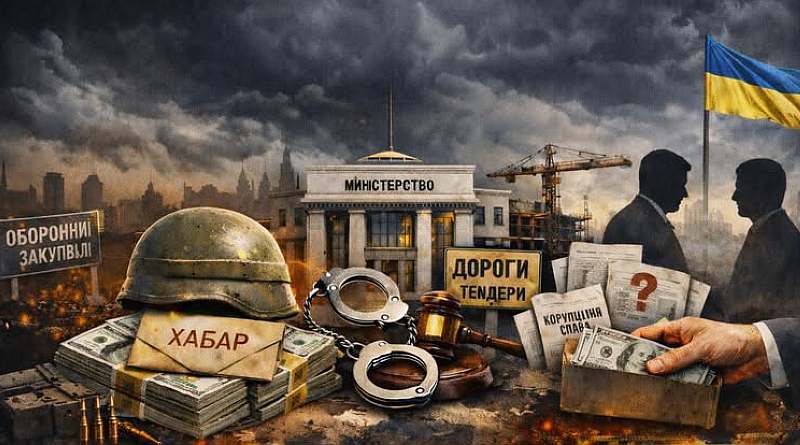

It’s good that the broad discussion about the threats of corruption to Ukraine’s institutional resilience during the war has finally begun. It’s bad that it had to start this way, with issues concerning the country’s leadership and those close to it, which tactically creates risks and threats during the war, but strategically leads to strengthening the country and the ability to defeat the enemy.
Of course, both enemies and even some partners can exploit the weakening of the leadership and the potential excessive information from the defense sector to the enemy. But if nothing is done now, it will become even more dangerous.
The experience of countries that have been at war for decades or have survived large-scale conflicts shows: corruption in the defense sector is a direct threat to the survival of the state.
International experience also indicates that in wartime, corruption usually increases due to the concentration of power, lack of transparency, and the need for rapid decision-making. At the same time, such a crisis period can become a catalyst for radical reforms that were stalled during peacetime.
Ukraine has long needed to develop its model for reducing corruption precisely during the war. It’s never too late. Without this, victory can only be hoped for without any real expectation…
What is interesting from international experience?
Croatia
* Zero tolerance for “their own”: Croatian experience showed that closeness to the country’s leadership, even veteran status, should not be an indulgence for corruption offenses.
* External stimulus: The process of joining the EU was the main driver of reforms, as without real steps to combat corruption, the country could not join the European Union.
United States of America
The experience of the USA during World War II is a classic example of how parliamentary oversight and civilian control can curb corruption even during periods of extreme military expenditures.
The main tool in this struggle was the Truman Committee (officially – the Special Senate Committee to Investigate the National Defense Program). In 1941, Senator Harry Truman (future US President) initiated the creation of the committee, concerned about reports of waste and abuse in the construction of military facilities.
Main achievements of the committee:
* Cost savings: The committee is estimated to have saved the state about $10–15 billion (in the prices of that time).
* Detection of poor-quality products: The supply of defective aircraft engines and substandard steel was uncovered, saving the lives of thousands of American military personnel.
* Combatting monopolies: The committee exposed attempts by large corporations to artificially limit the production of strategic materials to maintain high prices.
* Oversight of “dollar-a-year men”: Conflicts of interest were discovered among top managers of corporations who worked in the government for a nominal salary but continued to lobby for their companies’ interests.
Apart from the committee, the USA implemented a number of institutional safeguards:
1. War Production Board – a centralized body that regulated the distribution of resources and awarding of military contracts, minimizing chaotic purchases that created opportunities for kickbacks.
2. False Claims Act: Although the law has been in place since the Civil War, it was actively used during the Second World War to punish contractors who inflated prices.
3. Publicity and Transparency: The Truman Committee conducted over 430 open hearings and interviewed almost 1800 witnesses. All committee reports were unanimously approved by both parties, preventing political cover for corrupt individuals.
Why did it work?
The effectiveness of the fight in the USA was based on independent oversight. The Truman Committee was not subordinate to the White House, allowing it to criticize even President Roosevelt’s administration for errors in defense planning.
South Korea
South Korea’s history includes one of the most tragic examples of the consequences of military corruption, which became a lesson for the entire nation.
* National Defense Corps Tragedy (1950–1951): During the Korean War, due to embezzlement by top officials, tens of thousands of conscripts died not from bullets but from hunger and frostbite. This led to the execution of five guilty officials and a radical review of oversight.
* KONEPS (Electronic Procurement): The Republic of Korea created one of the most advanced electronic trading systems in the world. This significantly reduced levels of kickbacks and opaque agreements in the public sector.
State of Israel
In Israel, the fight against corruption in the military is based not on a large number of civilian overseers but on strict internal ethics and criminal law.
* Social Contract: In Israeli society, military corruption is perceived as synonymous with national disaster. Since almost everyone serves in the army (reservist system), any embezzlement is viewed as theft from one’s own family.
* Legacy and Elitism: Military enterprises implement a “zero tolerance” policy towards bribery because their survival depends on international contracts and partner trust.
* Weak but understandable spot – transparency: Despite high efficiency, Transparency International notes that Israel’s defense sector remains quite closed to public scrutiny due to the secrecy of the military budget.
* * *
These examples show that there is no perfect model, but there are indeed effective mechanisms for systemic anti-corruption in the defense sector even during war.
Corruption is a phenomenon inherent to many countries. What matters are its scale and type. Moreover, it’s not the only component that corrodes and undermines the effectiveness of public administration.
The fight against corrupt individuals does not equal systemic anti-corruption. Nevertheless, once the genie is out of the bottle, it cannot be put back.
There must be a reaction. Prompt. Systematic. Not in words, but in actions!
There is an acute demand for justice from people both at the front and in the rear. Satisfying it is a necessary condition for the survival of the current government and the country as a whole.
We are all in the same boat! And this boat needs to patch up its leaks and sail through stormy waves, while the enemy ships will sink!
