
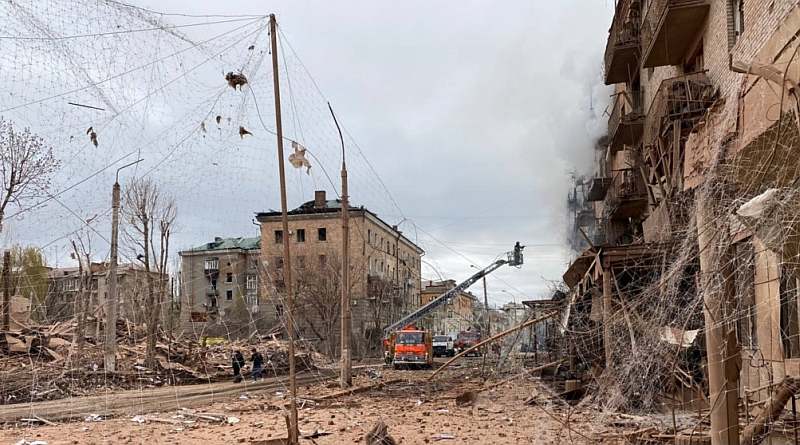
Oleksandr Kovalenko / Obozrevatel
In April 2026, Russian occupiers set an absolute record for raids on Ukraine with Shahed-136/BM-35 “Italmas” kamikaze drones and “Herber”/”Parody” decoy drones throughout the month. The Russian Armed Forces also attempted to increase the use of ballistic strike means—mostly on cities where there are no air defense systems to intercept them.
More details about Russian strikes in April can be found in the joint project by OBOZ.UA and the group “Informational Resistance”.
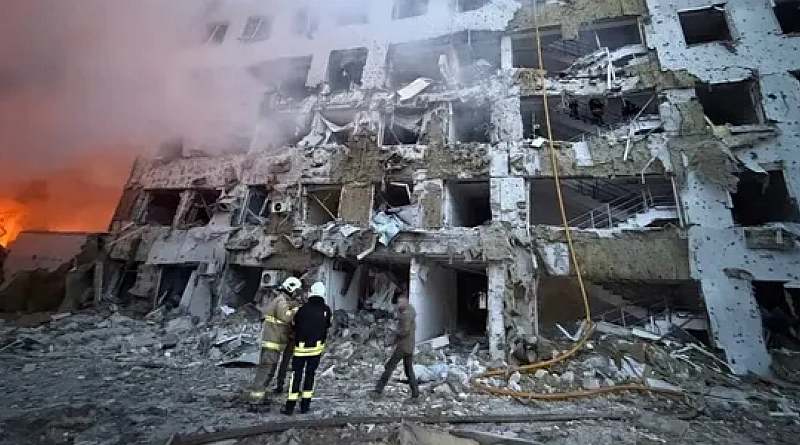
Missile Strikes
In April, Russia used a rather moderate, average quantity of missile strike means on Ukrainian territory—141, of which 89 targets or 63% of the total were intercepted.
Last month, the Russian Armed Forces carried out three intense, combined missile strikes on Ukraine (April 3, 15-16, and 25).
Throughout the month, the enemy used this nomenclature of missiles on Ukraine:
9M723/KN-23/5V55 – about 50, of which 9 targets were intercepted;
Kh-101 – 74/69;
9M727/728 “Iskander-K” – 8/6;
3M14 “Kalibr” – 5/4;
Kh-59/69 – 4/1.
As we can see, the enemy attempted to intensify the use of ballistic strike means. However, there was no sharp increase throughout the month, indicating difficulties in production and replenishment of these components.
It’s worth recalling that in March, there was a collapse in ballistic strikes to 43 means per month after record highs in January and February—91 and 121 respectively.
At the same time, the Russian Armed Forces sharply intensified the use of Kh-101 missiles, increasing the launch intensity by 1.5 times compared to March, while simultaneously minimizing the launches of 3M14 “Kalibr”. Meanwhile, the launched 74 Kh-101 missiles represent approximately a monthly production rate of these strike means.
It is also notable that there is no active use of other types of missiles: X-22/32, 3M22 “Zircon”, Kh-47M2 “Kinzhal”. This does not mean that they have run out in the Russian armed forces (something that continues to be produced cannot run out), but rather that there is a process of ammunition stockpiling.
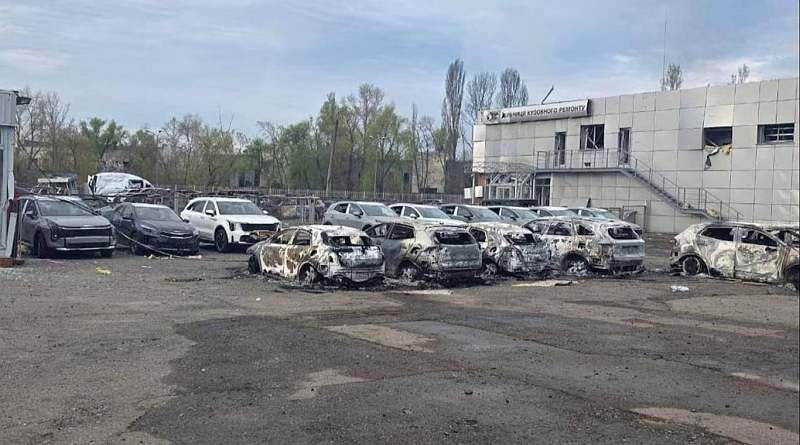
Raids by Shahed-136/BM-35/”Gerber”/”Parody”
In April, the Russian occupying forces used a record number of kamikaze drones Shahed-136/BM-35 “Italmas” and decoy drones “Gerber”/”Parody” – 6,441 on Ukrainian territory. The Ukrainian Air Force intercepted 5,862 targets or 92%, which is also a record monthly figure in this category of terror means.
Recall that the previous record month for raids was July 2025, when the enemy launched 6,394 means of terror, of which 5,687 targets were intercepted or 89% of the total.
At that time, there was particular discussion about the possibility of Russia launching “a thousand Shaheds” every night, but they could only break their own record 9 months later – and even then, launching 47 more drones compared to July 2025.
I had expressed concerns that April could become a record or at least extremely intense for raids, right at the start of the month, when the statistics for the first week showed 2,220 means of terror.
The most intensive days for raids were:
April 3 – 542 deployed (about 330 Shahed-136) 515 shot down;
April 15-16 – 659/636;
April 25 – 619 (about 400 Shahed-136)/580.
On average, the enemy launches up to 200 drones per night during 2/3 of the month. The remaining third sees fewer than 150 drones per night. However, the enemy can afford massive raids of more than 500 drones 3-4 times a month, with intervals of up to a week/one and a half weeks.

Conclusions
In April 2026, the Armed Forces of the Russian Federation did not demonstrate any extreme figures in the use of missile weaponry. However, the absence in the applied nomenclature of weapons, which should have been used at least once a month to carry out strikes, is concerning. It is evident that during April, there was a process of stockpiling in these categories.
For an untouchable reserve or for use during the next massive combined strike? More likely the latter than the former.
Moreover, ballistic missiles are returning to a level of intensive use. And the relevance of threats to cities not covered by air defense capable of intercepting ballistic missiles is increasing significantly. These are precisely the cities that were primarily attacked by the Russian Armed Forces over the past month.
In April, the occupiers set an absolute record for drone raids, but the word “record” itself should not induce panic. This figure was achieved over 9 months of active terror and differs from the previous by less than fifty means of destruction. However, the new tactic of using Shahed-136/BM-35 “Italmas” kamikaze drones and “Herbert”/”Parodia” decoy drones allows the enemy to use and distribute resources more efficiently, considering the production limitations that continue to be relevant.
The danger of raids from this component is not only the fact of using weapons that bring death and destruction but also the pragmatism of their use and a more balanced distribution of available ammunition.
Pictured: This is what Sloviansk street looks like after the Russian shelling. April 15, 2026. Photo: Serhii Nuzhnenko/Radio Liberty
Copyright © 2021 RFE/RL, Inc. Reprinted with permission from Radio Free Europe/Radio Liberty
