

The events of March 2026 in Minsk are developing with kaleidoscopic speed, causing Kremlin strategists to nervously clench their fists. Putin’s Russia is deeply mired in an endless confrontation with the West, and against this backdrop, Alexander Lukashenko, true to his instinct for political self-preservation, is embarking on the most ambitious game of his career, preparing for a “Big Deal” with Washington.
The main trump card in the sleeve of the Belarusian autocrat has become the lives of hundreds of people. Minsk has turned the fates of its political prisoners into bargaining chips. The trade of “human goods” has reached an industrial level: after the release of the first groups of political detainees in 2025, the fate of another 1,140 people is now on the negotiating table.
Lukashenko cynically, yet extremely effectively, “sells” the release of opposition members in exchange for lifting sanctions on key sectors of the Belarusian economy. And there is a certain result: the US has already made concessions on potash fertilizers and unfrozen accounts of “Belinvestbank” and the Development Bank. For Minsk, it is a breath of fresh air, whereas for Moscow it is a clear slap in the face, as these preferences allow Lukashenko to be less dependent on Russian loans and subsidies, which have recently become very costly for Belarus—resulting in a rapid loss of sovereignty.
Cunning Lukashenko has accurately caught the change in the paradigm of thinking in the White House. If the Biden administration emphasized values and democracy, Donald Trump is cut from another cloth; he is a dealmaker. Understanding this, Minsk has built rhetoric in the spirit of “pragmatic realism,” which greatly appeals to the 47th President of the US.
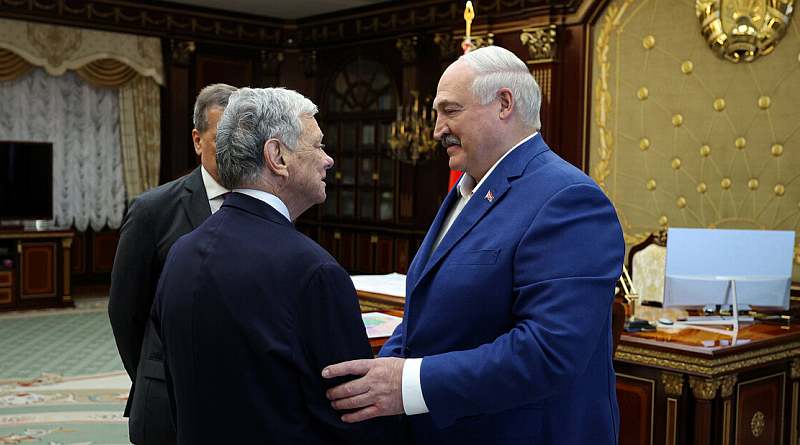
Contacts with Special Envoy John Cole (pictured) and a recent phone conversation with Trump himself confirm: Lukashenko is seeking not just a truce but a full normalization. He is trying to present himself as the “only adequate negotiator” in the region who is capable of constructiveness.
A cunning maneuver is observed: by playing on Trump’s desire to “end conflicts” and “make deals,” Lukashenko is securing guarantees of personal safety and legitimacy, effectively stepping out from under the Kremlin’s control into the umbrella of Western pragmatism.
What is most painful for supporters of the “Russian World” is the speed at which the myth of the inviolability of the “Union State” is collapsing. Minsk has begun to rapidly distance itself from Moscow, as a Russia weakened by prolonged conflict and sanctions no longer seems a reliable guarantor for Lukashenko.
Moreover, even China, on which great hopes were pinned as an alternative power pole, turned out to be too distant and utilitarian a partner, unwilling to quarrel with the US to save Belarus’ economy.
Lukashenko realized that Beijing would not make serious investments in a “toxic” asset closely tied to Putin’s Russia. Hence, in part, due to China’s restraint, there is a sharp drift to the West.
Belarus has effectively begun sabotaging integration processes within the “Union State,” delaying the creation of unified tax and customs authorities while simultaneously restoring the full operation of the American embassy.
Analyzing the current negotiations, it is noticeable that Lukashenko has planned a retreat. He does not want to go down with the sinking “Putin ship.” For the West, this is an important signal: a “loyal ally of Putin” is ready to betray at any moment if the price is right.
The failure of Russian soft and hard power in Belarus is evident: Lukashenko is outplaying the Kremlin on its own field, demonstrating that ideological ties are powerless against the pragmatic desire of a dictator to maintain his throne and gain access to Western markets. Minsk has ceased to be a concrete stronghold for Moscow. Lukashenko has chosen a path of “normalization through human life blackmail,” and judging by the invitation to Florida, this path is leading him away from the influence of the Kremlin.
Photo: president.gov.by
