
When institutions based on values do not work and agreements made in the name of values are not respected, international relations reset to “factory settings.”
When power matters. Power has several dimensions:
– military, when issues can be resolved by war;
– economic, when decisions can be bought;
– diplomatic, when through alliances and mutually beneficial agreements that are respected due to interests, one’s own is protected, and tasks are solved;
– technological, when advanced solutions allow achieving more with fewer resources;
– informational-psychological, when it is possible to influence minds and hearts…
You can practice modern theories by adding other dimensions. However, in any case, they are intertwined. Opportunities in each of them support others, and weaknesses weaken.
This seems understandable as an approach. But countries with significant potential often lag behind or even become victims of more skilled aggressors. Meanwhile, many “medium” countries at the start have turned into leaders.
The difference lies in management skills. Because it’s not enough to have resources – you need to know how to manage them. See the perspective. Notice opportunities. Act wisely. And most importantly, subordinate all this to the interests of the country today and tomorrow, not to fleeting temptations of enrichment or applause.
The speech of Canada’s Prime Minister Mark Carney at Davos became a kind of manifesto of such an approach from, in his words, a “medium” country. He considered Canada in this category, and Ukraine belongs to it too. Too big to “just be” without exciting anyone’s predatory appetites. And too small to dictate its own will.
Carney’s manifesto turned out to be entirely in the spirit of my favorite “Protestant Ethic and the Spirit of Capitalism” by Max Weber. Work hard – live well. Canada doubled its military budget, simplifies investment, builds multilateral cooperation projects to achieve specific goals… Who cares, has.
If we want to survive and win – we return to basic values.
Interestingly, Trump boasted of the US achievements for most of his speech. Although his country is already a leader, much attention was paid to the base (although, to be fair, the economy grew under the “predecessors,” whom he traditionally criticized).
Volodymyr Zelensky chose a different note. Complaints and admonitions to Europe. We, they say, are fighting, and you, and you, and you…
This sounded pleasant to many in Ukraine. Especially since the media-support lined up to compete in praise: from “the leader” from Moseychuk to “the military and spiritual leader of Europe” from Korchinsky (yes, and this surfaced; someone tell Zelensky that taking such on board is not to the good; ask either Tymoshenko or Yanukovych…).
However, in the old new world, the beauty of a pose must be a well-calculated seasoning, not the main goal. A fiery challenge speech has the right to exist if it is part of a strategy. And strategy is the planned use of resources to achieve a goal.
Was the goal to “stir up” Europe? The offended reaction of von der Leyen with a reminder of all the help provided, the outrage of European politicians over the ingratitude and rudeness of Zelensky shows: words are not enough to stir up.
Talk the talk, but work the work, as Zelensky’s newly named idol Trump would say. Because what kind of indignation can you allow yourself when new “gates” are exposed daily (Watergate, a symbol of a political scandal, literally means “gate”; symbolically, however).
Without uncovering abscesses, without cleaning filth in energy, defense, security, customs, construction,…, what the hell are admonitions, what leadership in Europe?
You must, like Carney, be able to present what is done. But you can only nod again and again to the heroism of the Army, which holds the front not thanks to, but despite. And why does supply evoke only indecent epithets?..
Without addressing mistakes, real unification of all resources and opportunities in society, throwing “schemes” and “deuces to Moscow” into the trash, admonitions will only hurt.
Then what was it? Just an emotional outburst for the internal audience, to magically blind the eyes from contemplating the real reasons why Ukraine was unprepared for mass shelling and frosts, and before that, for the invasion, and before that, for the pandemic?..
This is so, he “always thinks about it” like the character of a well-known joke. But is that really all?
Considering the dynamics of events, there may be another motivation for such behavior. The world press writes that Putin set the surrender of Donbash as his “irrevocable condition” back in Anchorage. And for Trump (and other allies), there is a dilemma: either force Putin to abandon this demand or force Zelensky to accept it.
The first is difficult: sanctions, pressure, tanker seizures, drone downings, asset arrests, fighting hybrid antics of the Kremlin and its agents, countering populists generously fed by Putin, etc., etc.
The second is unjust. The same world media state that it is unconstitutional and not supported by the vast majority of Ukrainians.
But since the world is abandoning principles, the “problems of the Indians do not concern the sheriff,” if we use Moseychuk’s terminology.
Therefore, in the world of Real Politik, avoiding the role of a victim, at the expense of which everyone reconciles, can only be achieved through very skillful work and maneuvering. Work in supporting the army (with weapons, money, technology, people), in protecting and “resilience” of communities, and maneuvering in foreign policy (which Carney called for, which Poroshenko skillfully did).
In this context, attacking European allies, especially on the eve of negotiations with the US and Russia, which for some reason agreed to go without Europe, is at least short-sighted.
But this can also have an explanation, albeit somewhat conspiratorial.
There is a suspicion that many people in Zelensky’s entourage would be willing to dismiss Donbas, if they could “sell” it to the country and somehow stay in power. At least the comments of some figures during the negotiations in Istanbul in 2022 create such an impression. By the way, Zelensky’s directives for those negotiations have not yet been made public…
So could it be that in the Emirates, our delegation will be made an offer they cannot refuse?
Then the government will face the task of explaining to Ukrainians why “betrayal” is “victory,” and there will be no better. Then a demonstrative offense at Europe and servility before Trump may look like part of a picture that will be attempted to be sold to the Ukrainian society. Supposedly, some allies betrayed us, others did not help, we are poor-unhappy, no way out… but we brought peace.
Is it real?
I think not now. Because now Russia believes it can achieve more. Negotiations will begin with generalities, meanwhile, the Russian will deliver another massive strike… there will be a period of claims against them…
…and so on until the next time.
But in such dynamics, the most important thing is where the resultant force goes: up or down. If internal problems are not solved, it will lead down, right to capitulation.
This path is unacceptable for most Ukrainians. So the only alternative is to force the government to make internal changes. And for that, its nature must change. Sooner or later this will happen, – the main thing is not too late.
_________________
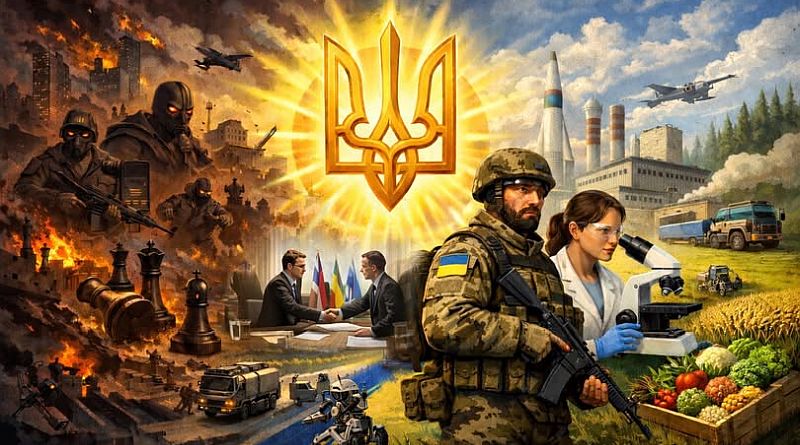
In the illustration: this is how the neural network sees the recipe for survival in dark times.
The world returns to the usual “war of all against all,” selfish interests, cynical actions – the usual chaos.
To survive and succeed, Ukraine must become strong, efficient, overcome corruption, have a large motivated army, advanced science, a developed economy (IT, robotics, military complex, agriculture) – and mutually beneficial alliances that strengthen through common interests…
This, and not self-preservation, should be what the government focuses on.
