
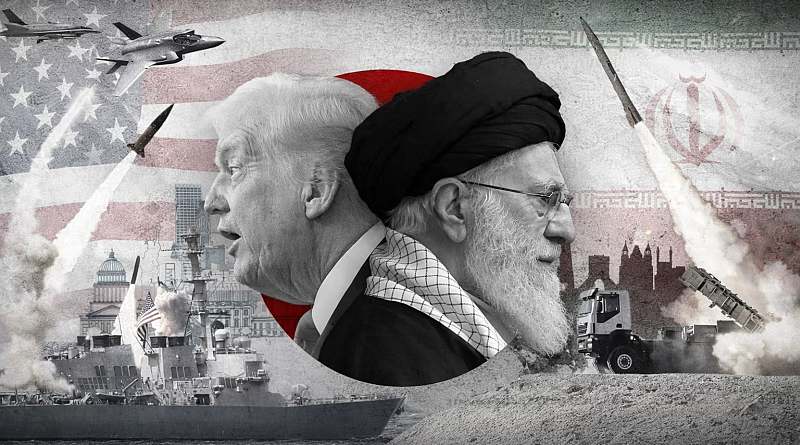
Timothy Ash / Translation by iPress
Dangerous Multipolarity. The World Becomes Less Predictable
This multipolar world, which Trump, Putin, and others seem to be trying to build, does not look safer or more predictable—in fact, quite the opposite, considering the ongoing wars in Ukraine, Iran, and other countries.
Regarding Iran, like many others, I try to understand what is happening: what are the driving forces, where is it all leading, and what does it mean in a broader context.
To begin with, let’s try to understand how we got to this point, and what actions by Trump and Netanyahu on Saturday morning became the “trigger” that launched strikes on Iran. Of course, one can go back far in the past—to October 7, to events that occurred before or after that. But let’s start with the negotiations that took place last week, and why we saw a transition from a situation where, according to the foreign minister of Oman, a deal was almost reached, to a point where something changed—and prompted Trump and Israel to pull the trigger and start destructive attacks, much more extensive than expected, resulting in the death of Supreme Leader Khamenei and a large number of senior leaders of the Islamic Republic.
In my view, to figure it out, one needs to look at the motivations of the key players. Israel, the Islamic Republic, and even the Gulf countries are relatively easy to understand, while the unpredictable factor remains Trump.
Israel: Strategy for Eliminating External Threats and Netanyahu’s Internal Interest
It is evident that since October 7, Netanyahu has aimed to eliminate all major external threats to Israel. Israel has recognized its military-technological superiority over its adversaries, including Iran, Hezbollah, the Houthis, and even Hamas in Gaza. October 7 was a turning point, and Netanyahu saw an opportunity—first due to the perceived weakness of Biden’s presidency in its final days, and then through the opportunism of Trump’s presidency—to leverage this advantage and eliminate sworn enemies in Iran and other countries. Netanyahu succeeded in imposing his agenda and pushing the US toward realizing his goals. It is also important to remember Netanyahu’s personal interest: military rhetoric helps distract from his legal troubles within the country and can even be used as a way to try to bring them to an end.
Iran: Logic of Survival, Deterrence, and Control of Escalation
For the Islamic Republic and its leadership, this is a matter of survival. Since its inception, it has been under nearly constant pressure and attacks from the US, Israel, and their allies. It has built a defense based on multi-level deterrence, including its nuclear program, ballistic missile program, and a network of aligned groups. However, the Islamic Republic approaches conflict escalation quite cautiously, always trying to carefully weigh its actions and signal them to limit escalation by the US and Israel, preventing them from increasing strikes to a level that would threaten Iran’s existence.
Iran did not escalate the conflict or attack Gulf countries before the current series of US and Israeli strikes, as it did not yet view it as a threat to its existence. Instead, it saw improving relations with Gulf countries as an opportunity for economic cooperation. Tehran also hoped this would strengthen its position in negotiations: Gulf countries, seeking to preserve their own security, would lobby for de-escalation by the US and Israel.
Iran had a nuclear program and could have begun developing a nuclear bomb or delivery systems earlier. Steve Witkoff suggested that Iran had enough fissile material to produce eleven bombs. But it did not, understanding that developing a nuclear bomb would immediately trigger strikes by the US and Israel.
Overall, Iran was relatively easy to “read,” but Israel used this predictability to its advantage, exposing its bluff and continually raising the stakes, knowing that at each level the Islamic Republic would either retreat or be unable to respond to the escalation.
Gulf Countries: “Vision 2030” and the Bet on De-escalation
It’s fair to say that ten years ago, Saudi Arabia would have been glad if the US removed the threat from Iran. But with the arrival of Mohammed bin Salman, the situation changed. Saudi Arabia is promoting an economic cooperation program with Iran, considering this the best way to ensure security for the implementation of its ambitious economic development program. “Vision 2030” and similar strategies in the Gulf—for countries like the UAE, Oman, Qatar, and others—are based on the premise of security, which should allow the economy to diversify from energy to tourism and logistics. Gulf countries have increased cooperation with Iran and were ready to lobby for peace conditions between Iran and the US/Israel.
Trump as a Factor of Uncertainty
He changes the rules of the game or simply breaks them. In recent years, previous U.S. administrations attempted to cooperate with Gulf countries to achieve a peaceful resolution with Iran. Trump turned everything upside down. And it’s important to remember: unlike previous U.S. leaders, and somewhat similar to Netanyahu, Trump has his own agenda, different from the agenda of the country he leads. Trump primarily thinks about himself, his ego, and his own interests. The key difference in this term from his first presidency—when he potentially kept neoconservatives regarding Iran like Bolton under control—is that now Trump is facing serious threats and risks domestically. First, there’s the Epstein investigation, which is not going away, and given his connections to Epstein, Trump has to worry about new evidence emerging. The Epstein case remains a toxic topic that cannot be “covered up.” Trump seems desperately trying to change the informational agenda. Furthermore, there are the president’s low approval ratings (partly related to the Epstein case, but also due to polarizing politics, particularly around the U.S. Immigration and Customs Enforcement (ICE), as well as with the K-shaped economic recovery). Currently, it seems the Republican Party might lose not only the House of Representatives but possibly the Senate as well. As Speaker Johnson said, this could mean the end of Trump’s presidency: a new round of impeachment—and likely, the opponents would have significantly more grounds to attack him a second time.
How Manipulation Works
Simply put, Trump believes he cannot afford to lose the midterm elections. He is desperately seeking a big victory, so he is willing to take significant risks, particularly regarding Iran—which contradicts the essence of the slogan “Make America Great Again” (MAGA) about avoiding foreign wars. Trump is a person who wants to leave a mark on history, in many senses a sociopath, easily manipulated through vanity, and in my opinion, Netanyahu (and Putin in this sense) repeatedly play on this. Initially, Netanyahu gradually weakened Iran’s positions over 12 days and then offered Trump the “cherry on top”—a chance to use bunker-buster bombs to try to destroy Iran’s nuclear program in Fordow and other places. Trump couldn’t resist, and I believe we’ve seen the same thing again this time.
Trump was likely disappointed that such an opportunity might arise at the end of the year when large opposition demonstrations took place in Iran. The U.S. could have then used force to change the course of the protests, and Trump encouraged the protesters, promising to protect them. But due to a strategic mistake, American forces were deployed thousands of kilometers away—in the Caribbean—as part of another of Trump’s vanity projects regarding the removal of Maduro.
The Islamic Republic did not believe Trump’s bluff back then, but I think Trump has not forgotten it. This time, in my opinion, Netanyahu played on Trump’s vanity by telling a story about how Khamenei and the majority of the Islamic Republic’s leaders are gathering together and that a preemptive strike could decapitate the leadership. Allegedly, this would once again push the opposition to become active and bring regime change closer. They probably offered Trump simple logic: what do you have to lose – you’ll be remembered as the president who removed Khamenei, avenged the embassy takeover in Tehran and the barracks and embassy bombings in Beirut. And if events go in your favor, the regime may fall and bring truly historic changes in Iran – and then, undoubtedly, there will be even more votes “for you.”
Trump wins the midterm elections, and Trump will be forgiven for the Epstein case (strange as it may sound). “And what’s wrong with that?” Netanyahu supposedly asked. “What did Iran do in response to the killing of Soleimani or Nasrallah, or even the June attacks on Fordo and other sites?” Allegedly, it’s a blow without a response for Trump and Israel. Trump could not resist.
Change in Iranian Logic: “Unthinkable” as a New Deterrent Mechanism
But all of the above did not take into account one thing: for the Islamic regime, survival is the main thing. When Trump, Netanyahu, and others began to talk about regime change as a goal, the Islamic Republic believed that this was indeed the case. In my opinion, Trump, his team, and Netanyahu made a fundamental mistake in assuming that if you “cut off the head,” the regime would fall. They did not take into account that there is a core – ideologically motivated support for the Islamic Republic (perhaps 15–20%) – ready to die for the regime and still having a monopoly on weapons. There is also an ideology of governance and even a religious doctrine, built on the logic of survival: to wait, hide, pass the baton to the next “believer” in line – and thus continue the Islamic Republic and the Shiite movement. Seeing that the Islamic Republic now faces an existential threat, and its previous policy of measured response and deterrence has suffered a loud failure, it concluded that predictability is no longer an advantage. They learned this from Trump. So the new response becomes the “unthinkable” – striking Gulf states, closing the Strait of Hormuz, or at least announcing the intention to do so. A possible next signal could be the pursuit of developing a nuclear bomb or launching a new global terrorism campaign as part of a new deterrence strategy.
Now it is a wounded regime seeking new deterrence mechanisms and unpredictability, and the “unthinkable” becomes part of this logic.
“Donro Doctrine” or “Donald Trump First”
First of all, the risks are significantly higher, as there are players whose thresholds for action have significantly decreased.
Secondly, the previous consensus — failed negotiations, then limited military actions by the US/Israel, staged reaction from Iran, followed by an agreement that might last a year or more, after which the world moves on to the next global crisis — no longer seems plausible. In this context, attacks on the Persian Gulf countries have called into question their very business model — tourism, logistics, and energy under the guise of “iron-clad” security. Whatever agreement is reached, the threshold for conflict escalation by Iran using drone strikes in the Persian Gulf has significantly lowered. At this stage, Iran seems to have much greater resilience to such strikes than the Persian Gulf countries have to repel them.
Will tourists and traders want to use the services of the Persian Gulf countries if there is no clear clarity regarding the durability of any agreement and its significance for regional security? It is clear that Israel is determined to destroy the Islamic Republic, which means it will continue to “mow the grass” with regular attacks, regardless of whatever short-term agreement may be made. This is also confirmed by the experience of agreements in Lebanon. If Israel, and possibly the US, attack Iran in six months, why wouldn’t Iran respond again by sending drones to attack the Persian Gulf countries? This constant risk of a prolonged and much more unpredictable conflict will pressure the economies of the Persian Gulf countries.
Thus, in a certain sense, the Persian Gulf countries need a final solution — possibly a regime change in Iran. They may be ready to support such an operation with military means, but their capabilities are limited. Are the Arab states of the Persian Gulf capable of deploying enough troops to change the course of events? And do they want such a military adventure in Persia at all?
Then, likely, there will be increasing pressure on the US from Israel and the Persian Gulf to enforce a regime change in Iran. This might explain Trump’s mention this week of the possibility of limited deployment of American troops in the country — something that MAGA supporters rejected after the defeats in Iraq and Afghanistan.
But we have seen this many times before — in Vietnam, Iraq, or Afghanistan — where the US gradually got sucked into a greater conflict. In Iran, where the regime is firmly entrenched, a regime change will be very difficult. And currently, it seems that the US has little understanding of what such a regime change might look like. It is also worth noting: Israel is inciting Iranian Kurds to revolt against the Islamic Republic, which causes serious concern for Turkey, but at the same time risks sparking a wider conflict and undermining the Kurdish peace process in Turkey, as well as peace in Syria and Lebanon.
I am also concerned that given Trump’s low poll ratings and the fact that Khamenei’s death did not yield the desired result, deepening the conflict in Iran might become an attractive option for Trump in the context of “risk-return.” A major conflict in Iran could also give Trump a reason to restrict democracy in the country and postpone midterm elections if he decides he would lose them anyway.
Thirdly, what we see in Trump’s actions in Iran, and earlier in Venezuela and regarding Greenland, is the behavior of a person driven by ego, selfishness, and opportunity. The idea of some grand Trump strategy – the Donro Doctrine (“The “Donro” Doctrine – a combination of the words “Donald” and “Monroe” – is a right-wing term circulated in 2026 describing the perceived foreign policy of the Trump administration aimed at reaffirming U.S. dominance in the Western Hemisphere – iPress) – has undoubtedly been dismantled by his actions in Iran. Remember the MAGA thesis: “no more foreign adventures unless in the U.S.’s interest”; protecting one’s own continent and building defense and economy against China? This explained the withdrawal of troops from Europe and limiting arms supplies to Ukraine – following Elbridge Colby’s line on conserving resources to counter China. So why now spend limited air defense resources in a war in Iran, which has minimal direct impact on the U.S.? It makes no sense unless viewed as Trump’s decisions based on ego, selfishness, and opportunity, or DTF: Donald Trump First.
All this means that in the coming months, we should expect even more unpredictable moves from Trump if his actions truly aim to improve miserable ratings: manipulating midterm elections to his advantage or perhaps even riskier military adventures in other regions. This is a president who has a much lower tolerance for risk because the domestic threats he faces outweigh the risks of foreign policy actions, like the war in Iran. And for Trump and his way of thinking, there’s always someone else to “clean up,” and there’s always someone else to blame.
Therefore, in the coming months, expect the unexpected and the unthinkable from Trump.
Invasion of Greenland – why not?
A deal with Putin to damage Ukraine, also possible?
But regarding Iran, the previous policy of carefully calibrated response, implying controlled escalation, has failed. So unpredictability should also be expected from Iran – now anything is possible.
And all this could have globally systemic consequences in a world where Trump has so weakened multilateral institutions that, in my opinion, they will find it difficult to coordinate a response to an event on the scale of a global financial crisis.
I imagine a scenario where Melania Trump leads the UN Security Council on the day the Persian Gulf burns. What a vision – but undoubtedly, this is the kind of vision Trump wants to show: a toothless UN and his Peace Council as the real decision-making body.
Fourthly, is China a winner from rising oil prices?
Possibly. But China will undoubtedly be pleased that the U.S. is likely stuck again in a prolonged war in the Middle East and rapidly depleting air defense missile reserves. Is it time to seize Taiwan? Possibly. Given that Trump shows little interest in defending Taiwan and seems to promote the policy of “might is right,” where large states take what they can, it could be a green light for Xi Jinping.
Fifthly, is Russia a winner from rising oil prices?
To some extent. But I doubt that Putin would be happy to see the potential loss of another ally – Khamenei – after losing friends like Yanukovych, Gaddafi, Assad, and Maduro, as well as possibly Cuba in the near future. Given the significant technological superiority of U.S. military equipment demonstrated in the current conflict, Putin might wonder: is he next? Is this enough to rush him into making a deal on Ukraine? Not yet. Most likely, Putin will want to wait and see how the war in Iran develops and whether it gives him additional leverage over Trump. Or he might wait for Trump’s position to weaken in the context of the midterm elections and events in Iran due to a botched regime change operation, to buy time.
Sixth, considering the risks that I believe are systemic, I was surprised by the relatively mild market reaction on Monday.
Illustration: SFG Media
