
Oleksandr Kovalenko / Information Resistance
In February, Russian occupiers carried out the most intense and numerous missile strikes on Ukraine in the last two years of war, primarily with ballistic missiles. It is clear that the enemy tried to cause maximum damage to our energy infrastructure in the last month of winter by using the maximum possible and available resource.
Military-political analyst Oleksandr Kovalenko writes more about this in a material from a joint project of OBOZ.UA and the group “Information Resistance”.
Missile Strikes
During the past month, Russia carried out seven intense, combined strikes on Ukraine (on the nights of February 3, 7, 9, 12, 17, 22, and 26) using 297 missiles. This made February 2026 the most tense regarding missile terror since March 2024 (when there were 345 missiles).
Intercepted/suppressed/lost – 173, accounting for 58% of the total. About 20 missiles, or 10% of the intercepted threats, were either lost or their use consequences were not determined (not announced). In some cases, missiles “disappeared” over Russian territory.
Also in February, as I predicted, an absolute record for the use of ballistic weapons in a month was set – 121 missiles! 40 of them were shot down. The previous ballistic record was in January this year – 91 units, and before that in October 2025 – 89 missiles.
The fact that in January 2025, the Armed Forces used 28 ballistic weapons on Ukraine, then 91 in January 2026, and 121 in February 2026, again confirms the warning that Russia will make maximum efforts to scale up the use of these missiles.
Missiles launched by the Armed Forces in February on Ukraine:
3M22 “Zircon” – 16 launched/12 intercepted;
9M723/KN-23/5V55 – 121/40;
Kh-22/32 – 7/3;
Kh-101 and 9M727/728 – 117/82;
3M14 “Kalibr” – 16/10;
Kh-47M2 “Kinzhal” – 5/3;
Kh-59/69 – 13/8;
Kh-31P – 1/0;
unidentified type – 1/1.
February was not only the most intense month by the number of missiles used in recent years but also by the variety of missiles used. The Armed Forces employed almost the entire available range of these weapons.
Shahed-136/BM-35/”Gerbera”/”Parody” Raids
In February, the Russian occupation forces used 5,060 Shahed-136/BM-35 “Italmas” kamikaze drones and “Gerbera”/”Parody” decoy drones on Ukrainian territory. Meanwhile, 4,522 of these targets or 89% were intercepted.
Let me remind you that in January the enemy launched 4,333 drones, of which 3,713 targets or 86% of the total were intercepted.
Overall, since the beginning of 2022, the effectiveness of drone interception is increasing and approaching 90%. Recall that last year the average interception rate was 82%.
However, the enemy continues to improve both tactical and technical methods to increase the effectiveness of terror.
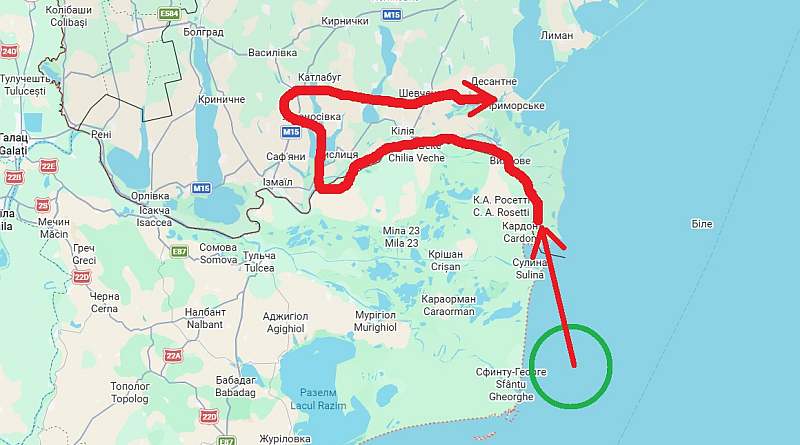
In particular, Russian Shahed-136 drones are increasingly using Romanian airspace for attacks on the southern regions of the Odesa region — the zone between the Sulyne mouth and Sfântu Gheorghe. Since they are not intercepted there, this allows the “kamikaze” to accumulate and move towards the Izmail district along the Danube with minimal risk of being intercepted.
Technically, the enemy has also introduced a number of innovations and modifications in their drone assembly. This primarily involved supplying Shahed-136 with mesh modems of various ranges and a number of other modules, even with very unusual names, such as “Sausage.” Additionally, Shahed-136-motherships have appeared — carriers not only of dropped munitions but also of FPV drones.
Thus, February could be called not so much a record month in terms of the means of terror used but in terms of the number of new drone modifications that appeared during this time, which poses serious challenges to the Air Forces of the Armed Forces of Ukraine.
Conclusions
In February 2026, the enemy tried to maximally destroy Ukraine’s energy infrastructure. A record number of missiles have been used since March 2024, along with the most diverse range of means of destruction. However, the main weapon of terror for the Russian Armed Forces continues to be ballistic, which has set another absolute record for monthly use.
However, I do not think the Russian Armed Forces will be able to maintain this intensity of missile use in the coming months. Both the mass and frequency of strikes will likely decrease in March. But this does not mean the intensity of ballistic means will decrease.
The use of Shahed-136/BM-35 “Italmas” kamikaze drones and “Herber”/”Parody” decoy drones in February did not show a quantitative record. A moderate level was recorded, which fully corresponds to the unchanging production rate of this product by Russian enterprises in Alabuga and the Kupol plant in Izhevsk for over six months.
On the other hand, both new tactical solutions to enhance the effectiveness of strikes and new drone modifications are being noted, which require time for adaptation and finding countermeasures.
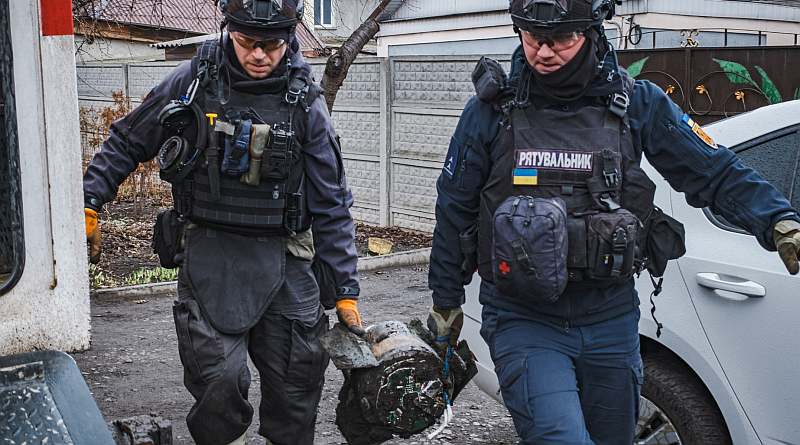
In the image: Pyrotechnics from the State Emergency Service of Ukraine removed remains of a “Tornado-S” missile in Dobropillya. Photo: Main Directorate of the State Emergency Service of Ukraine in Donetsk region
