
Vitaliy Portnikov / Vilni Media
The war between Russia and Ukraine is still unresolved, and events have already erupted in the Middle East, making it the most significant regional conflict of this century. A Ukrainian social media user posted two photographs: drones hitting buildings in Dubai and Kharkiv on the same day. They wrote that just a few days ago, no one could have imagined that drones would simultaneously attack these two cities!
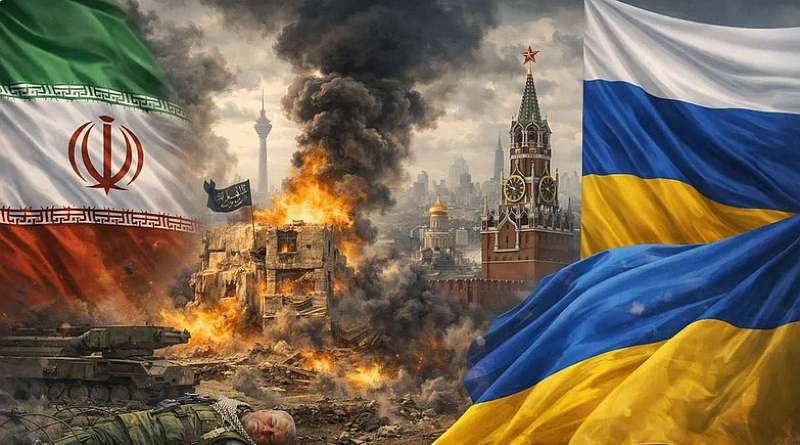
Indeed, when we think about strikes on Iran, we must remember that this is a country that has remained Russia’s most loyal ally all this time, supplying drones in the initial period of the war and helping to localize their production on Russian territory. The slain Ayatollah Khamenei has blood not only on his hands from his own compatriots who opposed his brutal regime, and not only from the Israelis killed in Iranian attacks. But also from Ukrainians.
Therefore, a swift defeat of the Iranian regime and the demonstration of Russia’s inability to support another ally—after the collapse of Bashar al-Assad and Nicolás Maduro—is in Ukraine’s interest. It is a different matter if the war drags on.
There will be numerous negative consequences. The first is already visible in the economic sphere: rising oil prices. For Americans, this means higher fuel prices—and consequently everything else—and reduced purchasing power. For Putin, it’s yet another opportunity to somewhat patch the “hole” in the Russian state budget. Therefore, the Russian president is keenly interested in making this new war last long.
The second risk is related to weapons, particularly air defense systems. It seems no one expected such a large-scale Iranian attack on the Gulf countries. Yes, these attacks may be tied to attempts to disable American military facilities in these states, but in reality, Tehran is attacking hotels and civilian airports as well. This is very similar to the Russian approach: if I’m losing the civilizational race, I must destroy the model of success and development of my neighbors. And clearly, if the Iranian regime survives, even if weakened, there will be many contenders for air defense and anti-missiles—just when Russia continues its attacks on Ukraine.
The third risk is further conflict escalation. Many might think that a U.S. and Israeli strike on Iran is unrelated to the Russian-Ukrainian war and would have happened even without it. But these beliefs overlook how much Russia’s war against Ukraine has affected global atmosphere and the readiness and ability to resolve conflicts diplomatically. If we’re talking about a total confrontation of “two worlds,” we must understand that when the situation on one front of such confrontation reaches a stalemate, there arises a need to disrupt the balance elsewhere. And so on—up to a global war. Or a war where the number of local conflicts in tension and consequences approaches a Third World War.
We cannot influence the timeline of the war with Iran. But we can and must do everything possible to ensure that, in the context of such a large-scale conflict, the war between Russia and Ukraine does not fall to the periphery of political interest, politicians’ concerns, and media coverage. We must remind of this war and its connection with the Middle Eastern conflict, as Federal Chancellor of Germany Friedrich Merz did, emphasizing that “the Russian war against Ukraine is no less unjust than the crimes of the Iranian regime, and the Moscow invasion of a peaceful neighboring country is just as unjustifiable as the terrorist war Tehran has waged against Israel for many years.”
This is what we all should remember and talk about.
