
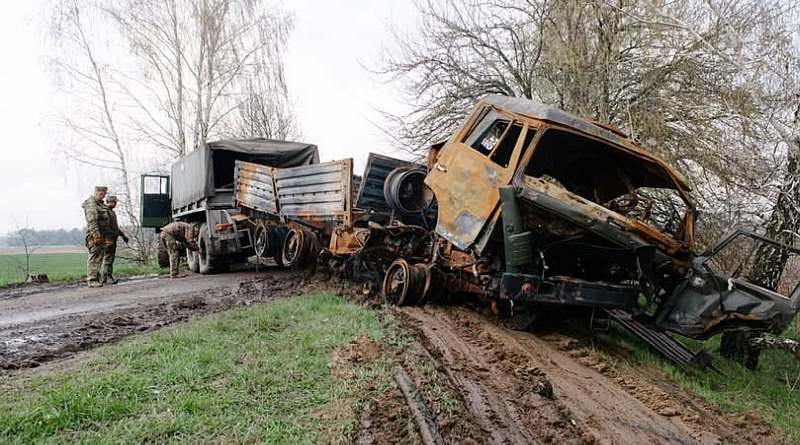
Oleksandr Kovalenko / Obozrevatel
In February 2026, Russian occupation forces maintained a fairly high intensity of offensive operations. However, despite improved weather in several active directions and the creation of favorable conditions for assaults, ROW did not show high effectiveness in capturing Ukrainian territories throughout the month. On the contrary, February turned out to be one of the worst for the enemy since 2025.
Read more about this and the losses of the Russian army in the war in Ukraine in the joint project material by OBOZ.UA and the “Information Resistance” group.
Personnel Losses
In February 2026, Russian occupation forces suffered some of the lowest personnel losses in almost two years of the war – 26,090 people.
The lowest losses for ROW were in October 2023 – 22,920.
According to available information, the number of dead accounted for about 15,000 from the total loss count. These were deaths on the battlefield and in hospitals. In percentage terms, this remains an extremely high figure.
Meanwhile, in February, the enemy captured 138 km² of Ukrainian territory, which is one of their worst results since 2025. It’s worth remembering that during the summer offensive of 2025, occupiers captured 130-150 km² per week. As they say – feel the difference.
The ratio of occupiers’ losses to the territories captured amounted to a record 189 bodies per 1 km². This is a very high indicator of enemy losses over the past few years and synergizes well with the necessity of conducting consistent and systematic depletion of ROW’s human resources.
In the context of these figures, the ambitions of Ukraine’s current Defense Minister Mykhailo Fedorov to raise the enemy loss figure to 50,000 people per month look quite notable.
And I’ll note that this is by no means a fantasy or an unattainable goal. In December 2024, ROW lost 48,670 people, and this figure can be achieved and even exceeded. The main thing is the application of the right tools, focused on destroying the enemy’s manpower, which they use and rely upon in offensive operations.
Currently, the essence of Ukraine’s victory is in an extremely simple concept – to kill as many Russian occupiers as possible. However, implementing this concept is not as easy as it sounds.
Tank Losses
In February 2026, Russian occupiers lost 84 tanks.
Overall, this is a usual, average indicator of MBT losses since June 2025, caused, in particular, by a critical shortage and strict conservation of this component by the enemy.
Armored Vehicle Losses
Losses of armored combat vehicles in the RF in February were also quite modest – 128.
The reasons are similar to the situation with main battle tanks – the absence of equipment at the front and the widespread transition of the RF to light civilian-type vehicles (LTV) due to shortages. This is caused both by the massive losses of armored vehicles over four years of full-scale war and by the inability of production to compensate even monthly losses in this category!
Artillery Losses
In February 2026, the occupying forces lost 944 artillery units, which is neither a record nor critically low but maintains a confident average level.
However, I am more than confident that 2026 will become critical for Russia in terms of production and supply of artillery, which will become as scarce as MBTs and armored vehicles.
MLRS Losses
During February, the Russian army lost 30 units of multiple launch rocket systems, a stable average indicator.
It should be noted that more than half of the affected MLRS equipment is not new but either restored Soviet heritage or North Korean means. A separate category consists of reactive “homunculi,” which the RF continues to fabricate to compensate for losses and shortages.
Air Defense Losses
In February, the RF lost 18 air defense systems.
An average indicator that has long remained unchanged in the hunt for Russian air defense that the Russian military-industrial complex cannot fully compensate for either through the production of new products, repair of damaged ones, or restoration of Soviet reserves.
Transport Losses
This category consistently shows high figures, as today light vehicles in the RF have replaced tanks, armored vehicles, and specialized armored and other transport. The only thing unknown to me is whether the General Staff of the AFU includes horse-drawn transport losses in the list of destroyed vehicles?
Either way, in February, the RF confidently receives silver in this category: minus 4,071 units.
This is the second highest among record losses of the enemy in this category for the entire time of the full-scale invasion. The only higher figure was in April 2025 – 4,104 vehicles.
The increase in losses is due to complex weather conditions and the need for the RF to carry out logistics and supply assault groups, as well as reinforcements to positions, which increases the LTV damage indicator.
Special Equipment Losses
In this category since March 2025 without significant changes – 20 units.
This situation for a year now indicates a catastrophic crisis in the RF with providing troops with engineering equipment.
Conclusions
On one hand, February 2026 is a fairly predictable month in terms of RF losses (given the exhaustion of the mechanized component and critical equipment shortages in various categories), but on the other hand, extremely unpleasant anti-records were set for the occupiers.
For the second month in a row, Russian troops are slowing down in their advance into Ukraine, with the offensive and assault actions remaining unchanged, and in some cases even intensifying. In turn, the ratio of losses to captured Ukrainian territories indicates increasing personnel costs for occupying each square kilometer of Ukrainian land, which now exceed two companies. This is not about significant operational or tactical-level advances, but about fields, forest strips, and villages with 10-15 houses, of which only ruins remain.
Moreover, the losses continue to demonstrate the growing technical degradation of Russian forces. This is not just a gradual transformation of the “second” army in the world in terms of equipment into something akin to an African terrorist group, but an irreversible process.
The demilitarization and denazification of the Russian occupying forces are proceeding strictly according to plan.
