
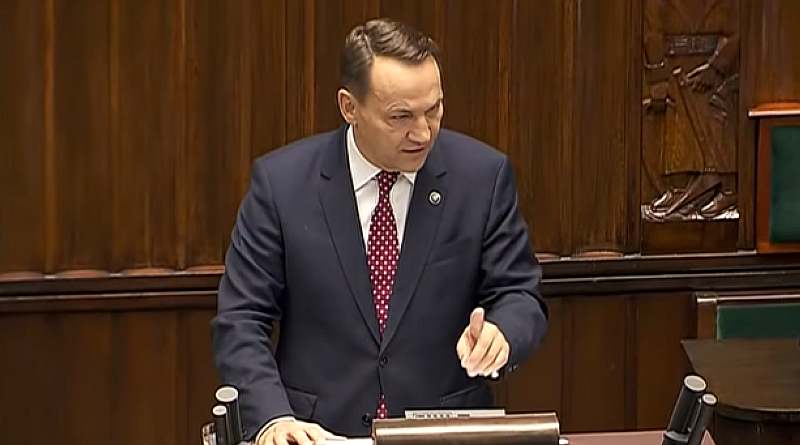
Svyatoslav Khomenko / BBC Ukraine
At the beginning of each year, the Polish Minister of Foreign Affairs traditionally delivers a speech known as the exposé before the Sejm, summarizing the country’s foreign policy over the past year and outlining priorities for the coming year.
For Radoslaw Sikorski, the exposé delivered on February 26th marks his tenth in his career. Polish commentators suggest it might be the most challenging one. The current world order is fracturing, the war in Ukraine doesn’t appear close to ending, and under Donald Trump, America has transformed from a reliable partner into an unpredictable player.
The situation for Sikorski is further complicated by the intense political polarization in his country, where preparations for next year’s parliamentary elections are already underway, and every issue, including those meant to unite the political sphere, has become subject to intense criticism.
The BBC attempted to gather the main points of Radoslaw Sikorski’s speech to form an overall impression of where the foreign policy of Ukraine’s largest western neighbor currently stands.
On the war and Ukraine: “Kiev’s victory will be our victory”
Radoslaw Sikorski began his speech by stating the seriousness of the situation his country finds itself in and warning those in Poland (of which there are many) who believe the war in Ukraine doesn’t concern them.
“Awareness of danger can either paralyze or mobilize. We cannot afford paralysis. Passivity or relying on others invites escalation. Just like claiming this is not our war. On the night of November 19, a seven-year-old Amelia, a citizen of our country, was killed in a missile strike on Ternopil along with her mother,” he reminded.
“We must be prepared for a conflict on the scale that our grandparents and great-grandparents participated in,” Sikorski warned.
He emphasized the exceptionally important role that Ukraine plays for Poland’s security (which, as read between the lines, many in Poland underestimate).
“If Ukraine loses, the threat (to Poland) from Russia will not decrease, but increase!” he addressed parliamentarians with seemingly obvious arguments, which, however, are not apparent to many Poles. “Imagine if Putin’s tanks were in Medyka near Przemysl. We would have to spend much more on strengthening the defense of our territory than what aiding Ukraine costs us now.”
At the same time, Sikorski wholeheartedly supports Ukraine’s victory in this war, saying it would also be Poland’s victory and an opportunity for Poles to “defang Russian imperialism,” strengthen their own defense capabilities and military-industrial complex, and intensify economic cooperation.
“The stakes of the war in Ukraine are not only its independence and our security. The outcome of this war will determine who, besides the US and China, becomes the third pillar of the new global order—Russia or the EU. For a Polish patriot, the choice should be obvious,” he concluded.
About Ukrainians: “Russia brings suffering, Poland brings warmth”
Despite the evident rise of anti-Ukrainian sentiments in Poland, Sikorski focused on the positive in his speech (although it must be acknowledged that the Ministry of Foreign Affairs indeed has limited means to influence the attitudes of ordinary Poles).
Sikorski stated that the level of professional activity among adult emigrants from Ukraine is higher than similar indicators for Poles (i.e., the stereotype that Ukrainians are a burden on hard-working Poles has nothing to do with reality), and he reminded for quite some time about the statistical data on the positive impact of Poles on the Polish economy.
However, Sikorski separately mentioned that Polish society still actively helps Ukrainians.
He recalled the initiative of Krakow’s Cardinal Grzegorz Rys, who announced that all money collected “in the collection plate” (a traditional charitable payment after each Sunday service in Catholic churches in Poland) on February 1 would be spent on purchasing generators for Kyiv and other Ukrainian cities freezing due to Russian bombings.
“Some predicted that the baskets would remain empty, but the faithful collected almost 6 million zlotys (about 70 million hryvnias),” described the results of this action, Sikorski.
“Hosting Ukrainian refugees, providing assistance to soldiers and the wounded will remain a point of pride in Poland’s history. Russia brings suffering, Poland brings warmth,” he concluded.
About Russia: “Russia has never been and is not invincible”
Despite Moscow’s propaganda assurances, Russia is by no means winning the war it started against Ukraine, Sikorski claimed in his speech.
“Do not be fooled: Russia is not and never has been invincible. Only in the 20th century, Moscow lost the war against Japan in 1905, World War I, the Polish-Soviet War of 1920, the war in Afghanistan, and the Cold War,” he declared.
“Moreover, it lost the chance for democratization and modernization,” added Sikorski.
According to him, if Russia hadn’t started the war against Ukraine in 2014, its GDP today would be about 20% higher.
“In just the first year of the (full-scale) war, at least 800,000 Russians fled the country. As a result of sanctions, businesses lost access to Western markets. Military spending accounts for as much as 40% of the budget. Putin will lead Russia to bankruptcy—just like Brezhnev,” he concluded.
For a complete picture, it remains for Sikorski to add that over the past year, he closed the last two Russian consulates in Poland and restricted the right of Russian diplomats to move freely within the country. “We are complicating Russia’s conduct of what the Soviets called ‘active measures,'” he said, clearly hinting at the espionage and subversive activities of Russian diplomats.
About the USA
A separate and expected theme in Sikorski’s speech concerned his country’s relations with the USA.
Poland is traditionally considered one of the most pro-American countries in Europe, with about ten thousand American soldiers stationed on its territory.
“Close ties with the USA have been a pillar of our foreign policy for decades, regardless of who ruled in Poland or who occupied the White House… For Poland, Washington remains the most important partner in military cooperation,” said Sikorski.
However, Warsaw now notes the deterioration in relations between Washington and Europe, which inevitably impacts Poland.
“We view the changes in the USA with understanding, but also with concern. We remember the historical support for Poland by Presidents Wilson and Reagan, when under different circumstances we fought for independence. But we also remember Yalta,” Sikorski said.
“After the fall of Nazi Germany, President Franklin Roosevelt sought Stalin’s help to fight Japan. He got it, but at the cost of freedom for this part of Europe. The American national interest was realized, and we paid the price… If you swap Japan in 1945 for China today, can we be sure that the national interest of the USA will be the same as Poland’s?” Sikorski asked.
“We have been and will remain loyal partners to America. But we cannot be dupes,” he declared.
About the EU: “Our membership is neither accidental nor forced”
One of the main themes of Radosław Sikorski’s address was Poland’s European choice: with the rising popularity of right-wing and far-right parties in the country, Eurosceptic slogans, including calls for “Polexit” – Poland’s exit from the EU – are increasingly heard in politics.
A significant portion of the minister’s speech was directed at these Eurosceptics, aiming to present specific figures on the economic benefits for Poland in the EU (and the losses in case of leaving) as well as appealing to emotions.
EU membership, Sikorski said, does not strip Poland of independence: on the contrary, only after gaining independence was Poland able to join the European Union.
“Poland’s membership in the EU is neither a matter of chance nor the result of coercion. It is a sovereign strategic choice we made in the 1990s, evaluating various possible scenarios for development after the fall of communism. Other paths were also available, but they were much less beneficial.”
Sikorski separately addressed the European defense capacity building program SAFE: the current Polish opposition actively criticizes it, claiming that its true aim is to increase the burden on German defense industry enterprises.
Firstly, Sikorski responded to the growing anti-German sentiments in Polish politics: implying that some of his colleagues’ understanding of international politics is stuck at the level of events described in Sienkiewicz’s novel “The Crusaders.”
Secondly, he specifically addressed SAFE. “The opposition claims that investments in the Polish army serve Berlin. This is false. It wasn’t Berlin in September (last year) that faced Russian drones, but Lublin and Zamość.”
Cover photo: video screenshot
