
David Carretta, The European Morning / Translated by Information Resistance
So why is Viktor Orbán not a “Patriot of Europe,” but the “Chief Traitor of Europe.” The latest example is Hungary’s decision to block a 90 billion euro loan necessary for Ukraine’s survival, on the eve of the fourth anniversary of the war with Russia, writes David Carretta, “The European Morning.”
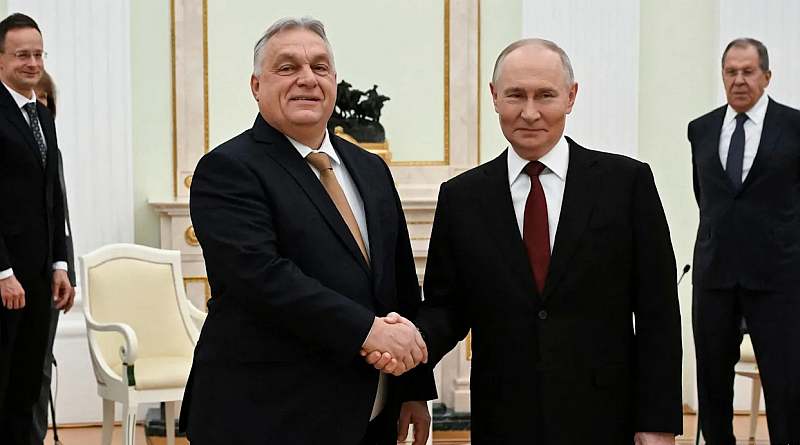
They are not “Patriots of Europe.” They are “Traitors of Europe.” The gang that Viktor Orbán gathered after the European Parliament elections in June 2024 has nothing patriotic about it. Starting with the Hungarian Prime Minister, who, by blocking the 90 billion euro loan to Ukraine and vetoing the twentieth package of sanctions against Russia, once again demonstrates his true nature. Orbán is not a European patriot, and not even a Hungarian patriot. Orbán is a traitor, ready to sell himself to the enemies and opponents of liberal democracy, the rule of law, and the rule-based international order. He fights against the fundamental principles of European civilization, with those for whom Vladimir Putin, Donald Trump, and Xi Jinping fight. Including peace among peoples, free to choose their own fate. This is the great paradox of Orbán and his company: self-proclaimed “Patriots,” sovereignty fanatics, ready to submit to hostile foreign states. To wage war on their behalf. The EU’s tactic was to ignore Orbán, hoping that Hungarians would get rid of him in the April legislative elections. But what if they don’t?
The latest betrayal by Orbán occurred on the eve of the fourth anniversary of Russia’s aggressive war against Ukraine. The Hungarian Prime Minister decided to block the green light for a 90 billion-euro loan funded by joint EU debt, despite his country receiving an exemption (as did Slovakia and the Czech Republic). The justification: in January, Russia attacked the “Druzhba” oil pipeline, which transports Russian crude oil to Hungary and Slovakia via Ukraine, disrupting supply. Budapest and Bratislava accuse the Ukrainians of delaying repairs.
“We will block the EU’s 90 billion-euro loan to Ukraine until oil transit is restored to Hungary via the ‘Druzhba’ pipeline,” declared Hungary’s Foreign Minister Péter Szijjártó. At today’s Foreign Affairs Council, Hungary will also block the adoption of the twentieth package of sanctions. “Until Ukraine restores oil transit to Hungary and Slovakia via the ‘Druzhba’ pipeline, we will not allow Kyiv to make important decisions,” added Szijjártó.
Slovakia under Robert Fico takes the same position regarding sanctions. Budapest has already blocked the supply of diesel fuel to Ukraine. Hungary and Slovakia threaten to cut off electricity supplies. The Prime Minister of Hungary not only conspires with Putin, violating all principles of genuine cooperation and solidarity within the EU, but also acts as his agent to destabilize Europeans, and undermines Ukraine’s ability to survive the war.
This episode is just the latest in a long series. Since March 2023, Orban has vetoed the “Ukrainian fund” of the European Peace Facility, which allows funding for arms deliveries to Kyiv: 6.5 billion euros have been blocked for almost three years. The target is Ukraine, but the victims are EU member states. The European Peace Facility is designed to reimburse weapons that European countries have already sent to Kyiv. Poland is supposed to receive a check for over 2 billion euros, which it is likely never to see.
In 2024, Orban abused Hungary’s six-month presidency of the EU Council to promote Vladimir Putin’s interests through a “peace mission” that led only to further war. From January 2025, Orban began threatening to refuse approval for the renewal of sanctions against Russia and ceased to adhere to the European Council’s conclusions on Ukraine. Hungary’s veto blocks the start of accession negotiations, despite Kyiv having implemented the reforms necessary for expansion.
Polish Prime Minister Donald Tusk addressed him at the beginning of October. “Viktor Orban, it is Russia that waged war against Ukraine. It is Russia that decreed that we live in times of war. And in such times, only one question arises: whose side are you on?” “Viktor deserves the Order of Lenin,” wrote Polish Foreign Minister Radosław Sikorski on X in December after Orban accused the EU of declaring “war” on Russia by freezing the sovereign assets of the central bank.
The Hungarian prime minister has become a parrot of statements by Dmitry Peskov, the Kremlin spokesman, and Maria Zakharova, the Russian Foreign Ministry spokeswoman. This role is performed with even more zeal by Hungarian Foreign Minister Péter Szijjártó. “Do you really want a war between Russia and Europe?” Szijjártó responded to his Polish colleague Sikorski. “If Russia doesn’t invade again, there will be no such war, but we know that this time you will be on its side,” Sikorski concluded.
Mistrust of Orban is not new. “Viktor Orban is a ‘Trojan horse’ who destroys European unity and protects Russian interests,” said Czech Minister for European Affairs Martin Dvořák in 2023 after blocking financial assistance to Ukraine.
“You are a traitor,” is the accusation made by former Belgian Prime Minister Guy Verhofstadt. Verhofstadt, a member of the European Parliament and president of the Alliance of Liberals and Democrats group from 2009 to 2024, is well-acquainted with the history and career of the man who led Hungary for 15 years and is effectively the oldest among the heads of state and government sitting at the European Council’s table.
The issue of Orban’s betrayal is increasingly being considered seriously in other capitals. “If the threat is considered existential by the majority of the EU, a member state cannot evade its obligation of solidarity,” a diplomat told us, discussing Orban’s case. “The threat from Russia is a matter of life and death for some member states.” “I fear that Viktor Orban hasn’t played for the European team for a long time,” explained Slovenian Prime Minister Robert Golob at a press conference with German Chancellor Friedrich Merz on November 28, when the Hungarian prime minister was about to go to Moscow to demand energy concessions from Putin. “He goes without a European mandate and without consulting us,” said Merz.
The President of the European Council, António Costa, has chosen to ignore Orbán. Conclusions of the summit regarding Ukraine are being adopted by 26 instead of 27 countries. But this tactic has reached its limits. Other member states are forced to resort to legal means to bypass Hungary’s veto. This was the case in December when it was decided to use Article 122 of the treaty, which allows majority voting in times of economic crisis, to indefinitely immobilize Russian assets. With Slovak Robert Fico and Czech Andrej Babiš (also a member of the self-proclaimed “Patriots”), European summit conclusions regarding Ukraine now risk being adopted by 25 or 24 EU member states.
The Commission tried to use EU funds as a carrot and stick to bring Orbán back to the European consensus, but unsuccessfully. In a conclusion published on February 12, Advocate General of the European Court of Justice Tamara Ćapeta criticized the Commission’s decision to unfreeze 10.2 billion euros of structural funds for Hungary, taken in December 2023, to persuade Viktor Orbán to lift his veto on granting Ukraine candidate status. The funds were frozen in 2022 due to systematic violations of the rule of law. According to the Financial Times, Ursula von der Leyen may now unfreeze another 2.6 billion euros of EU funds for Hungary. But several diplomats are skeptical. Is this enough to convince the Hungarian Prime Minister? “With Orbán, it’s no longer a transactional relationship. There is an ideological divide,” one of them told us.
Alberto Alemanno, a professor at HEC Paris, believes that the EU could have prevented Orbán’s betrayal by using “its oversight mechanism,” which allows the revocation of a country’s voting rights in the event of a serious and persistent breach of EU values. “Hungary has been under Article 7 proceedings since 2018. It’s been eight years,” Alemanno reminded. But the EU’s political system has shown its “inability” to implement it. The result: “Nothing. Zero. Orbán realized that Article 7 is all bark, no bite,” Alemanno explained. “And yet it could have been used. If not now, when?”
Costa and von der Leyen hope that Orbán will suffer electoral defeat in the legislative elections on April 12 and be forced to resign. It’s a risky gamble. Although most independent polls give opposition leader Péter Magyar and his party TISZA a lead, Orbán is using all state tools to stay in power. His party Fidesz has begun to gain ground in the polls. Two months is an eternity in politics.
Other “patriots” are no different from Orbán. As soon as he returned to the position of Prime Minister of the Czech Republic, Andrej Babiš immediately aligned with his Hungarian colleague. Italian party “Lega” led by Matteo Salvini calls for the return of sovereign Russian assets.
Geopolitics
Hungary blocks 90 billion euros for Ukraine – Hungary under Viktor Orban unexpectedly blocked on Friday the adoption of a legislative measure necessary to provide Ukraine with a loan of 90 billion euros, which it urgently needs to continue defending against Russian aggression. The decision was postponed due to “a reservation expressed by a member state,” a diplomat told us. “We will block the EU loan to Ukraine of 90 billion euros until oil transit to Hungary through the ‘Druzhba’ pipeline is restored,” said Hungarian Foreign Minister Peter Szijjarto. In January, Russia attacked the ‘Druzhba’ pipeline, which transports Russian crude oil to Hungary and Slovakia through Ukraine, halting supplies. Instead of holding Moscow accountable, Hungary blames Ukraine for the delay in pipeline repairs. Hungary’s blackmail comes at the most inappropriate time for the EU. Tomorrow marks the fourth anniversary of Russia’s full-scale invasion. If the EU loan is not confirmed by the end of February, Ukraine risks bankruptcy by the end of March.
Sanctions blocked, Ukraine threatened by Orban and Fico – this is another damaging image for the EU’s credibility: the attempt to approve the twentieth package of sanctions against Russia on the occasion of the fourth anniversary of the war against Ukraine risks failing due to Hungary’s veto. This issue will be on the agenda of today’s Foreign Affairs Council. High Representative Kaja Kallas seeks an agreement on sanctions. But “Hungary will block it,” Hungarian Foreign Minister Peter Szijjarto said yesterday: “Until Ukraine restores oil transit to Hungary and Slovakia through the ‘Druzhba’ pipeline, we will not allow important decisions for Kyiv,” said Hungarian Foreign Minister Peter Szijjarto. Slovakia under Robert Fico holds the same position on sanctions. In negotiations between ambassadors of the 27 member countries, the Commission’s proposal was already partially softened after Malta and Greece opposed a total ban on maritime transportation for Russian oil tankers without a G7 agreement. Budapest and Bratislava also threaten to stop electricity supplies to Ukraine, as the country struggles to keep lights and heating on amid Russian attacks on its energy infrastructure. “If oil supplies to Slovakia are not restored by Monday, I will ask SEPS, the state-owned company, to stop emergency electricity supplies to Ukraine,” Fico said on Saturday.
