
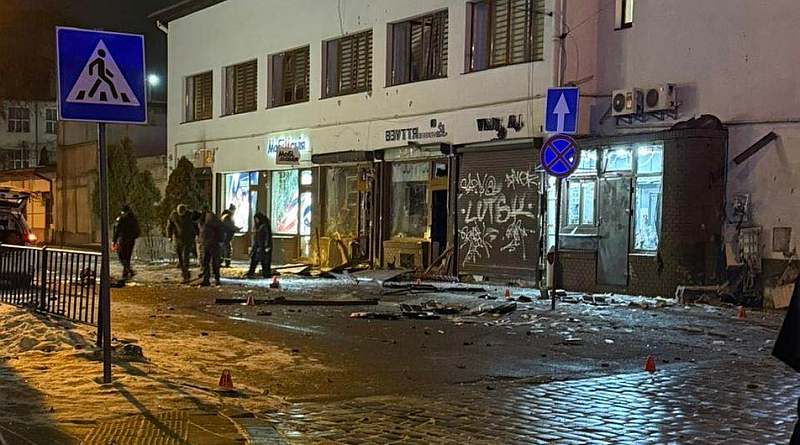
A few days before the fourth anniversary of the large-scale Russian attack on Ukraine, an explosion in the very center of Lviv was classified by law enforcement as a terrorist act.
The incident once again reminded us of the multilayered nature of the Russian-Ukrainian war, showing that it cannot be reduced solely to a clash of armies. Ultimately, the war against Ukraine is waged by a state where power is monopolized by special services—the successors of the former KGB of the USSR, which now exist under the names of the Federal Security Service and the Foreign Intelligence Service of Russia. But the main institution taken over by the KGB was the presidency of Russia. The country’s main office, the one every guardian dreamed of occupying: what security officer wouldn’t want to take the chair of their own “subject”!
It must be understood that the war led by security services is different from that of generals. Yes, in the Kremlin, they would certainly prefer the army to simply seize the entire territory of Ukraine, allowing the FSB to proceed with “cleansing” and “enemy identification” procedures. But when the military, which is one of Putin’s tools, fails to achieve this, it doesn’t mean the FSB will calm down and wait for military outcomes.
Destabilizing an enemy country through terror is a crucial factor in aiding the army, as it keeps the country’s population in constant tension, eliminates unwanted politicians and activists, and creates new lines of division. By the way, when I talk about an enemy country, I want to remind you that for the FSB’s leadership, even Russia itself was considered an enemy country during a period when there were societal demands for a normal life. The army waged war in Chechnya, while security services staged terror, blowing up buildings in Moscow and other Russian cities, killing opposition politicians and journalists—thus “working.”
Another significant factor in Ukraine’s capture is political propaganda. Until 2014, Russian television—along with channels close to Ukrainian authorities and oligarchs like “Inter” or “1+1″—was the main source of information for many Ukrainians. This TV helped Leonid Kuchma and Viktor Yanukovych win presidential elections in 1994 and 2010, aiding the degradation of Ukrainian society and keeping Ukraine in the “gray zone” of Russian influence. After 2014, Medvedchuk’s channels replaced Russian TV, and after 2022, anonymous Telegram channels have played a similar role in “dumbing down” Ukrainians. Now, I see a new trend—Russians will enter the Ukrainian market with the help of right-wing radicals from the West. Formally, we will see the launch of some American or European media, but in reality, it will be the same FSB.
Another important factor of influence is economic control combined with bribery—not only of officials and oligarchs but also of the population, which often forgets the saying about the trap and the cheap cheese—in this case, gas. Gas was used to try to keep Ukraine from turning towards the West even in Boris Yeltsin’s time, and Putin was ready for open blackmail, which only intensified after the 2004 Maidan and Viktor Yushchenko’s victory. No one said Russia wouldn’t use economic tools in the future—even in the unlikely event of concluding military actions in the foreseeable future, the Kremlin will aim to incorporate economic controls into any peace agreement. Of course, with support from the American administration, which even at the vice-presidential level with J.D. Vance, spoke of the importance of trade between Russia and Ukraine. How could this view of the situation not be leveraged?
This list of tools confirms that the question “when will the Russian-Ukrainian war end?” has only one correct answer—never. As long as Russians believe Ukraine’s statehood should be abolished, and the Ukrainian people canceled, the conflict will persist on several escalatory levels, even if Moscow lacks the power for intensive military action. This is the reality to which both Ukrainians at home and those abroad must prepare.
Because preserving the state and the Ukrainian people in the face of a prolonged war, terror, propaganda, and economic pressure remains our main task. The years of Russian-Ukrainian conflict—starting even from the 2013-2014 Maidan and the Russian invasion of Crimea and Donbas—have shown this task can be managed even in the most challenging of times if unity, common sense, and a realistic understanding of the situation are maintained.
In the image: the site of the terrorist attack in Lviv, 22.02.2026. Photo: Facebook/Andriy Sadovyi
